Winter sun hair: January in the Canaries and the southern summer
January is the month hair changes hemispheres. You board with winter hair, set for static and heated rooms, and land somewhere the sun is doing summer's work: the Canaries, where AEMET measures January ultraviolet at mainland-double, or the southern summer, where Sydney's UV peaks for the year. What the sun and the water actually are in January, including the number we do not have, and the routine that covers both trips.
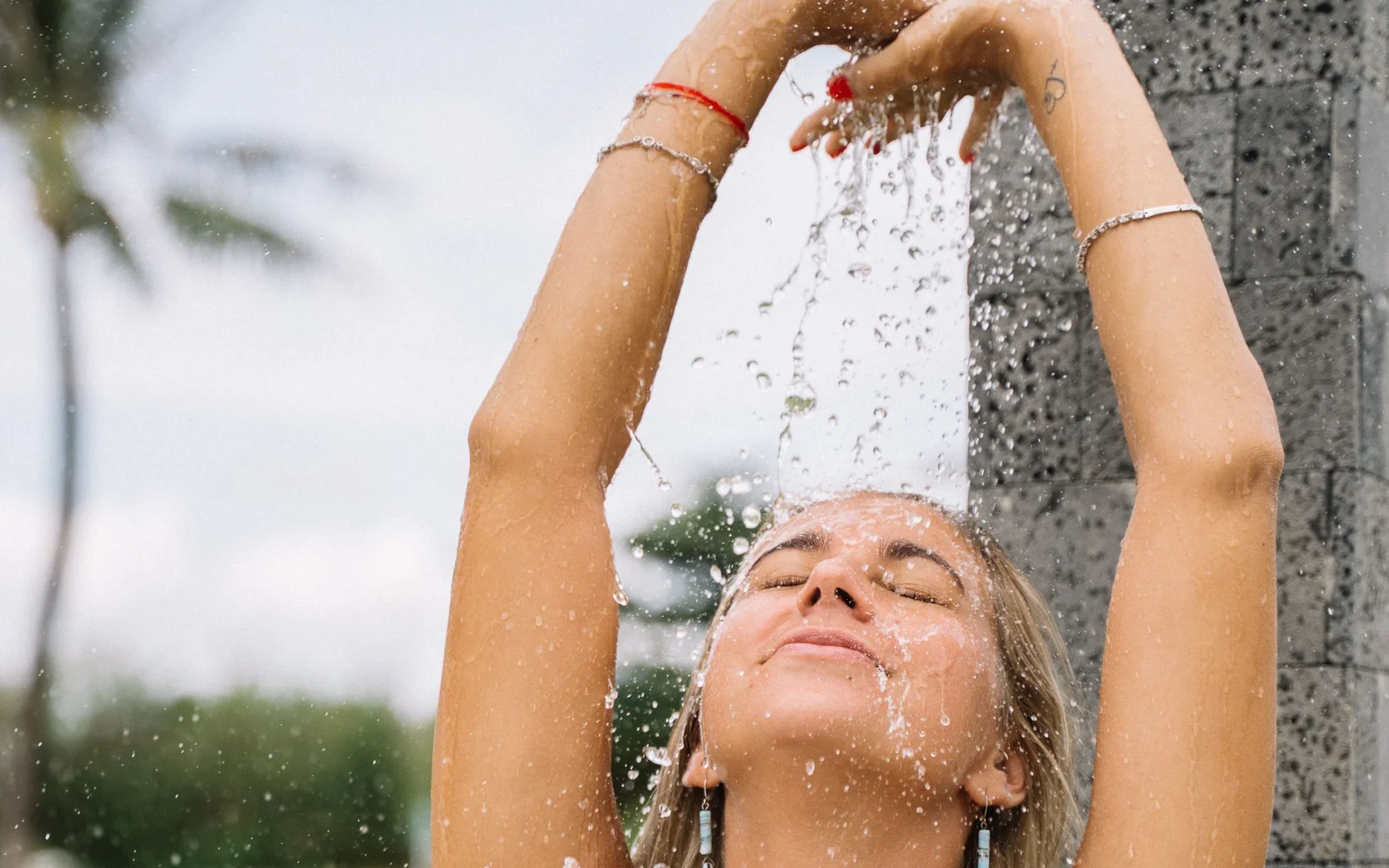
There is a particular confidence trick January plays on hair. At home the enemy is the indoors: heated rooms, dry air, the static halo that arrives with the first wool jumper, the whole winter pattern we set out in static season. So the wash bag gets packed for dryness and defence, and then the plane lands somewhere the problem has reversed. The sun is out at strength, the sea is warm enough to swim in, and hair set up to fight static meets the oldest opponent it has. Counter-season travel is a hair problem because it arrives unannounced. The calendar says January. The sun has not been told.
The Canaries: January, at half strength and twice the mainland's
The Canary Islands in January are the gentle version of this trip, and gentle is worth measuring rather than assuming. AEMET, Spain's meteorological agency, puts January daytime highs on the islands' coasts at 20 to 22 degrees in its published climatological normals: T-shirt weather, not heatwave weather. The ultraviolet tells the more interesting story. Spain's highest ultraviolet values are measured in the Canaries all year, AEMET's monthly radiation reports note, because of how far south the islands sit, and winter does not exempt them. In January 2026 the highest ultraviolet index registered anywhere in Spain was 7.2, measured on Tenerife, admittedly up at the Izaña observatory, 2,371 metres above the sea. At sea level, Santa Cruz de Tenerife has recorded a January peak of 6.2, which on AEMET's scale sits in the high band. The mainland peaked at 3.2, and its stations averaged daily maxima of about 2.7.
Those are peaks on the brightest days, not the run of a cloudy week, and a January week in the Canaries can be grey. But hold the shape of it: the sun over a January beach in Tenerife is roughly twice the sun over the mainland you flew from, and it strengthens fast with height, so the day trip up towards Teide is a bigger exposure than the beach morning, as our guide to hair at altitude sets out. Most winter sun damage is done by people who left their sun routine at home with the summer clothes, because nothing about a January departure lounge suggests packing one. What ultraviolet light is doing to the strands while it works, the protein and pigment it spends, is the whole subject of salt water and sunshine, and it applies here unchanged, at something under summer's full dose.
The water question we cannot answer yet
Here this site owes Canaries travellers an honest gap. We hold a verified water figure for more than 360 cities, and not one of them is in the Canary Islands: no Tenerife, no Gran Canaria, no Lanzarote or Fuerteventura. Our standard is a number from the water supplier itself or a citable published source, and until one of those lands for the islands, we print nothing rather than borrow a figure from a holiday page and dress it up as data. If the Canaries are your January, that leaves you reading the shower instead of the map, which is a workable skill: what hardness feels like translates each band into what the first two washes do, the lather that dies on contact, the squeak and coating that say minerals, the rinse-clean softness that says the opposite.
And the packing answer to an unknown number is the one we give for every unnumbered destination: pack for the hard case. A chelating wash, a detox wash, is one small bottle. If the island shower turns out soft, it stays in the bag and nothing is lost. If it turns out hard, it is the difference between a week of build-up and an evening's reset, used once, on the last night, the way the beach routine already prescribes.
The southern summer is not the gentle version
Fly the other way in January and the calibration changes completely, because the southern summer is a real summer at its peak. Sydney in January is at the top of its ultraviolet year: the Bureau of Meteorology's climate record for the city puts January's average maximum ultraviolet index in the extreme band, 11 and over, the highest readings of its twelve months. That is not half-strength winter sun with a misleading name. That is the strongest sun of the year, arriving for a traveller whose skin and hair have just spent two months under the weakest. The dose argument from the beach piece runs at full power here: long days, midday peaks, water and sand doing their reflecting, and a winter traveller's habits running a season behind.
The water, though, refuses to follow the sun's script, which is why this site exists. On our dataset, Sydney's tap water runs at 57 mg/L, soft, an official figure from Sydney Water: a week of sea and sun with a gentle shower at the end of it. Cape Town, the other classic southern summer escape, runs at 32 mg/L, also soft, also official. Brisbane sits between at 117, moderate. And then Santiago de Chile runs at 394 mg/L, very hard, the hardest figure in this article by a factor of seven over Sydney, an official figure from Chile's water regulator. January contains the whole scale. The traveller who assumes summer water is kind water because the weather is kind has it exactly backwards as often as forwards, and the traveller who checks their destination's number before packing knows which trip they are actually taking.
One routine covers both trips
The pleasant news is that the two Januarys ask for nearly the same bag, with one bottle's difference. The sun and salt routine is already written, in salt water and sunshine: hair wetted through with clean water before swimming, a little leave-in worked through it first, ours being K18's Leave-In Molecular Repair Mask, long hair up or braided, a wide-brimmed hat as the first line rather than the last, sunscreen on the parting, and a rinse with fresh water as soon as the beach lets you go. Evenings: wash gently at the scalp, condition the lengths, and give the hair one richer night midweek, Briogeo's Don't Despair, Repair! Deep Conditioning Mask being the weekly mask in the planner's list. In the Canaries, run that routine at something like respect rather than alarm: cover up at midday on the bright days, and do not let a grey morning talk you out of the hat by noon.
The bottle that changes is the chelating wash. Where the number says very hard, Santiago's 394 above all, it stops being an end-of-trip courtesy and becomes part of the week: K18's Peptide Prep Detox Shampoo is the planner's default in that slot, used on the planner's rhythm rather than daily. Where the number says soft, Sydney or Cape Town, leave it out entirely and spend the effort on the sun instead: soft water asks nothing of a chelating wash, and every wash you do not need is moisture kept. And where there is no number, the Canaries case, carry the bottle and let the shower decide, one detox wash on the last night if the first two washes told you the water was loaded.
That is the whole counter-season discipline, and it is smaller than it sounds. The sun in January is either half of summer or all of it, depending on which way the plane points, and neither version matches the month your hair thinks it is in. Check the sun's real strength, check the water's real number where we hold one, and let the planner count the washes for the trip you are actually taking, rather than the season you left behind.