The final rinse: does rinsing with bottled water actually work?
It is the most repeated hard water tip there is: wash your hair in the shower as usual, but let the last water to touch it come from a bottle, so the tap never gets the final say. The tip survives contact with the mineral numbers in exactly one narrow case. The rest of the time it is timing, labels and litres that undo it, and the label on the bottle decides which.
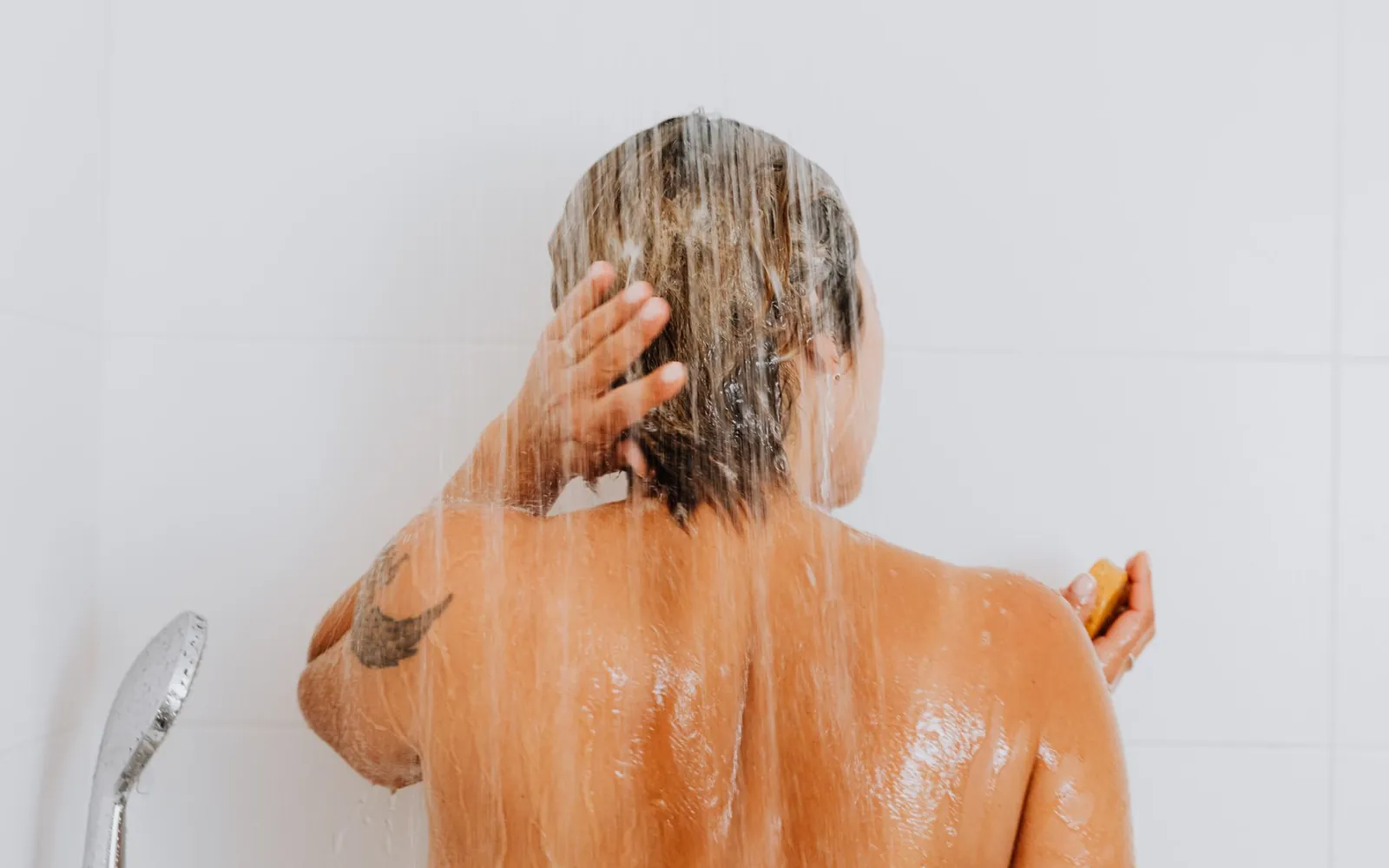
The ritual goes like this. You wash your hair exactly as usual, shampoo, conditioner, the works, and then, before you step out of the shower, you pour a bottle of water slowly over your head. The last water to touch the hair, the theory says, should never come from a hard tap. It is the most repeated hard water tip on the internet, it turns up in salon advice and underneath every video about dull hair, and it has the great advantage of feeling like action. So we ran it against the mineral numbers, which is the only court a tip like this can be tried in. It survives in one narrow case. The rest of the time, three things undo it: timing, the label, and the litre.
The minerals arrive during the wash, not after it
Start with the clock, because the clock is where the tip is weakest. A wash is not a dip. Your hair spends minutes soaking in shower water: wetting through, shampooing, rinsing, conditioning, rinsing again. Throughout all of it, the calcium and magnesium in that water are in contact with the hair, and minerals take their chances as they come. They settle on the surface and bind most readily where the hair is porous, which means the older lengths, the ends, and anywhere colour or heat has opened the surface up. That is the whole mechanism of hard water build-up, and we have set it out in full in our guide to hard water and your hair.
By the time the bottle comes out, the wash has already happened. A final rinse in softer water changes one thing only: the water your hair is left wet with, the water that dries on it. That is worth something, and we will come back to it. But it cannot call back the minerals the minutes of washing laid down, and it does precisely nothing about last month's build-up, which is the problem most people who try this tip are actually trying to fix.
Bottled is a container, not a category
The second problem is printed on the bottle, in small type, and almost nobody reads it. Bottled water is not soft water. It is water in a bottle, and its mineral content is whatever its spring picked up on the way, which for the famous names is often a great deal.
Take Evian, one of the best known bottles in the world. Its own published analysis gives calcium at 80 mg/L and magnesium at 26 mg/L. Convert those the way tap water hardness is measured, as calcium carbonate, and the bottle works out at roughly 300 mg/L. On the scale this site uses, that is very hard water, and it is a near match for London's tap supply at 320 mg/L, a figure from our own dataset. Rinsing London hair with Evian is rinsing it in a second, considerably more expensive London.
Now take a lighter name. Volvic's label gives calcium at 12 mg/L and magnesium at 8, which converts to roughly 60 mg/L, right on the border between soft and moderate. The quick tell, if you do not want to do arithmetic in a supermarket, is the dry residue figure on the label, the total mineral content: 345 mg/L for Evian, 130 for Volvic. Same shelf, same word "water", nearly three times the minerals. The reliable exception is distilled or demineralised water, the kind also sold for steam irons, where the minerals were taken out before bottling and the number is effectively zero. That is the bottle the tip's logic actually describes. It is rarely the bottle anyone buys.
Then there is the litre problem
Even with the right bottle, the ritual usually fails on volume. A final rinse has to reach all of the hair, including the underneath lengths, poured slowly enough to displace the tap water rather than splash over it. Short hair might be honestly rinsed with half a litre. Long hair wants a litre to a litre and a half. The 500 ml bottle from the minibar, tipped over the crown, is a gesture over the top layer while the lengths beneath stay rinsed in exactly the water you were trying to avoid.
On a trip there is a plainer objection. A litre of water weighs a kilogram. A week of final rinses is a week of kilograms, bought one wash at a time, forever. The bottle is consumed by the ritual. Nothing about it accumulates.
When the final rinse genuinely helps
Honesty cuts both ways, and there are cases where the tip earns its keep. If the water in the bottle is genuinely soft, distilled above all, then the water your hair dries in carries almost no minerals, and porous lengths in particular can feel smoother and look less coated that day. On a short trip somewhere extremely hard (our dataset holds Cancún at close to 700 mg/L), a distilled final rinse is a reasonable finishing touch for hair that has to photograph well the next morning. And if your hotel has a softener in the basement, the question may already be answered before you ask it, which is a story we tell in hotel water.
The rinse also has one use nobody mentions: it is a diagnostic. If a week of distilled final rinses transforms your hair, you have strong evidence that minerals are your problem, with your own hair as the test case. That is valuable information. It just points at a different purchase.
The cheaper answer removes minerals instead of dodging them
Here is the mechanical difference the ritual cannot get around. Soft water, however soft, can only dilute what is loose. It cannot unbind mineral that has already attached to the hair, because nothing in plain water takes hold of a calcium or magnesium ion and carries it away. A chelating wash can, because that is what its ingredients are for: chelating agents such as EDTA take hold of the mineral ions and hold them in the rinse water, so the mineral that previous weeks of washing laid down leaves with the lather. It treats the build-up itself, not just the last thirty seconds of one wash.
The planner's chelating list for hard water is built for exactly this: Malibu C Hard Water Shampoo, a chelating cleanser aimed squarely at calcium, magnesium and metal deposits, alongside K18 Peptide Prep Detox, OUAI Detox Shampoo and L'Oréal Professionnel Metal Detox. Used on the planner's water-led rhythm rather than daily (every fourth wash in hard water, more often in very hard water), and followed by conditioner, since a strong cleanser leaves hair asking for one, a chelating wash does the job the bottle ritual advertises. The full account of how chelating differs from ordinary clarifying is in chelating, clarified. One bottle covers many washes. It is not bought again every time you shower.
If you are going to do it anyway
Do it properly or not at all. Choose the bottle by its label: calcium and magnesium low, dry residue low, or the word distilled on the front. Pour at least a litre, slowly, after the last tap rinse, and get it through the underneath lengths, not just the crown. Treat it as a finishing touch for a day that matters, in water that genuinely earns it, and keep the chelating wash for the build-up itself. The ritual is not a fraud. It is a small, real effect with a large, real price in effort, and now you have the numbers to decide whether your hair is one of the cases where it pays.