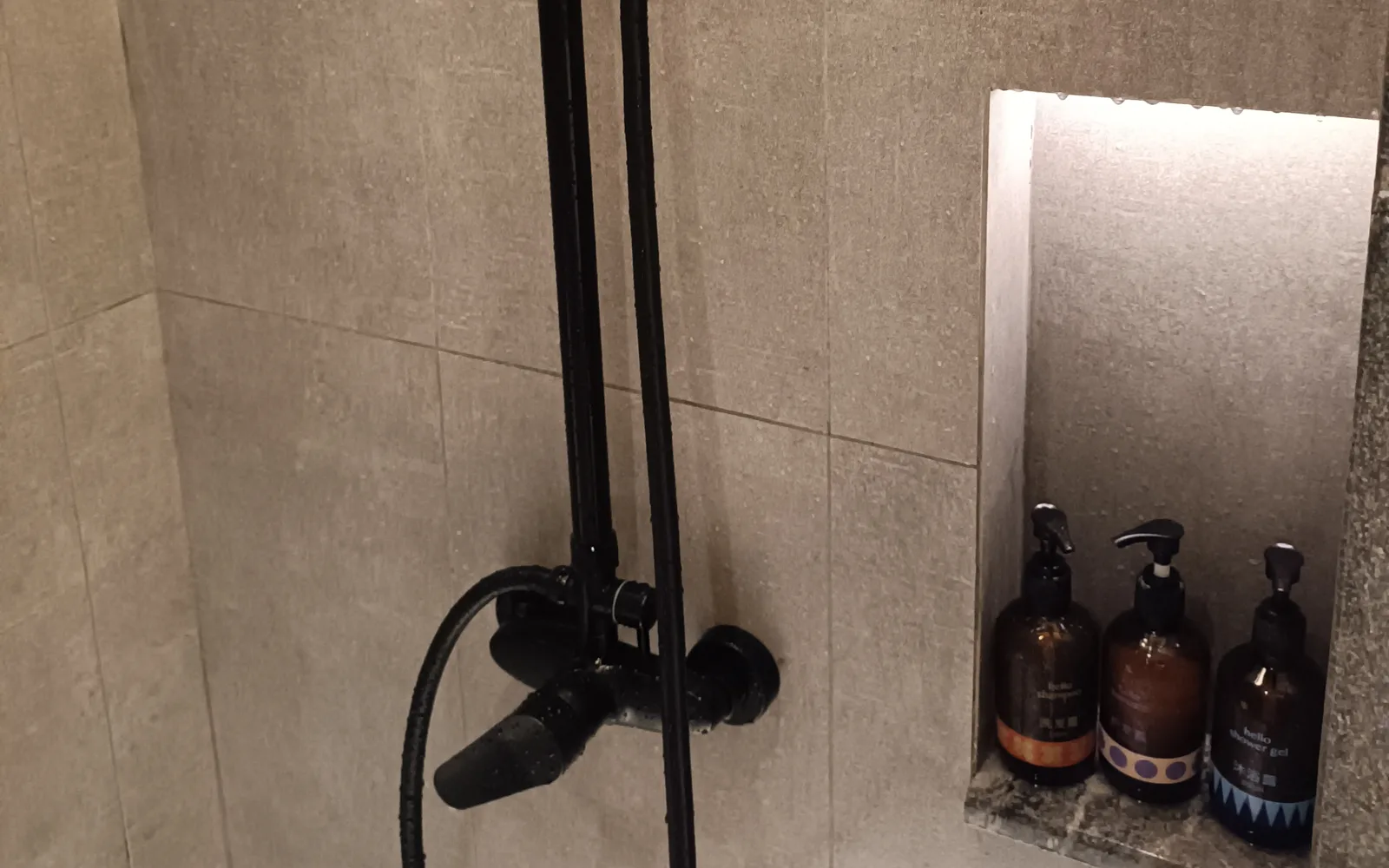
It is the puzzle we hear most often. The map said soft, the hair said straw. Or the map said very hard, and the hotel shower produced the silkiest wash of the year. Both travellers checked the same city. They simply did not wash in the same water, because a hotel is not connected to a city the way a tap suggests. It is connected the way a small town is: through plant rooms, tanks and treatment kit of its own.
The city number stops at the front door
Every figure on our map describes a public supply: the water a utility delivers to a district, measured and published at the level of the town or the network zone. That is the water a building receives at its boundary. What arrives at a shower head on the fourteenth floor has finished a second, private journey, and the building has had every opportunity to change it on the way.
Most buildings do very little, and for most stays the city figure is exactly what lands on your hair. But hotels are not most buildings. They run industrial laundry, commercial boilers and kitchens that scale up expensively, and they employ engineers whose job is water. A hotel is the building most likely to have edited the supply.
The softener in the basement
The commonest edit is deliberate softening. A commercial softener passes the water through a resin that swaps its calcium and magnesium for sodium, the classic ion exchange. The reasons are practical rather than cosmetic: soft water stops scale in boilers and pipework, keeps glassware and linen presentable, and cuts the detergent bill in the laundry. The guest benefit arrives as a side effect.
Softened water announces itself. It feels slippery, almost silky, and takes a long time to rinse soap away; lather arrives in quantities your home shower never produces; skin feels less tight afterwards. Hair washed in it is smoother but can lose its grip: fine hair goes flat by lunchtime, and a rich conditioner suddenly feels like too much of a good thing. In a very hard city this is the pleasant direction of the surprise. London's public supply runs at about 320 milligrams per litre, deep in our very hard band, yet a traveller in a well softened London hotel can wash in softer water than a traveller at home in a moderate city whose building does nothing at all.
Treated is not the same as softened
The confusing middle case is the building that treats its water without softening it. Scale inhibitors, including phosphate dosing, condition the minerals so they are less inclined to deposit inside pipes and plant. The plumbing is protected, but the minerals are still in the water, and they can still settle on hair. A hotel can truthfully describe its supply as treated while your hair experiences the full hardness of the city.
Filtration raises the same point in miniature. Many hotels filter drinking water at the bar or the breakfast buffet for taste. The showers are almost never on that circuit. What improves a glass of water says nothing about the water over your head.
Tanks, pipes and time
Large buildings also store water, in rooftop or basement tanks, and push it through long runs of pipe to reach distant rooms. Two quiet changes follow. The chlorine that leaves the treatment works fades as water travels and waits, so a tank fed building usually delivers a gentler disinfectant dose than a house close to the mains. And the pipework itself can contribute traces of its own materials: copper from copper pipe in some buildings, a rust tint from ageing iron in older ones. Neither changes the hardness band. Both can change how a wash feels, particularly on fair or colour treated hair, which shows mineral tinting first.
Reading your hotel shower
The practical skill is not prediction, it is diagnosis, and the first wash is the test. Slippery water, runaway lather and flat roots say the building softens: go easier than the map suggested, condition lightly, and save the rich mask for home. A rough, squeaky wash with dull lengths in a city the map calls soft says the building passes the supply through untouched, or treats it without softening: wash for the water you have, not the water you hoped for, with conditioner at every wash and one chelating wash (a detox wash) in the middle of a longer stay to lift what has settled.
For a weekend, that is all you need. For a long stay, a relocation, or a hotel you will return to, it is worth asking the question outright: do you soften your water? Front desks do not always know, but engineers do, and hotels that soften are usually pleased to say so, because it costs them money to run. The answer turns a guess into a plan.
Why we still publish the city number
None of this demotes the map. The city supply is the water every building starts from, most buildings pass it through with no softening at all, and it remains the right number to pack by. The hotel exception explains the outliers rather than breaking the rule, and it points at the honest limit of any city figure, ours included: it is measured where the public supply ends, not where your shower begins. It is also why, whenever we can, we prefer a number measured at an actual tap to one inferred from a network average. Buildings have opinions. The city number is the opening position, and your first wash tells you how far the building moved it.