Grey hair travels differently: the yellowing problem
Silver hair leaves home bright and comes back from a week away faintly yellow, sometimes with a green edge, and it is rarely one culprit. Hard water coats it in minerals, sunlight yellows the fibre itself, and pool water can leave copper behind. Grey and white hair shows all of it faster than any other hair, because there is no pigment in the way. What is actually happening, and the order to do things in so it stays silver.
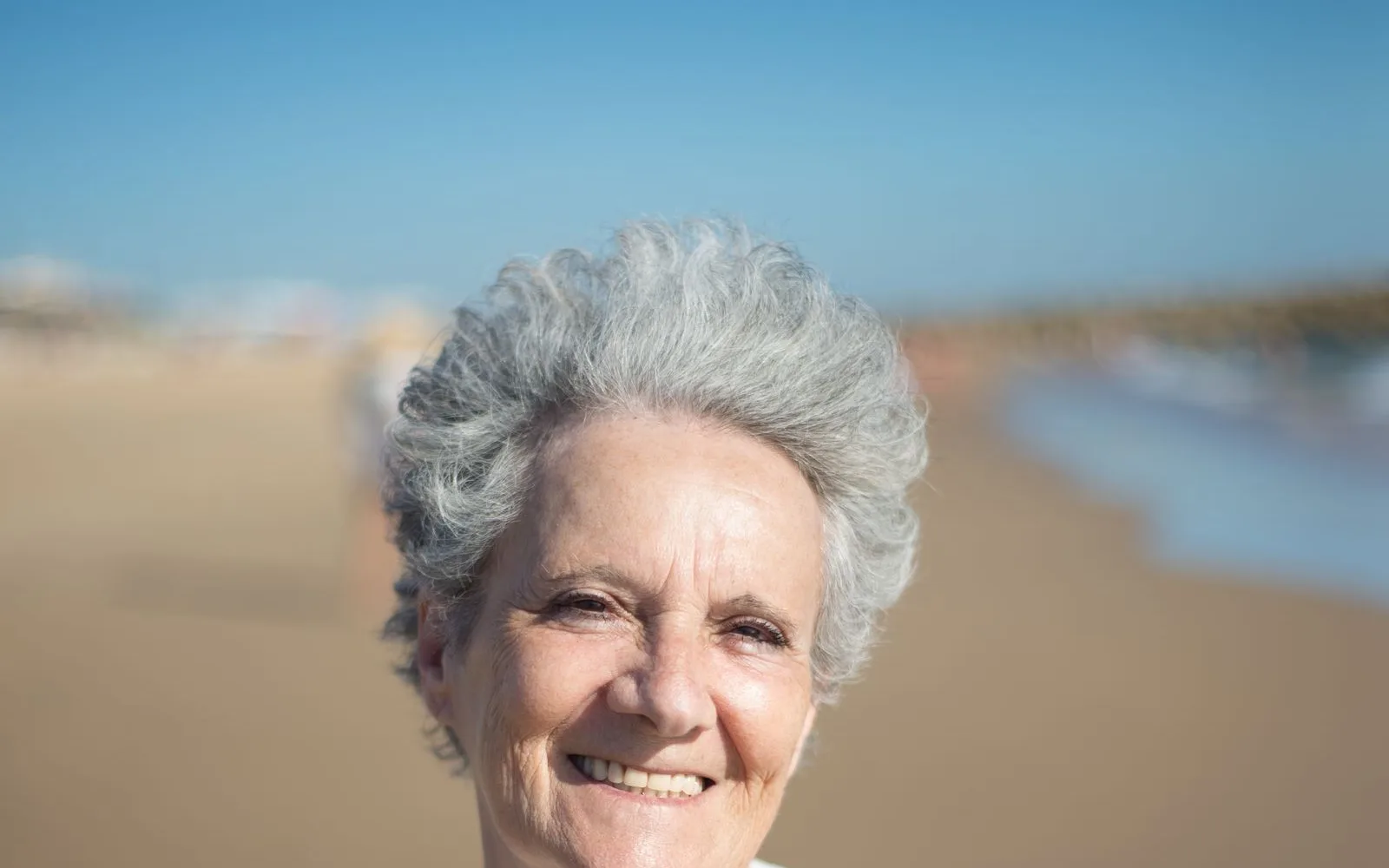
It usually shows in a photograph first. The silver that left home bright looks cream in the holiday pictures, and by the time you are back at your own mirror it reads yellow, with a greenish cast at the ends if the pool was good. Nothing about your routine changed. Your hair did not either. What changed is everything that touched it: the water, the sun and the pool, all at holiday strength, all landing on the one hair colour with nothing to hide behind.
Why white hair shows everything
Colour in hair is melanin, and melanin does more than tint. In pigmented hair it soaks up ultraviolet light and takes the damage first, bleaching a little in the process, which is why brown hair lightens in the sun. White hair has no melanin at all. There is no shield and no camouflage: sunlight reaches the fibre itself, and anything that lands on the surface, a mineral film, a metal deposit, sits on a blank background and shows at full strength.
The fibre itself is different too. Studies comparing white hairs with the pigmented hairs growing beside them find significantly less internal lipid and less bound water in the white ones, which makes them more porous and quicker to dry out. Porous hair drinks. Whatever is dissolved in the water, minerals, metals, chlorine, gets in more easily and holds on harder. Grey hair on holiday is not being difficult. It is the most absorbent hair on the beach, with the least cover.
The water leaves its minerals behind
Start with the shower, because it works on you every day of the trip. Hard water carries calcium and magnesium, and washing leaves a little of both on the hair each time. This is measured, not folklore: in a dermatology study, hair washed in hard water on alternate days for a month held about three times as much calcium and more than four times as much magnesium as hair washed in distilled water, and its surface came out visibly rougher under the microscope.
On dark hair that film mostly steals shine. On white hair it is the colour you see: a dull, creamy yellow cast that creeps in wash by wash and that no amount of ordinary shampoo seems to shift, because ordinary shampoo is not built to remove it. Our planner says it plainly for grey and white hair: mineral build-up shows fast as yellowing. The full mineral story is in Hard water and your hair.
And the classic silver-hair holiday map is hard-water country. On our dataset, Palma de Mallorca runs at 267 mg/L and Nice at 255, both very hard; Barcelona is 175 and Athens 145, both hard. Lisbon, at 81 mg/L, is moderate, and the gentlest of the five on grey hair. Four of the most popular weeks away in the sun are also four of the hardest showers on the map.
Sunlight yellows the fibre itself
Minerals sit on the hair. Sunlight changes the hair. Hair protein absorbs ultraviolet, and in white hair the keratin takes the hit that melanin would otherwise absorb. The breakdown products of its amino acids, tryptophan and tyrosine among them, are themselves yellow: the fibre quite literally manufactures its own tint. Researchers who irradiated grey hair found ultraviolet pushing the white fibres towards yellow while the pigmented fibres beside them bleached instead. Heat plays its own part in the same research: white fibres yellowed under heat alone, which is worth knowing before a week of daily straightening in a hot hotel bathroom.
There is no wash that reverses this, because nothing has been deposited. There is only prevention, and it is the oldest one going: cover it. A hat is sun protection for hair in the most literal sense, and midday shade is a styling decision as much as a comfort one.
The green is copper, not chlorine
The greenish ends have a different cause, and it is not the chlorine. Pool water often carries copper, from copper-based algaecides and from corroded pipes and heaters, and copper binds to hair protein and shows green, most visibly on the lightest hair. The cosmetic-science literature settled this decades ago: hair exposed to copper in water takes it up and turns green, and hair that has been oxidised takes up the most.
That last part is chlorine’s real role. Chlorine oxidises hair protein and roughens the cuticle, which leaves the fibre more porous and better at grabbing copper. It loads the dice; the copper throws them. Grey hair, already porous, is the fastest learner. Wetting your hair with clean water before you swim helps, because hair that is full of clean water drinks less pool water; a conditioner through the lengths helps too, and rinsing afterwards is not optional. The full swimmer’s routine is in Chlorine, salt water and your hair.
Two washes, two different jobs
The fix splits in two, and the order matters. A chelating wash (a detox wash) is the remover: its ingredients bind minerals and metals, copper included, so they rinse away instead of sitting on the fibre. It is the only wash that actually takes the yellow’s raw material off. How often is set by the water: every second wash in very hard water, every fourth in hard, which on a one-week trip lands as one or two washes, the last on the final night. The planner’s default in this slot is K18’s Peptide Prep Detox Shampoo.
The silver shampoo is the corrector, and it removes nothing. A neutralising (silver) shampoo leaves a trace of violet pigment on the hair, and violet sits opposite yellow on the colour wheel, so the two cancel out visually and the hair reads silver again. It is a touch-up for the tint that is left once the deposits are gone, used occasionally, and it belongs after the chelating wash, not instead of it. Used on top of a mineral film, it simply tones the film.
It is also easy to overdo. Porous white hair grabs the pigment as readily as it grabbed the copper, and too much, too often, trades yellow for a dull, faintly lilac cast. That one, at least, is temporary: it fades over a few ordinary washes, and a chelating wash speeds it on its way. Styling products play a quiet part here too: films from oils and sprays dull the surface and give minerals something extra to stick to, one more reason the detox wash comes first. We pulled the whole distinction apart in Chelating, clarified.
The routine, in order
Before you go: one chelating wash at home, so the trip starts from clean hair rather than adding to a film that is already there.
On the trip: clean water through your hair before the pool, a hat in the midday sun, and the chelating rhythm your destination’s number calls for. In Palma or Nice that is every second wash; in Barcelona or Athens, every fourth; in Lisbon the water barely asks for one at all.
Home again: one more detox wash if the water was hard, then a silver shampoo only if a tint is still looking back at you. Grey hair does not need a bigger routine on holiday. It needs the same routine in the right order, matched to the number of the place it is going. So start with the number, as always. It is on the map.