Dry shampoo, honestly: what it does and what it cannot do
The name promises a wash and delivers a pause. Dry shampoo is a powder that drinks the oil at your roots and buys you a day; it cleans nothing, and used past its one honest job it starts charging interest. What is in the can, how to use it properly on a trip, and when to put it down and wash.
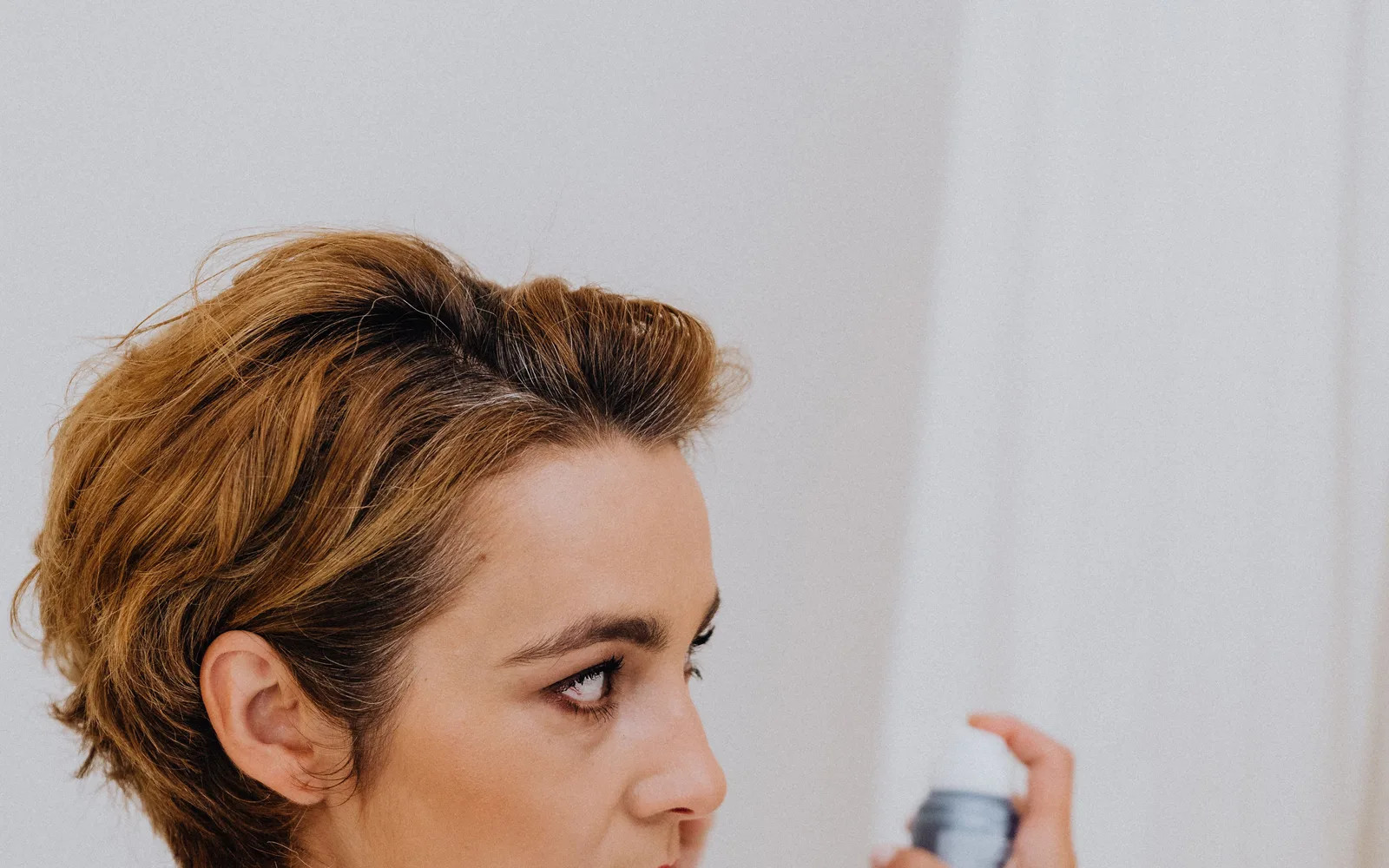
Start with the name, because the name is the one dishonest thing about it. Dry shampoo contains no shampoo. There is no detergent in the can, nothing that lifts dirt off hair and rinses it away. What there is, is powder: very fine, very thirsty powder, delivered to your roots. Everything good about the product follows from that, and so does everything it cannot do.
What the powder does
Open the ingredient list of a typical spray and the first names are the machinery: butane and propane to push it out of the can, alcohol to carry it onto the hair and then evaporate. The working names come next. Rice starch, corn starch, aluminium starch octenylsuccinate, silica, sometimes clay. These are absorbents, ground fine enough to spread across the roots and sit there taking up sebum, the scalp oil that makes day-two hair look flat and separated. Oil that has soaked into powder no longer coats the hair shaft, so the roots look matte, feel drier and lift a little. That is the whole trick, and it is a good one. The oil has not left your head, though. It is sitting in the powder, and it only actually leaves when you brush the powder out, which is why the brushing matters as much as the spraying.
What it cannot do
The American Academy of Dermatology, the US dermatologists' body, is blunt about this: dry shampoo does not clean hair. Only shampoo and water remove the oil properly, along with the dead skin cells and microorganisms that gather on a scalp, and they remove the dry shampoo itself while they are at it. Everything else that collects on hair between washes is equally untouched by a spray: sweat, sunscreen, city dust, yesterday's styling product. Dry shampoo changes how your roots look for a day. It changes nothing about how clean they are, and any routine built on it as a substitute for washing is built on the gap between those two things. This site put it in one line when we counted washes on holiday: it absorbs oil and buys a day, it does not wash anything. The counting itself is in how often you should actually wash your hair on holiday.
The right way to use it
Used inside its limits, it is genuinely useful, and most disappointment with it is technique. Start on dry hair only: powder sprayed onto damp hair pastes and clumps instead of spreading. Shake the can, lift the hair in sections and spray along the partings from the distance the label asks for, which on the can this site recommends is 15 cm, in short bursts. Use less than instinct says. The dermatologists' warning about excess is specific: too much leaves hair dry, stiff and gritty, with the powder visible. Then wait the full two minutes the directions give it, because absorption is not instant, and massage it in with your fingertips so it reaches the scalp rather than sitting on the surface. Then brush, properly and thoroughly. The brush-out is not tidying up afterwards; it is the step that carries the oil away. One variation earns its keep on trips: spray the night before, and the powder gets the whole night to take up oil, so the morning brush-out starts from further ahead. If your hair is dark, pale powder can show at the parting until it is brushed out; distance, patience and the full wait fix most of it, and tinted versions exist for the rest, carrying mineral pigments matched to brown hair rather than white starch alone. A tint can also cover grey roots in a pinch, a use the dermatologists note without disapproving of it.
When to skip it entirely
The same guidance sets the limit, and it is short: wash with ordinary shampoo and water after one or two uses. Past that, the account turns negative. Powder and oil left sitting on the scalp can cause breakage and shedding, and a routine that replaces washing with spraying altogether could lead to seborrhoeic dermatitis, the itchy, scaly scalp condition. If your scalp itches or burns after using it, stop, and if the irritation has not cleared within a few weeks, that is a dermatologist's business, not a stronger product's. Skip it, too, on a scalp that is already flaring, sore or broken; that skin needs less on it, not more. And skip the homemade versions mixed from cornflour or bicarbonate of soda: the dermatologists steer people to bought products, because the kitchen mixes can clump and clog the pores of the scalp. There is one more honest entry in this section, from 2022. In October of that year Unilever recalled aerosol dry shampoos from Dove, Nexxus, Suave, TIGI and TRESemmé, all made before October 2021, after benzene was found at potentially elevated levels. The US Food and Drug Administration's notice is worth reading for its calm: the fault was traced to the propellant, no adverse events were reported, and the health hazard evaluation said daily exposure at the levels found would not be expected to cause adverse health consequences. It was a manufacturing fault in specific older lots of specific brands, not a property of starch. But it is part of why loose powders, which have no propellant at all, have their travelling fans.
Where it earns its place on a trip
On this site, dry shampoo has one defined job. In the planner it appears for soft-water stops, where there is nothing in the water to strip off the hair and an extra wash buys nothing: there, a spray on the morning of day two replaces a wash rather than adding one, and three washes can cover a week. The pick written into the planner is Klorane's Dry Shampoo with Oat Milk, the French pharmacy original. Klorane launched the first dry shampoo in 1971, for new mothers in hospital who could not wash their hair; the full story is in hair care trends around the world. The formula runs on rice starch and oat, it comes in the tinted version for dark hair mentioned above, and for flying it comes in a 50 ml travel can, because the familiar full-size can is 150 ml and an aerosol counts in the liquids bag like everything else in it. The packing maths is in the carry-on hair kit.
So the honest summary is the one on the tin this site wishes it carried. Dry shampoo is a powder that drinks oil at the roots, buys you one presentable day, and asks in return to be brushed out and washed out on schedule. Give it that, and it is one of the best travellers in the wash bag. Ask it to be a wash, and it will let you down slowly, in public, at the roots.