Curly hair meets hard water: the routine that changes most
Curls leave home springy and, three days into a hard water city, dry stretched, stringy and frizzy, coated and thirsty at the same time. The products get the blame, but nothing in the wash bag changed: the water did, and curly hair is where hard water shows first. What the minerals do to a curl, the reset wash that clears them on a ration the pattern can afford, and the moisture routine that makes the reset stick.
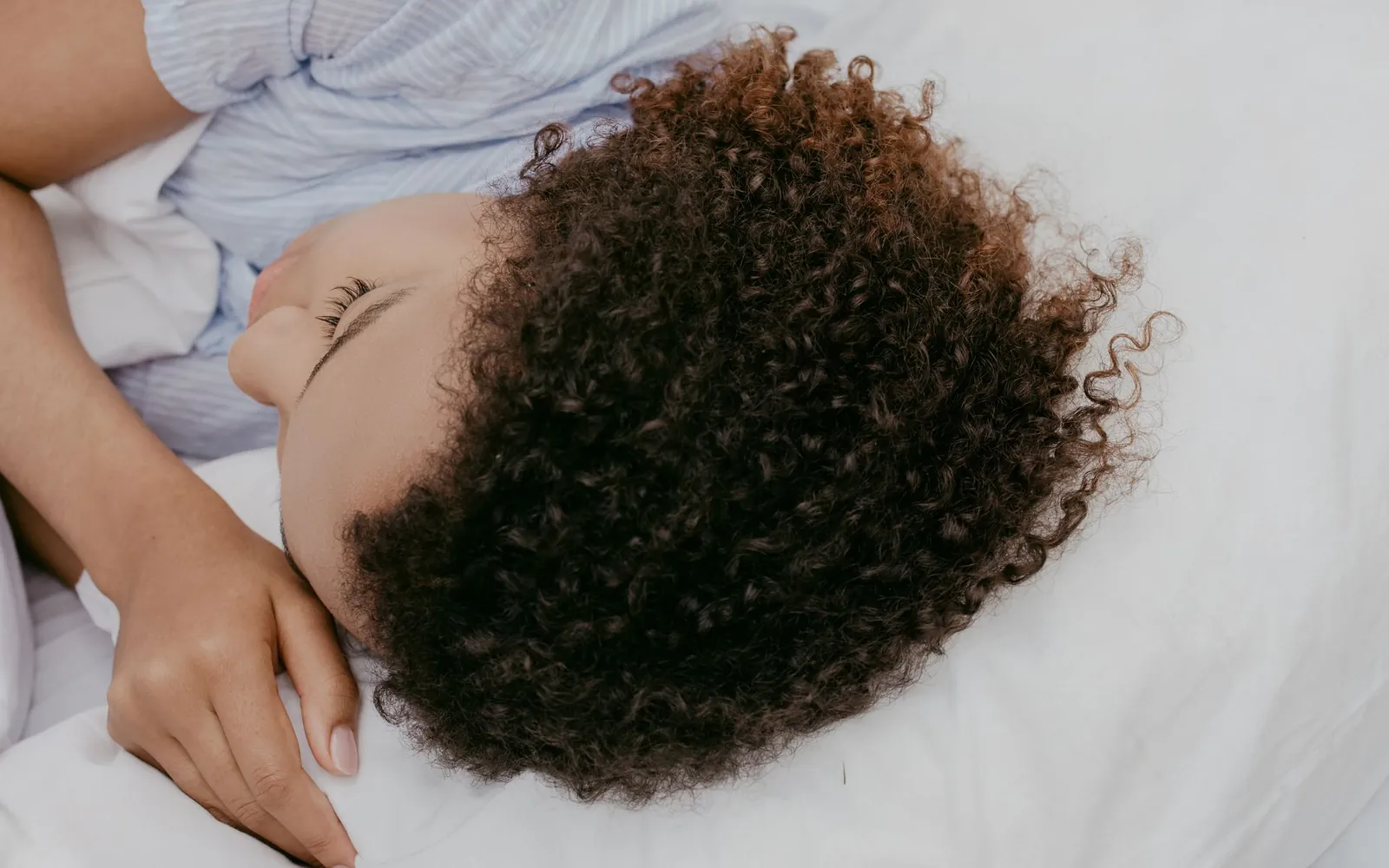
It tends to announce itself around day three. The curls that left home springy come out of the hotel shower and dry different: the ringlets stretched and stringy, the canopy frizzy, the whole head somehow coated and dry at the same time. More conditioner does not fix it. A different styling cream does not fix it. The products get the blame, packed and unpacked in the wash bag, but nothing in the bag changed. The water did, and curly hair is where hard water shows its handwriting first.
Why curls start with less margin
Curls run dry by design, and the reason is geometry. The oil your scalp makes has to travel the length of the strand to do its conditioning work, and on a straight strand it slides. On a curved one it crawls: the spiral shape impedes the distribution of sebum along the shaft, so the lengths and ends of curly hair are the driest hair on the head even at home, in kind water. The fibre itself varies along its length, thinner at the bends, and the bends are the points where it wears and breaks first. None of that is damage you caused. It is the shape doing what the shape does, and it means curly hair arrives in a hard water city with its moisture reserves already spent.
What the minerals do to a curl
Hard water pays a deposit on every wash: calcium and magnesium, left behind on the strand. In the Srinivasan and Rangachari microscopy study, hair washed in hard water on alternate days for a month held about three times as much calcium and more than four times as much magnesium as hair washed in distilled water, and its surface came out visibly rougher. Work by Evans, Marsh and Wickett adds the part that matters most for a curl: the hardness metals lodge in the cuticle layers and stiffen the fibre.
A curl is not a structure. It is a habit, a shape a flexible fibre falls back into. Stiffen the fibre and coat it, and the habit weakens: lengths that would spring into ringlets dry longer, looser and separated, with a rough halo where the pattern has come apart. The film does one more quiet sabotage. It sits between your conditioner and your hair, so by midweek you are conditioning the minerals, and the obvious response, more product, heavier product, builds a second film on top of the first. Curly hair that feels coated and dry at once is not a contradiction. It is the diagnosis.
The reset wash, rationed for curls
The fix starts with the one wash that removes minerals: a chelating wash (a detox wash), whose ingredients bind calcium and magnesium so they rinse away instead of resettling on the hair. The full distinction between chelating and merely clarifying is in Chelating, clarified. What matters here is the ration, because the wash that clears the pattern also dries it. Our planner caps curly hair at one chelating wash in every five, whatever the water asks for, and the cap is a ceiling, not a target: in soft water it schedules none at all, because there is nothing to remove.
On the reset day, order is everything. Chelate first, then go straight to moisture while the hair is clear: the weekly mask belongs on the reset wash, not on a random later day, because that is the one moment conditioner and mask can reach the hair itself instead of the film. Between resets, keep the ordinary washing gentle. Curly hair does best sulfate free day to day, in the planner’s own words, and a conditioner only rinse, a co-wash, refreshes the pattern on the days between without spending a shampoo wash. The counting behind that, washes per stay rather than days per week, is in How often should you actually wash your hair on holiday?
Which bottle takes the reset slot follows the water. In moderate water the gentler hand earns its place: Living Proof’s Triple Detox takes on product residue, pollution and hard water metals at once, with a gentler hand than most clarifying washes, and gentle is what a dry pattern asks for. In hard and very hard water the planner’s default is K18’s Peptide Prep Detox Shampoo, the strong clear-out, colour safe and built for occasional use: at the curly ration it clears a week’s deposits in one wash, and it is never an everyday shampoo. Malibu C’s Hard Water Shampoo, made specifically for hard water homes, is the other name on that shelf. The bottle matters less than the discipline around it: one wash in five, followed immediately by moisture.
The moisture routine that makes it stick
A reset without the routine after it buys about two washes. Condition every wash, and condition properly: worked through the lengths and ends, left for its minutes, not waved at the hair on the way past. The planner steps curly hair up a conditioner weight when the water is hard, from the mid shelf to the rich one, where Davines’ NOUNOU Conditioner and Living Proof’s Restore Conditioner sit: filmed, thirsty curls are the hair that step exists for. The everyday wash stays the gentle one, and the planner’s gentle list is led by Davines’ MOMO Shampoo, a moisturising wash for dry or dehydrated hair, mild enough to repeat without stripping what the mask just put back.
Once a week, the mask. For curly and coily hair the evidence leader in the planner’s mask slot is Briogeo’s Don’t Despair, Repair! Deep Conditioning Mask, on a repeated pattern of less fragility, strong softness, detangling slip and definition that lasts most of a week. Detangle while it is in, when the slip is there to help, rather than dry and afterwards. None of this is a bigger routine than the one most curly travellers already own. It is the same routine with its two load-bearing pieces, the rationed reset and the weekly mask, pinned where the water cannot move them.
A hard water week, counted
Put numbers on it. On our dataset, London runs at 320 mg/L, Rome at 346 and Paris at 269, all very hard. Sydney at 57, Madrid at 30 and New York City at 32 are soft, which is why a curly traveller from Sydney can feel ambushed by a London shower: the home water never filed a complaint. A week in London, at the planner’s wash about every second day, holds three or four washes. One of them is the reset, and on a trip that short the reset does its best work on the last night, clearing the week’s deposits before you fly home; the mask lands on the reset or on whichever wash the hair feels driest; the remaining days are the gentle wash and the co-wash. The same week in Madrid holds the same washes and no reset at all, and the effort goes on moisture alone. Same head, same bag, two different weeks, decided entirely by the number on the tap. London’s figure and its source are on its city page.
Start with the number
Curly hair does not need rescuing from hard water, and it does not need a shelf of new products. It needs the deposit cleared on a ration the pattern can afford, and the moisture routine treated as part of the structure rather than decoration. Both decisions start where everything on this site starts: with the number. Check your destination’s figure before you pack, and the week plans itself.