













Same hair. Different city. Same great results.

Every destination has a hair story. Notes on water, hair and travel with a brush of inspiration.

The world is your oyster. The water? That is another story.

Know your water. Some cities serve up soft water. Others are hard, heavy with minerals. Find your destination, check what is coming out of the tap, and see what it could mean for your hair. Tap a pin or a city to add it to your trip.

Soft · easy does it · under 60 mg/L Moderate · the middle ground · 60–119 Hard · mineral territory · 120–180 Very hard · the minerals mean business · over 180

The interactive map could not load here, so use the city list: it carries the same hardness figures.

New destination, new shower chemistry. Pick a city to see what is coming out of its taps.

How hardness is measured

One number, three scales. Milligrams per litre (mg/L) is the common currency; France uses degrees French (°f), Germany degrees German (°dH). 1 °f = 10 mg/L.

Bandmg/L°f°dHWhat it does to hair
Softeasy does itUnder 60Under 6Under 3.4Lathers easily, rinses clean. Can leave fine hair limp and flyaway; conditioners feel heavier.
Moderatethe middle ground60–1196–11.93.4–6.7The comfortable middle. Most routines work unchanged; a clarifying wash now and then keeps shine.
Hardmineral territory120–18012–186.7–10.1Minerals start to coat the strand: dullness, tangling, colour fade. Chelating (detox) washes enter the routine.
Very hardthe minerals mean businessOver 180Over 18Over 10.1Build-up is fast, especially on porous or bleached hair. Weekly chelation and richer conditioning are worth it on long stays.

Let’s get your hair ready.

Your shampoo did not change when you landed. Your water did. Hard water carries extra calcium and magnesium, and those minerals settle on your hair wash after wash, leaving it dull, dry and harder to manage, while the products that worked at home quietly stop working the same way. Soft water sits at the other end: hair often feels lighter in it and products rinse clean away, though fine hair can go flat. It is why a routine that behaves beautifully at home can misbehave two cities later. Tell us where home is, add the places you are heading, and we will check the water in each one and work out what your hair needs along the way.

First, a little about your hair.

Straight, wavy, curly, kinky coily: every head has its own agenda. Tell us a little about yours so we can tailor your plan. Texture does most of the work; age and routine fine-tune it.

Start here. Your home water is what your hair is used to, and putting up with, right now: every stop you add gets measured against it.

Hair texture

Colour changes what hard water does that you can see: minerals show on fair and grey hair as brassiness or yellowing, and red fades fastest.

How do you dry it?
Organic products

Add your next stop. Weekend in Rome? Two weeks in Tokyo? A summer of island-hopping? Let’s see what the water has in store for your hair. Pick a city from the suggestions, then tap Add this destination. Add stops in the order you visit them, up to 10 cities.

Your plan

Altitude, UV and your hair

Height changes the sunlight and the air, not the strand itself. Both are in every city plan, alongside the water.

UV climbs about 10–12% per 1,000 m

Thinner air filters less ultraviolet, so the sun gets stronger with every kilometre up. UV breaks down keratin and lifts the cuticle: hair goes drier, rougher and weaker, and colour fades faster. At Tignes (2,100 m) the UV load is roughly a quarter higher than at sea level.

Snow bounces it back up

Fresh snow reflects most UV back at you, so an alpine resort in winter delivers it from above and below at once. That is why a ski week wrecks hair in a way a beach week at the same water hardness does not: UV damage, dry air and minerals landing together.

Mountain air is dry air

High air holds very little moisture, and cold air holds less again. Hair loses water to the air around it: dryness, static and flyaway ends, plus a dry, flaky scalp. Heated indoor air dries it further overnight. The fix is moisture and sealing, not more washing.

Altitude bandElevationWhat changes for hair
LowUnder 500 mSea-level rules: UV and air moisture are background factors, water hardness does the talking.
Moderate500–1,500 mUV is measurably stronger and the air drier. Add a leave-in with a UV filter in summer and step up moisture a notch.
HighOver 1,500 mUV protection becomes part of the routine, not an extra: colour fades faster, scalps burn along the parting, and dry air plus indoor heating pulls moisture out day and night.

Elevations are approximate, from Open-Meteo elevation data at each city's map position. Treat them as planning guides, like the water figures.

The Journal

Every destination has a hair story. Notes on water, hair and travel: what the numbers on the map mean in the shower, in a hotel, and in your wash bag.

Water8 min read

The Mediterranean runs hard: one sea, two kinds of shower

Antibes runs at 476 mg/L and Madrid at 30: one sea holding every water band in Europe. The limestone pattern behind the numbers, the two famous exceptions, and the routine a Mediterranean fortnight calls for.

Read the article →

Water8 min read

Hard water in Britain: the chalk south and the soft north

Rain is soft, so British water should be gentle. The dataset disagrees: London runs at 320 mg/L and Glasgow at 15, one island split in two along the chalk. What each half of Britain asks of your hair, and the routine that answers it.

Read the article →

Water8 min read

Christmas market hair: the circuit runs hard

Mulled wine, cold squares, and the hardest showers of the year. The Christmas market circuit runs hard and very hard almost end to end, and a long weekend is long enough for it to show. The circuit on the scale, and the routine that fits around it.

Read the article →

Water8 min read

Beyond the Alps: the Rockies run harder, Japan runs soft

The Alps were only half the story. Park City runs harder than Megève, Japan’s ski towns run softer than Chamonix, and the Rockies numbers move with the snowmelt. The rest of the ski world’s water, and what to pack for it.

Read the article →

Weather8 min read

Winter sun hair: January in the Canaries and the southern summer

You board with winter hair and land in somebody else's summer. January sun and water in the Canaries and the southern summer, the numbers we hold, the one we do not, and the routine that covers both.

Read the article →

Swimming8 min read

Travelling with extensions: the water rules change

The hair can take more than the join can. Keratin bonds, tapes, weaves and beads each meet hard water, chlorine and salt differently: what happens to each, what to avoid, and what to pack.

Read the article →

Water7 min read

New city, new water: your hair's first month after a move

Sydney washes at 57 and London at 320. If the second one is your new home tap, your old routine is not coming with you. A first month plan for hair after a move, by the size of the step.

Read the article →

Water7 min read

Dry shampoo, honestly: what it does and what it cannot do

It absorbs oil and buys a day. It does not wash anything. What the powder in the can actually does, the two-minute way to use it on trips, and the point where the honest answer is a shower.

Read the article →

Water8 min read

What 200 mg/L actually feels like: the hardness scale in plain words

The scale runs from Glasgow's 15 to Cancún's 693, but the feel changes at the band borders, not at the round numbers. What each band does to lather, rinsing and day-two hair, and why 200 is where most people first notice the water at all.

Read the article →

Water8 min read

Read your own city's number: what the mg/L on your tap means

Glasgow washes at 15 and London at 320. What the mg/L on every city page actually counts, where it comes from, and why the gap between your home tap and the tap you are travelling to is the only reading that matters.

Read the article →

Water8 min read

The final rinse: does rinsing with bottled water actually work?

Wash in tap water, finish from a bottle. The internet's favourite hard water ritual, run against the label numbers: when it helps, when it is theatre, and the wash that actually removes minerals.

Read the article →

Swimming8 min read

Kids' hair on holiday: chlorine, tangles and burnt parts

Pool all day, sea after lunch, and a knot by dinner. Why children's hair tangles, greens and burns its parting on holiday, and the before and after routine that stops most of it without tears.

Read the article →

World6 min read

Eight hours at 35,000 feet: cabin air and your hair

You board with hair that behaved at breakfast. You land with hair that feels like it belongs to someone else: dry at the ends, flat at the roots, full of static, and oddly tired looking. Nothing happened to it. No rain, no heat styling, no new water. It simply sat, with you, in one of the driest indoor environments most of us ever enter, for the length of a working day.

Read the article →

World7 min read

Losing hair on weight loss injections: what the new research found, and what helps on the road

It is often noticed away from home, under a hotel bathroom light: more hair in the brush, more on the pillow, a parting that looks wider than it did in the summer. New research presented in Vienna this autumn gives that experience proper numbers for the first time. It also comes with honest limits, and this page will keep to them: the findings are early, they do not prove the injections cause the shedding, and no shampoo in the world switches it off. What travel can still change is how well the hair you have is fed, handled and looked after while it grows back.

Read the article →

Water8 min read

Men’s hair on the road: the two-product answer

A short cut is weeks old at the tips, so the lengths forgive hard water almost everything. The scalp does not. Why the two-in-one bottle lets it down, and the two products that answer it.

Read the article →

Water8 min read

Curly hair meets hard water: the routine that changes most

It leaves home springy and comes out of the hotel shower stretched, stringy and frizzy. Hard water coats curls in minerals they cannot afford, and the fix is a rationed reset plus moisture treated as load-bearing. Here is the routine.

Read the article →

Water9 min read

How often should you actually wash your hair on holiday?

Daily, every third day, Sundays only: everyone has a law, and every law was written at home. On holiday the water charges by the wash, texture stretches or shortens the count, and a swim counts whether you shampoo or not. How to count a trip’s washes before you pack.

Read the article →

Water10 min read

Coloured hair in hard water: why your colour fades faster, and what actually helps

It leaves the salon right and comes home warmer, flatter, duller. Coloured hair drinks more of the water it is washed in than any other hair, and hard water charges it rent in minerals, metals and fade. Here is what is happening, and what actually helps.

Read the article →

Water8 min read

Grey hair travels differently: the yellowing problem

It leaves home silver and comes back yellow, sometimes green at the edges. Hard water, sunlight and the pool all mark grey and white hair faster than any other, and the fix is mostly a matter of order.

Read the article →

World7 min read

The carry-on hair kit: what fits in the 100ml bag

One clear bag, no bottle over 100 ml, a week of washes to cover. The carry-on kit that handles hard water and sun, built from the planner’s own products in the sizes that fly.

Read the article →

Water8 min read

Hard water in the Alps: the ski towns with the toughest showers

Megève runs at 255 mg/L and Chamonix at 36, an hour apart. Our dataset numbers for sixteen Alpine ski towns, why geology beats altitude, and the wash routine each band calls for.

Read the article →

Weather8 min read

Static season: why winter hair crackles, lifts and snaps

It starts the first week the heating comes on: the crackle, the halo, the hair that follows your hat. Winter static is your hair reporting that the air has run out of moisture, and it comes with a quieter cost: dry ends that snap.

Read the article →

Water8 min read

Chelating, clarified: the wash that takes the minerals out

Detox, clarifying, chelating: the bottles use the three words as if they were interchangeable, and they are not. What a chelating wash actually does to the minerals and metals your water leaves in your hair, and how often your water calls for one.

Read the article →

Water6 min read

Same city, different shower: why hotel water plays by its own rules

The number on our map belongs to the city. The water in your shower belongs to the building, and between the street and the shower head sit softeners, storage tanks and a long run of pipe. They explain the trips where your hair politely ignored the forecast.

Read the article →

Weather6 min read

Hats, beanies and caps: keeping your hair great under cover

Hats protect your scalp and hair from sun, wind and cold, but friction, sweat and static can undo a style. A smooth lining, a loose fit and the right hat for the trip make all the difference.

Read the article →

World6 min read

Professional or supermarket shampoo: what the extra money actually buys

A salon bottle can cost five times a supermarket one. Some of that buys real tuning, a lower pH and narrower formulas. Much of it buys fragrance, packaging and distribution. Here is how to tell the difference.

Read the article →

Weather6 min read

Salt water and sunshine: what a beach holiday actually does to your hair

The waves and lighter streaks are the visible part of a beach week. Underneath, sunlight is breaking down hair protein and pigment while salt roughens every strand. What the sun does to hair, why the beach concentrates it, and the routine that keeps the look without the damage.

Read the article →

World6 min read

The pillowcase question: does your hair care what you sleep on?

Silk promises less frizz and fewer tangles, but the clinical evidence for hair is thin. We look at what friction and moisture tests actually show, who is most likely to notice, and why a pillowcase is a useful travel extra, not a transformation.

Read the article →

Altitude5 min read

Après-ski hair: why the mountains are tougher on your locks

Cold air, bright snow, cosy indoor heating. A dream holiday for you, and quite the workout for your hair. What altitude does to hair, and what a week in the mountains asks of your routine.

Read the article →

History7 min read

Before shampoo bottles: the surprisingly long history of a good hair wash

Today’s shower routine feels ordinary. But the story of how we wash our hair involves centuries of rituals, curious ingredients and some unexpected detours. It began as a massage, not a wash.

Read the article →

Swimming6 min read

Chlorine, salt water and your hair: a swimmer's guide

The green tint is not the chlorine. What pool water and sea water each do to hair, and the rinse first habit that prevents most of it.

Read the article →

Weather6 min read

Hair and the weather: planning around humidity, heat and temperature swings

The water gets the blame, but the air does half the work. What humidity, dry heat and a twenty degree day to night swing actually do to hair, and how to pack for a day that cannot make up its mind.

Read the article →

World6 min read

Hair care trends around the world

Dry shampoo was born in a French pharmacy and bond building in a California garage. How the world's hair ideas travel, and what they leave behind at the border.

Read the article →

Water7 min read

Hard water and your hair: the minerals you never invited

That stubborn feeling after a wash might not be your shampoo’s fault. Meet the invisible minerals that can build up on your hair, one shower at a time, where they come from and what they actually do.

Read the article →

World5 min read

The brand that will not sell you shampoo

Milbon supplies more Japanese salons than any other hair care company, and it refuses to sell you a bottle online. Inside the synchrotron science, the soft water logic, and the two different Milbons: the one Japan keeps at home, and the one it sends to the world.

Read the article →

History6 min read

The history of conditioner

Conditioner is older than shampoo, and for most of its history it was oil. From Macassar oil and the antimacassar to protein science and the silicone era.

Read the article →

Water5 min read

The water is different here

Your shampoo did not change when you landed. Your water did. What hard water actually does to hair, why a week in a hotel exposes it, and what to do about it.

Read the article →

Traditions6 min read

Traditional Indian hair care: oiling, herbs and the head massage

The original shampoo was an Indian head massage. The oiling ritual, the washing herbs and the Ayurvedic logic that modern hair care keeps coming back to.

Read the article →

Traditions6 min read

Traditional Japanese hair care

Rice water, camellia oil and the boxwood comb: a thousand years of Japanese hair care built on patience, polish and very soft water.

Read the article →

Tropics5 min read

Tropical humidity: when your hair has other plans

You packed the outfits. You planned the itinerary. Your hair, meanwhile, has entered its own weather system. What saturated air does to hair, why the water is rarely the problem in the tropics, and the lighter kit that works.

Read the article →
← Back to the Journal

The water is different here

Your shampoo did not change when you landed. Your water did. What hard water actually does to hair, why a week in a hotel exposes it, and what to do about it.

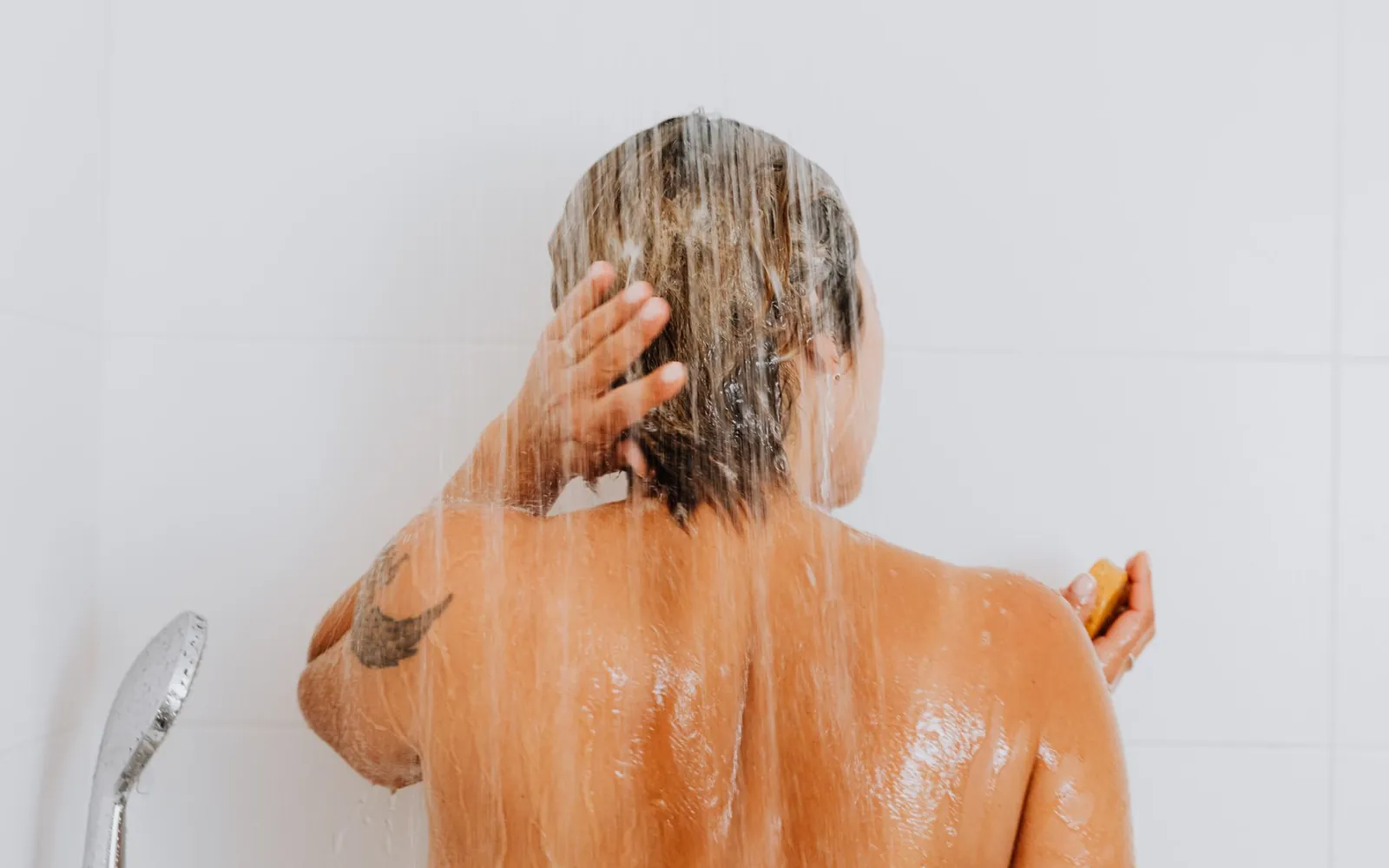
Back view of a woman rinsing her hair under a running shower

You know the feeling: same shampoo, same routine, and your hair comes back from a trip acting like it belongs to someone else.

Every wash is two products, not one. There is the shampoo you packed, and there is the local water, which is an ingredient too, whether you chose it or not. Water hardness is simply how much calcium and magnesium the water picked up on its way through rock and soil, measured in milligrams per litre. Toyama in Japan runs at about 40. London runs at 320. Paris is 269. Cancún is close to 700. Same shower, same shampoo, completely different chemistry, and your hair can tell the difference within three or four washes.

What the minerals actually do

Hard water does not damage hair the way bleach or heat does. It coats it. Each wash leaves a thin film of mineral residue on the hair shaft, and the film builds. Hair that is coated feels rough and dry at the ends even when it is well conditioned, because the conditioner is now sitting on top of minerals instead of hair. Shine goes first, then softness. Colour follows: mineral build up dulls salon colour and makes it fade unevenly, and where the water also carries copper or iron, fair hair can pick up a greenish or brassy cast that no toner at home quite explains.

There is a second, quieter effect. Hard water makes shampoo work harder for less result. The minerals react with cleansers, so you get less lather and more residue, and the natural response, washing more often with more product, adds more build up. People come home from a hard water city convinced a product has stopped working for them. The product is innocent. The water changed.

The soft water problem nobody mentions

Soft water is not automatically kind. In very soft water cities, Tokyo, Hong Kong and Vancouver among them, cleansers rinse almost too well. Shampoo strips efficiently, hair can feel squeaky and flyaway, and fine hair goes limp because there is no mineral weight in it at all. Travellers from hard water homes often over-wash in soft water cities and then over-condition to compensate. The fix is the opposite of the hard water fix: a gentler shampoo, less of it, and a light conditioner kept away from the roots.

Why travel exposes it

At home your hair and your water have reached an accommodation. Your routine, your products and your wash frequency are all tuned, without you thinking about it, to one water supply. Travel breaks the tuning in both directions at once. Hotel stays usually mean daily washing, hotter showers and unfamiliar products, so a week in London can lay down more mineral build up than a month at home. Then you fly somewhere soft and the same hair suddenly feels over-cleansed and thin. It is the contrast that makes it visible. Most people have had both problems on the same trip and blamed the hotel shampoo for both.

What actually works

The honest answer starts with a distinction the beauty industry blurs on purpose. A clarifying shampoo is a strong cleanser: it removes product build up, oils and silicones. A chelating shampoo (a detox wash) does something different. It contains ingredients such as EDTA or phytic acid that bind to metal and mineral ions and carry them off the hair. Only the second one addresses hard water. A clarifying wash in a hard water city can leave hair feeling cleaner for a day while the mineral film stays exactly where it was.

Used well, chelating is a small, occasional intervention, not a routine. In a hard water city, one chelating wash partway through a week, and a second near the end if the stay is long, is enough for most hair. Colour treated hair needs less: chelating also lifts colour, so the frequency drops and the rich conditioner matters more. In a soft water city, skip it entirely. There is nothing to remove.

Shower filters sit in an awkward middle. A good one reduces chlorine, which is a real benefit for hair and skin, but it barely touches hardness, because dissolved calcium and magnesium pass straight through a carbon filter. If a filter promises to soften your hotel shower water, it is promising chemistry it cannot do. The only true fixes for hardness are ion exchange softeners and reverse osmosis, and neither fits in a suitcase. What fits is a plan: know the water where you are going, pack the two or three products that match it, and leave the rest of the shelf at home.

A traveller's rule of thumb

Under 60 mg/L, the water is soft. Go gentle, wash as normal, keep conditioner light. Between 60 and 119, you are in moderate territory: most hair copes, with one stronger wash in a week long stay. From 120 to 180, treat it as hard water country: plan a chelating wash, take the richer conditioner, and if your hair is coloured, protect it like you would from the sun. Above 180, the water is very hard: London, Paris, Rome and much of the Mediterranean sit in this band, where the water is a real factor in how your hair will behave, and it is worth planning for rather than discovering on day four.

That planning is what this site is for. The water map and the trip planner turn a city's number into a short list of what to bring. Your hair does not need more products. It needs the right ones, for the water you are actually standing under.

← Back to the Journal

Après-ski hair: why the mountains are tougher on your locks

Cold air, bright snow, cosy indoor heating. A dream holiday for you, and quite the workout for your hair. What altitude does to hair, and what a week in the mountains asks of your routine.

A woman with long hair blowing sideways in the wind, snowy mountain peaks behind her

Cold air, bright snow, cosy indoor heating. A dream holiday for you, and quite the workout for your hair.

A mountain trip changes three things at once. The sunlight gets stronger, the air gets drier, and the water, which most people assume is soft because it comes from snow and springs, is often nothing of the kind. Hair that behaved all winter at home can come back from a ski week dry, faded and full of static, and its owner blames the cold. The cold is the least of it.

The sun you cannot feel

Ultraviolet light rises by about 11 per cent for every 1,000 metres of altitude. Thinner air filters less of it, so the same midday sun that is unremarkable at sea level does measurably more work at resort height. Tignes sits at 2,098 metres, where the UV load is roughly a quarter higher than on the coast, and it arrives in winter, when nobody is thinking about sun protection for their hair.

What UV does to hair is slow chemistry. It breaks down keratin, the protein the strand is built from, and it lifts and roughens the cuticle, the overlapping outer layer that keeps hair smooth and shiny. The visible results are dryness, roughness and colour that fades weeks earlier than it should. Colour-treated hair shows it first. The scalp is skin, too, and it burns along the parting in a way people rarely connect to a day on snow.

Snow sends it back up

Fresh snow reflects most of the UV that hits it straight back up. On a glacier or a bright piste, your hair and scalp are lit from above and below at once, and the exposure runs all day, not just at noon. It is why a ski week is harder on hair than a beach week at the same water hardness: the beach has the sun, but the mountain has the sun twice, plus dry air, plus whatever minerals the local water carries.

The air is dry, and the heating makes it drier

Cold air holds very little moisture, and high air holds less again. Hair gives up its water to the dry air around it, between washes as much as during them. The results are the familiar mountain set: ends that feel like straw by day three, flyaway strands, and static that makes a brush crackle. Hats and helmet liners add friction on top: wool and fleece rub the cuticle the wrong way all day, which roughens the surface and builds the charge that lifts fine strands. Then you go indoors, where heated air is drier still, and the hair loses more moisture overnight. None of this is fixed by washing more. Washing is not where the water is going.

The water is not always soft up there

It is tempting to assume mountain water is soft: it fell as snow, after all. What matters is the rock it travelled through afterwards. Tignes runs at 128 mg/L, which is hard water, on the French Hub'Eau network figures. Aspen, at 2,404 metres, runs at 215 mg/L, well into very hard territory. Denver is the counterexample that proves the rule needs checking: 1,598 metres up, with moderate water at 97 mg/L. Altitude tells you about the air. It tells you nothing reliable about the tap, which is why the planner holds the two as separate layers for every city.

What to do differently

Four changes cover most of it. First, treat UV protection as a daily product at altitude, the way you would sunscreen: a leave-in with a UV filter every morning, not just on beach days, and a hat or hood whenever you are out for hours. Lining matters: silk or satin under a hat cuts the friction that roughens the cuticle and feeds static.

Second, step the conditioner up a weight, even where the water is only moderate. In Denver the water is not drying your hair; the air is, and a richer conditioner is the compensation. Third, set a mask rhythm: a deep conditioning mask mid week and another at the end of a ski week, because moisture loss at altitude is cumulative and a single treatment on the last night arrives after most of it has happened.

Fourth, keep whatever hardness routine the water asks for. In Tignes the chelating wash (a detox wash) still belongs in the week, on the plan's schedule, because mineral film and UV damage together are worse than either alone. And on the brightest days, covering your hair does more than any product applied afterwards.

The planner on this site carries an elevation for every one of its 386 cities, and the plan adjusts for it: at high altitude it adds the leave-in with a UV filter, steps up the moisture, and in snow season adds a hat or helmet liner to the packing list. Put your resort in, and the altitude is already in the plan.

← Back to the Journal

Tropical humidity: when your hair has other plans

You packed the outfits. You planned the itinerary. Your hair, meanwhile, has entered its own weather system. What saturated air does to hair, why the water is rarely the problem in the tropics, and the lighter kit that works.

A rainy street in the tropics, a woman carrying an umbrella past classic cars

You packed the outfits. You planned the itinerary. Your hair, meanwhile, has entered its own weather system.

Step out of the airport in Bangkok and the air does something to your hair within the hour. It is not damage, exactly. It is physics, applied continuously, and most routines built for a temperate climate lose to it by the second day.

Humidity, in plain words

Hair absorbs water from the air. The strand is built from keratin proteins held in shape by weak hydrogen bonds, and water loosens those bonds temporarily, which is why wet hair can be restyled and why a style set in a dry room quietly comes undone in wet air. In saturated tropical air the process never stops. The cuticle, the strand's outer layer, swells as it takes in moisture, and it swells unevenly, so the surface roughens and neighbouring strands stop lying together. That is frizz: not dryness and not damage, but a strand full of air water, bending in its own direction.

Curls, which are already bends, expand along them and grow outward. Straight hair tends to go limp at the root and rough at the ends at the same time, which is why tropical frizz confuses people: the top is flat and the bottom is a cloud. No product changes the weather. The aim in the tropics is not to defeat humidity but to slow it down and keep the strand's own moisture where it belongs.

Sweat, scalp and the washing question

Heat means sweat, and sweat plus the scalp's own oil makes a scalp feel unwashed faster than the hair below it actually is. The answer is to wash more often, and in the tropics that is correct, provided the washing is gentle. Use a mild shampoo, a small amount, and aim it at the scalp, which is where the sweat and oil are. Let the rinse carry it through the lengths. A strong shampoo used daily to chase the feeling of freshness will strip the strand, and stripped hair in humid air frizzes harder, because a raised cuticle takes in air moisture even faster. A rinse with water alone, or with conditioner only, covers the in-between days for most hair.

The water is mostly moderate

Here is the good news the map shows: most tropical cities sit in the moderate band, where most routines work nearly unchanged. Bangkok runs at 90 mg/L, an official figure from the Metropolitan Waterworks Authority. Kuala Lumpur runs at 65 mg/L. At those numbers there is no mineral film to chelate (wash out, like a detox) away, and one stronger wash in a week is a reset, not a necessity. The exceptions are the limestone coasts: Cancún, where the aquifer runs through limestone, is close to 700 mg/L, some of the hardest water in the dataset. Tropical does not guarantee moderate, which is why the number is worth checking rather than the climate assumed.

The second climate is indoors

Tropical days are a swing, not a steady state. Saturated street air, then an air conditioned room cold and dry enough to feel like another country, then back out again, several times a day. Each swing swells and then dries the strand, and hair that swells and shrinks repeatedly through a holiday comes home tired: rougher, duller, more prone to tangle. You cannot opt out of the swing, but a leave-in conditioner worn through the day blunts it, holding moisture in the strand and smoothing the cuticle the street air is trying to lift.

Sea, pool, and the rinse first rule

Salt water dries hair and leaves it rough and tangled; pool chlorine strips it and can leave fair hair with a greenish cast. The single most useful habit costs nothing: rinse your hair with clean water before you swim. A dry strand takes up water like a sponge. A strand already full of clean tap water takes up far less of the sea or the pool. Rinse again when you come out, and wash properly at the end of a swimming day, gently. The damage people bring home from a beach holiday is usually a week's un-rinsed salt and chlorine, not the swimming itself.

The tropical kit

It is a short list, and it is lighter than the temperate one. An anti humidity leave-in is the core product, worn daily: it is the layer that slows the air's water getting in. Conditioner goes down a weight, not up: heavy masks in humid air weigh hair down and seem to melt out of it by midday, so a light or mid-weight conditioner, ends only, does more. The gentle shampoo earns its place because of the washing frequency, and the richer products stay home.

In the planner, this is already wired in. Cities carry their humid months in the dataset, and Bangkok's run from May to October. A trip in those months puts the anti humidity serum and the leave-in with a UV spray on the packing list without being asked, next to the moderate water's simple washing plan. Check your destination's number and its season before you pack. In the tropics the water will probably be kind. It is the air you are dressing for.

← Back to the Journal

Before shampoo bottles: the surprisingly long history of a good hair wash

Today’s shower routine feels ordinary. But the story of how we wash our hair involves centuries of rituals, curious ingredients and some unexpected detours. It began as a massage, not a wash.

A vintage barber shop with green leather chairs and a chequered floor

Today’s shower routine feels ordinary. But the story of how we wash our hair involves centuries of rituals, curious ingredients and some unexpected detours.

For most of human history, shampoo was not a product, and it was not really a wash either. It was a pair of hands. The word comes from Hindi: champo, a form of a verb meaning to press or knead, and in India it named a head massage given with oils, often as part of a bath. When you say shampoo today you mean a bottle. For most of its life, the word meant a service.

The massage that travelled

British traders and soldiers encountered champi in India and brought the habit home with them. Its great populariser was Sake Dean Mahomed, born in Patna in 1759, who had served in the East India Company's army before settling in England. In 1814 he and his wife Jane opened Mahomed's Baths on the Brighton seafront, offering vapour baths, herbal treatments and shampooing, and the resort town took to it immediately. Hospitals referred patients to him. In 1822 George IV appointed him his shampooing surgeon, a post Mahomed kept under William IV, and he published a book setting out the treatment's benefits. One small consequence outlasted the baths: the word stuck to the washing that sometimes followed the massage, and by the early 1900s shampoo had quietly changed meaning, from the pressing and kneading to the soap.

Soap, and the problem with soap

Through the 1800s, hair in Europe and America was washed with the same soap used for everything else, and washed rarely. A full hair wash was an event: planned, assisted, sometimes monthly. Soap cleans, but it has a flaw that this site exists to talk about. In hard water, soap reacts with calcium to form an insoluble film, the same scum that rings a bath, and on hair that film means dullness, drag and a residue that brushing could not remove. The countermeasures were kitchen chemistry: rinses of vinegar or lemon juice to cut the film with acid, egg yolk beaten into a wash for shine, oils for gloss. Empress Elisabeth of Austria, famous for hair that reached her ankles and for spending hours a day on it, is said to have washed hers in a mixture of cognac and egg yolk. Between washes, brushing and scented powders did the rest.

A powder in Berlin

The break came in 1903, when Hans Schwarzkopf, a Berlin chemist, launched Schaumpon: a violet scented powder, sold in small paper bags for a few pennies, that dissolved in water and washed hair without soap's film. It was cheap, measured and consistent, and it sold across Europe. In 1927 the same house produced the first mass made liquid shampoo, and in 1933 Onalkal, the first alkali free shampoo, set the template modern formulas still follow. In the United States the 1930s brought Drene, the first shampoo built on synthetic detergents rather than soap. The distinction sounds technical and is actually this site's whole subject: detergents do not form scum with calcium the way soap does, so a detergent shampoo works in hard water where soap had failed for centuries.

The wash becomes a habit

After the war came bathrooms with showers, rising incomes and television advertising, and the frequency of washing climbed with them: monthly became weekly, and by the 1970s and 1980s daily washing was normal for many people, shampoo makers' preferred outcome. Salon culture moved the same way. Vidal Sassoon's precision cuts of the 1960s were designed to be washed and fall back into place, a style that quietly assumed a wash was never far away. Lather became the public sign of clean, although foam is mostly theatre: it is what cleansers do in soft, clean water, and it vanishes first exactly where the water is hardest, which is why generations of travellers have concluded that foreign shampoo does not work.

The ingredient era, and the return of water

The late twentieth century segmented the bottle: shampoos for fine hair, coloured hair, dry hair, dandruff. The 2000s brought a counter movement: sulfate free formulas for gentler cleansing, co-washing, conditioner only washing borrowed from curly hair practice, and the no poo argument that daily detergent washing was the problem all along. Chelating shampoos (detox washes), once a salon and swimmers' niche, moved into ordinary shops as hard water households recognised their own problem on the label.

The newest shift is the oldest idea coming back into fashion. Mahomed's customers understood that a wash was an encounter between hair, hands and water. The chemistry changed beyond recognition, but the encounter did not: a shampoo that sings in Toyama can sulk in London, not because the bottle changed, but because the water did. Reading the water first, then choosing the wash, is not a modern invention. It is the original one, returning with better chemistry.

← Back to the Journal

The history of conditioner

Conditioner is older than shampoo, and for most of its history it was oil. From Macassar oil and the antimacassar to protein science and the silicone era.

A traditional red, white and blue barber pole on a shopfront

Every traveller knows the moment: the wash went fine, yet the hair still feels wrong, and the fix turns out to be the step that comes after it.

Shampoo's history is about taking things away. Conditioner's is about putting something back, and as a practice it is by far the older of the two. People were dressing hair with oils and fats for thousands of years before they washed it with anything stronger than water. The bottle labelled conditioner is new. The idea that hair needs something left on it, not just rinsed through it, is ancient.

Oil first

Ancient Egyptian preparations worked castor and other plant oils into the hair. In India, oiling before washing became a complete system of its own, with its own herbs and rituals. In Europe, pomades and scented greases served the same purpose: coat the strand, add shine, keep it in place. All of it ran on the same principle, and all of it had the same flaw. Oil conditions generously and stops reluctantly.

The Macassar years

In the late 1700s the London barber Alexander Rowland popularised Macassar oil, a dressing said to be made from oils sourced from Makassar, in what is now Indonesia. It became the fashionable hair product of the early Victorian decades, and its popularity left a piece of furniture vocabulary behind: the antimacassar, the small cloth pinned over the back of chairs and sofas to protect the upholstery from their owners' hair. Few products can claim to have named a household object. Fewer still would want the honour to be a stain guard.

Paris, 1900: the first modern conditioner

At the 1900 Exposition Universelle in Paris, the perfumer Édouard Pinaud presented a product he called Brilliantine: a perfumed, lighter dressing intended to soften men's hair, beards and moustaches and give them gloss without the weight of grease. Brilliantine is usually credited as the first modern conditioner, and the description matters more than the date. Its job was not to clean, and not to hold a style in place. Its job was how hair felt and looked after everything else was done. That is the job description every conditioner since has inherited.

Cream rinses and the damage economy

In the first half of the twentieth century, what most shops sold was the cream rinse: a thinner preparation, closer to a detangler than to a treatment, meant to make washed hair combable. Meanwhile the need for something stronger kept growing. Permanent waves, bleaches and dyes spread through salons, washing itself became more frequent, and hair was being asked to survive chemistry it never evolved for. A detangler was no longer enough. Conditioner needed a theory of repair.

Protein and pH: the Redken turn

It arrived in California in 1960, when the actress Paula Kent and her hairdresser Jheri Redding founded Redken Laboratories with, by the company's account, 3,800 dollars from a beer commercial. Their argument was scientific: hair is made of protein, hair and skin are mildly acidic, so products should return protein to the strand and be formulated at an acidic pH, between 4.5 and 5.5, instead of the alkaline settings of soap era products. Redding, who also pioneered pH balanced shampoos and put vitamins and minerals into hair products, is widely credited as the inventor of the modern conditioner. Whether one man invented it is debatable. That Redken marks the moment conditioner stopped being a dressing and became a treatment with a mechanism is not.

The chemistry of smooth

From the 1970s, conditioner became the standard second step, and its chemistry got precise. Damaged hair carries a stronger negative electrical charge than healthy hair, and most where it is most damaged. Modern conditioning ingredients, the quaternary ammonium compounds, are positively charged, so they deposit preferentially exactly where the damage is, and stay through rinsing. Silicones added the second trick: a thin, even, slippery film that lowers friction between strands, so hair combs without tearing and shines without oil's weight. Fatty alcohols gave the cream its body. The result is a product that is less a coating than a targeted delivery system, aimed by static electricity.

Conditioner meets water

What the twentieth century's conditioners were never designed for is mineral film. In a hard water city, each wash lays calcium and magnesium on the strand, and conditioner applied over that film conditions the minerals, not the hair: the softness never quite arrives, so more product gets used, and the build up compounds. In soft water the opposite holds, and the rich masks built for hard water homes weigh hair down. The newest conditioners are quietly sold by water as much as by hair type, and the planner on this site treats the pairing as the decision: chelate (wash out the minerals, like a detox) first where the water demands it, then condition, at the weight the water allows.

← Back to the Journal

Traditional Japanese hair care

Rice water, camellia oil and the boxwood comb: a thousand years of Japanese hair care built on patience, polish and very soft water.

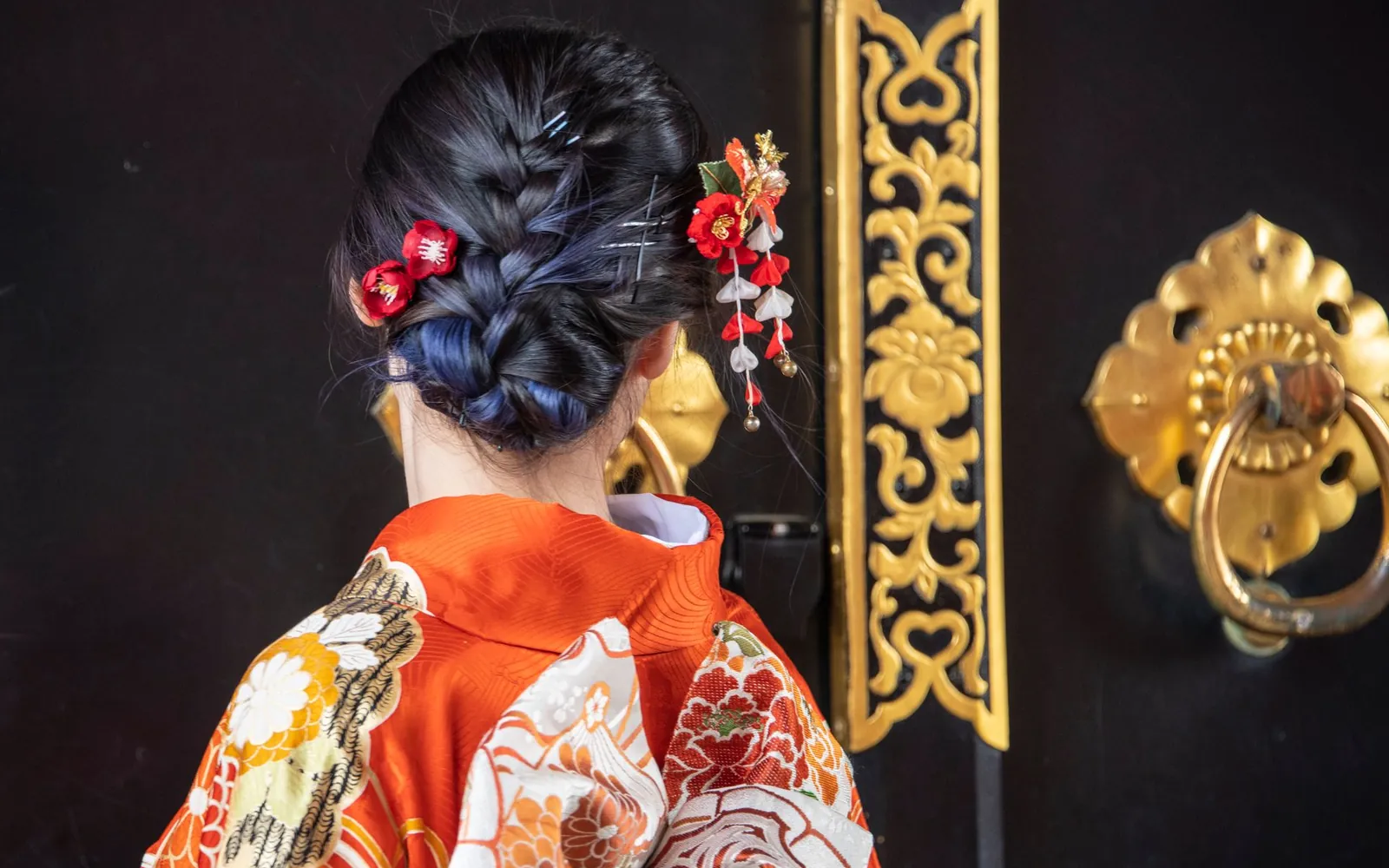
Back view of a traditional Japanese hairstyle with ornamental hairpins, above a patterned kimono

Imagine hair so long that washing it takes a full day, and help.

In Heian Japan, beautiful hair was not a style. It was a discipline, and it was measured in metres.

Hair longer than the woman wearing it

The Heian period, from 794 to 1185, set the ideal: court women wore their hair loose, straight and unbound, grown past their feet, in some accounts longer than the women were tall. Hair like that reorganised a life around itself. A full wash was an all day affair that needed attendants to lift, wash and dry the length in sections. Court waiting women were granted days off remembered as washing hair holidays, because drying hair of that length simply took that long. Hair was trimmed at the ends only. To cut it short was to announce a withdrawal from the world, the gesture of a woman entering religious life.

Between the great washes, care was daily and small: combing, smoothing, and combing again. That rhythm, rare deep cleanses and constant gentle attention, is the skeleton of Japanese hair care ever since.

Rice water

The cloudy water left over from rinsing rice was the Heian court's working rinse, combed through the hair to add moisture and keep it orderly between washes. Rice water carries starch and amino acids from the grain, and the practice has an unbroken pedigree: variants of it, including fermented rice water, circle the internet today as a discovery. In Japan it is not a trend. It is a habit older than most countries, and it survived because it suits the hair and the water it evolved with, a point this article comes back to.

Camellia oil

The gloss came from tsubaki, camellia oil, pressed from the seeds of Camellia japonica. It is a light oil that spreads thin and sinks in rather than sitting on the surface, which is why it could dress very long hair without weighing it into strings. Geisha used it to keep dressed hair sleek and shining. It is still at work in the sumo ring, where a wrestler's topknot is set with camellia based wax, and the island of Izu Oshima, covered in camellias, remains famous for the oil. Of all the traditional ingredients now exported in Japanese hair products, camellia is the one that travelled with its reputation intact.

The comb as an instrument

Grooming meant the tsuge comb, cut from dense boxwood and polished smooth by years of use and the oil it carried. A fine wooden comb does several jobs at once: it detangles without tearing, it draws oil from the roots along the length of the hair, it massages the scalp as it passes, and wood raises far less static than plastic, so the hair lies where it is put. In a culture of floor length hair, the comb was not an accessory. It was the main tool, used daily, where the bottle is used weekly.

Soap arrives, the philosophy stays

Western products arrived in force in the Meiji era, and the industry that grew from them kept the older logic. Shiseido opened in 1872 as a Western style pharmacy in Tokyo's Ginza district, a pharmacist's shop before it was a cosmetics house, and Japanese hair care has carried a pharmacist's respect for the scalp ever since: the scalp treated as skin, the wash treated as a procedure, cleansing thorough but never harsh. The modern head spa, in which the wash itself becomes a long, deliberate treatment of the scalp, is the Heian rhythm in modern dress, and it is now exported to salons around the world.

The soft water underneath it all

There is a material reason the tradition works. Japan's tap water is mostly soft: on this site's map, Toyama runs at 40 mg/L, Kyoto at 40, Osaka at 41 and Tokyo at 60. Gentle cleansers, light oils and infrequent deep washing are perfectly calibrated to water that leaves almost nothing behind. There is little mineral to remove, so nothing in the routine is built to remove it. Take the same routine to London, at 320 mg/L, and it feels underpowered within a fortnight, not because it is wrong but because it was tuned, over a thousand years, to different water. Traditions are technologies for local conditions. The planner's job is to translate them when the conditions change.

← Back to the Journal

Hair care trends around the world

Dry shampoo was born in a French pharmacy and bond building in a California garage. How the world's hair ideas travel, and what they leave behind at the border.

A spacious modern hair salon interior with styling chairs and mirrors

Scroll any feed and you will meet a hair ritual from the other side of the world, usually without the story of where it started.

Hair trends used to travel at the speed of a magazine. Now they travel at the speed of a feed. But they still start somewhere specific, and if you look at where each one began, you usually find a local problem it was solving: a climate, a hair type, or, very often, a water supply.

France: the pharmacy and the stretched wash

France's gift to the world's wash bags is restraint, sold through pharmacies. Its emblematic invention is dry shampoo: in 1971 Klorane, a botanical brand owned by the pharmacist Pierre Fabre, launched the first one, made for new mothers in hospital who could not wash their hair. The product of necessity became the product of style, the engine of the undone French look. It helps that Paris runs at 269 mg/L, hard water in which daily washing punishes hair with mineral build up. A national habit of stretching washes, and a pharmacy culture that treats hair care as near medicine, is rational chemistry wearing chic clothes.

Brazil: the smoothing boom, and its lesson

Brazil's keratin smoothing treatments, the escova progressiva at home, promised months of straight, weatherproof hair and swept the world's salons in the 2000s as the Brazilian blowout. Then came the correction. In 2011 the United States OSHA issued a hazard alert and the FDA sent a warning letter to the leading brand, after testing found that products marketed as formaldehyde free released formaldehyde when heated with a dryer or iron. Regulators in other countries acted too. Smoothing did not disappear; the chemistry got cleaner and the labelling more honest. The episode remains the industry's standing lesson in reading an ingredient list sceptically, including the absences.

The United States: natural hair, and the law follows

The natural hair movement that grew through the 2010s, wearing curls and coils as they grow and styling them in braids, twists and locs, ran into workplace and school dress codes that treated those styles as unprofessional. California answered with law: the CROWN Act, signed in July 2019, made it the first state to ban discrimination based on hair texture and protective hairstyles. New York followed within days, and other states have followed since. It is the rare hair trend that changed statutes as well as salons, and it reframed protective styling from a preference into a right.

East Asia: the scalp becomes skincare

Korea and Japan exported an organising idea: hair care starts at the skin it grows from. Multi step scalp routines, exfoliating scalp scrubs, serums dosed like facial skincare, and the Japanese head spa, the wash rebuilt as a treatment, all come from this school. The beauty industry calls the wider shift skinification, and you can see it on any shelf now: shampoos and scalp products sold by active ingredient, the way serums are. The aesthetic flagship is glass hair, the mirror flat, high shine finish popularised from Korean salons, which is less a product than a standard of surface: cuticle lying flat, light bouncing straight back.

Bond building: repair goes inside the strand

The most technical trend began in a Santa Barbara garage in 2014, where Olaplex launched with a single patented molecule designed to patch broken disulfide bonds, the strong links inside the hair shaft that bleach and heat snap. In late 2020 K18 arrived with a different mechanism, a peptide intended to reconnect broken keratin chains. Between them they moved the idea of repair from coating the surface of hair to working inside it, and every major brand now sells a bond product. Notably, both are answers to damage done by chemistry and heat rather than by water, which is why they pair with, rather than replace, the mineral side of care.

What travels, and what does not

Set the trends side by side and a pattern shows. Techniques travel beautifully: a head spa works in any city, a braid protects anywhere, a peptide does not care about geography. Conditions do not travel at all. The French stretched wash is liberation in Paris and slow frustration in a soft water city where hair needs the opposite. The products inside every exported routine were chosen, originally, for the water, climate and hair of the place that invented them. Copy the technique by all means. Then check the number on the map for where you actually are, and adjust the products to your own tap.

← Back to the Journal

Hard water and your hair: the minerals you never invited

That stubborn feeling after a wash might not be your shampoo’s fault. Meet the invisible minerals that can build up on your hair, one shower at a time, where they come from and what they actually do once they reach your hair.

A gloved hand scrubbing a shower head to remove limescale

That stubborn feeling after a wash might not be your shampoo’s fault. Meet the invisible minerals that can build up on your hair, one shower at a time.

Hard water is not a judgement about quality, and it has nothing to do with dirt. It is a measurement of two minerals, calcium and magnesium, that water collects honestly on its way from the sky to your tap. This is the science underneath everything else on this site, set out in one place.

Where hardness comes from

Rain falls soft. As it soaks through soil and rock it dissolves what it touches, and limestone, chalk and dolomite are generous: they load the water with calcium and magnesium compounds. Water that runs over granite or sand, or is collected before it travels far underground, picks up very little. Geology, not plumbing, sets most of a city's number. London's supply crosses chalk and limestone country and arrives at 320 mg/L. Cancún sits on a limestone aquifer and runs close to 700. Toyama, fed by snowmelt off the Japanese Alps, runs at 40. Cities can blend sources and treat water at the plant, which is why figures vary by district and season, but the rock has the first and last word.

How it is measured

The unit used on this site is milligrams per litre, expressed as calcium carbonate: mg/L as CaCO3. The United States also uses grains per gallon, at 17.1 mg/L to the grain. The bands used across this site, and in every plan the planner builds, are these: under 60 mg/L is soft, 60 to 119 is moderate, 120 to 180 is hard, and over 180 is very hard. They are worth learning as a traveller's scale, the way you learn what a temperature means in a new country. At 60 your home routine works anywhere. By the time the water passes 180, it has become an ingredient in your hair care whether you invited it or not.

Temporary and permanent hardness

Part of the load can be boiled away. Calcium bicarbonate, the main form in limestone country, breaks down with heat and deposits as solid carbonate: that is the fur inside a kettle, and the fraction it represents is called temporary hardness. The rest, mostly calcium and magnesium sulfates and chlorides, survives boiling unchanged: permanent hardness. Your kettle, in other words, is a hardness meter you already own. A kettle that furs in a fortnight is telling you the temporary fraction of your water's story, and a shower in the same house is writing the rest of it on your hair.

What the minerals do in the wash

Three things, in the order you meet them. First, they fight the cleanser. Soap reacts with calcium to make soap scum, an insoluble salt that coats whatever it touches; that reaction is why soap performed so badly for so long in hard water cities, and why synthetic detergents, which resist it, were a revolution. Even with detergents, minerals blunt lather and consume cleansing power, so you reach for more product to get less clean. Second, they deposit. Wash after wash, calcium and magnesium salts settle onto the hair shaft and build a mineral film: hair turns rough, dull and tangly, and conditioner applied over the film conditions the minerals instead of the hair. Third, they carry colour problems with them. Where water also picks up copper or iron, from wells or ageing pipes, those metals oxidise on hair: copper pushes fair hair green, iron pushes it brassy and orange.

Why hair minds more than skin does

Skin renews itself and sheds its evidence. Hair cannot. A strand is dead keratin, armoured in overlapping cuticle scales and carrying a slight negative charge, and mineral particles lodge at the lifted edges of those scales and stay. The film roughens the surface, friction between strands rises, and the hair tangles, snags and breaks at the points of most friction. The ends of long hair show it first and worst, for a simple reason: they are the oldest hair on your head and have survived the most washes. Hard water damage is cumulative bookkeeping, and the ends hold the longest ledger.

Removing it: chelation

You cannot rinse minerals off with more of the water that deposited them. What removes them is chelation (washing the minerals out, like a detox): ingredients such as EDTA, phytic acid and citric acid whose molecules bind metal ions and hold them dissolved, so they rinse away instead of resettling. That binding step is the entire difference between a clarifying shampoo, which strips oils and product build up, and a chelating shampoo, which takes the minerals too. At home, the genuine fix is an ion exchange softener, which swaps calcium and magnesium for sodium before the water reaches the tap. Carbon filters, whatever their boxes promise, do not remove hardness: dissolved minerals pass straight through them. A filter can take chlorine out of your shower, which is worth having. It cannot soften it.

Reading your own water

The field signs are easy once you know them: a furring kettle, a scum line that survives the bath being cleaned, soap and shampoo that will not lather, spotted glassware, hair that feels coated by day three of a trip. Then get the number. Every city on this site's map carries its figure and its source, and the planner turns the band into a short list of decisions: how often to chelate, how rich a conditioner to pack, when to leave both at home. Hard water is not a mystery and not a misfortune. It is a measurement, and like most measurements, it is only a problem when nobody has taken it.

← Back to the Journal

Chlorine, salt water and your hair: a swimmer's guide

The green tint is not the chlorine. What pool water and sea water each do to hair, and the rinse first habit that prevents most of it.

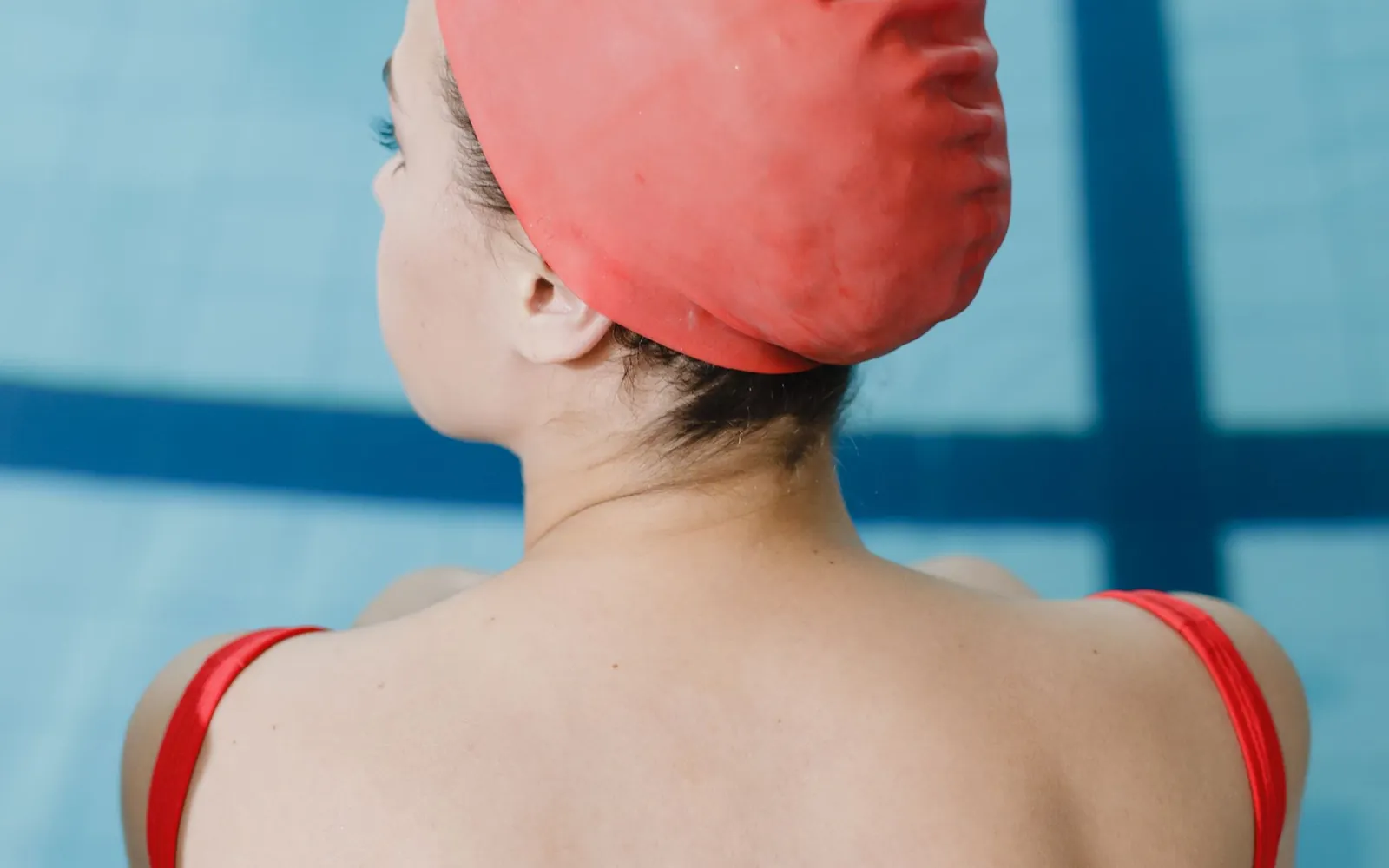
Back view of a swimmer in a red swim cap sitting at the edge of a pool

The holiday hair in the photos rarely matches the hair that comes home.

Most of the hair damage people bring home from a holiday was not done by the tap. It was done by the other two waters of a trip, the pool and the sea, working on hair for hours at a time while its owner was thinking about lunch. The good news is that the two waters damage hair in different, well understood ways, and most of both is preventable with one habit.

The pool: an oxidiser at work

Pool chlorine is held deliberately low, typically between 1 and 3 parts per million, enough to keep the water sanitary. But chlorine is an oxidising agent, and hair is one of the things it oxidises. It strips the sebum that waterproofs the strand, attacks the keratin the strand is built from and fades colour pigments, salon colour first. One swim does little. A holiday's worth of daily swims, in and out of the sun between them, is a slow bleach bath: hair comes home dry, porous, tangly and lighter than it left, and porous hair then absorbs everything faster, including the next swim.

The green tint is copper

The famous green cast on fair hair after a pool week is not chlorine, and treating it as chlorine sends people to the wrong remedy. The colour is copper: from algaecide treatments dosed into pools and from corroding copper plumbing, oxidised by the chlorine and bound onto the hair, where porous and bleached strands take it up most eagerly. Chlorine's role is accomplice: it oxidises the copper and roughens the hair so the copper sticks. This is why purple shampoo disappoints. It lays a compensating tint over the surface while the metal stays in the hair. A chelating wash (a detox wash) is the actual fix, because chelating ingredients bind copper ions and carry them out, the same binding chemistry that removes hard water minerals from hair in a London shower.

The sea: salt, crystals and sun

Sea water is about 3.5 per cent salt, and salt is hygroscopic and drying: it draws water out of the strand, and as hair dries between swims, salt crystals form on and in it, roughening the cuticle and setting the tangle. Wet hair full of salt then meets the day's other two agents, ultraviolet light, which degrades keratin and colour, and wind, which works the roughened strands against each other. None of this argues against swimming. It argues that sea hair is a managed condition, not an accident, and that the management is cheap.

Before you get in: the rinse first rule

Hair takes up water like a sponge, and a sponge that is already full takes up very little more. So the single most useful act in this entire guide costs nothing: before you swim, soak your hair thoroughly with clean tap water. A strand saturated with fresh water absorbs a fraction of the pool or sea water a dry strand would. Work a little leave in conditioner through it as a barrier layer, braid long hair or put it up so the lengths are not trailing and tangling, and if you swim seriously or daily, wear a cap: unfashionable, unbeatable. Every later step in this guide is a partial repair of damage this one step prevents.

After: rinse, wash gently, chelate occasionally

Rinse with fresh water as soon as you leave the pool or the beach, even if a full wash has to wait. At the end of a swimming day, wash gently: a mild shampoo aimed at the scalp, a proper conditioner on the lengths. Shampooing harder does not remove chlorine damage and adds its own. Then, the rhythm that ties this guide back to the rest of this site: after a heavy swimming week, or whenever fair hair starts to show a cast, use one chelating wash. It clears copper, mineral load and pool residue in a single pass, and it is the same product a hard water traveller already has in the bag.

When the tap joins in

The two exposures compound in hard water destinations. A swimmer in Cancún, where the tap water runs close to 700 mg/L, some of the hardest in this site's dataset, is laying pool chemistry over mineral film every single day, and the rinse first habit plus one mid week chelating wash stops being a refinement and becomes the plan. The planner treats swimming the same way: tell it your destination and it weighs the water from the tap and the water you will be swimming in together, which is how your hair experiences them anyway.

← Back to the Journal

Traditional Indian hair care: oiling, herbs and the head massage

The original shampoo was an Indian head massage. The oiling ritual, the washing herbs and the Ayurvedic logic that modern hair care keeps coming back to.

Hands working hair oil through the ends of long hair

In millions of homes, wash day still starts the night before, with oil and unhurried hands.

The word shampoo is Indian, and so is the thing it first named. Not a bottle, and not even a wash: a head massage, done slowly, with warm oil, by somebody who had time. Traditional Indian hair care is built around that act, and its logic, oil first, wash second, length protected always, is the oldest complete hair system on this site.

The ritual: oil, massage, then wash

Ayurveda, India's traditional system of medicine, treats the head as a site of care in its own right. The practice is unhurried: oil warmed and worked into the scalp with the fingertips, massaged in, left to sit for an hour or overnight, and only then washed out. The massage has its own name, champi, and the name travelled. When Sake Dean Mahomed opened his baths in Brighton in 1814, the shampooing he sold to kings was this massage, and the washing that came with it was the incidental part. In Indian households the order has never reversed: the oil is the treatment, and the wash exists to serve it.

Why the oil works

The classic oils are regional: coconut in the south, sesame and mustard further north, often infused with herbs and kept in the family like a recipe. Coconut oil is the one modern laboratories have put to the test, and it passed in an interesting way. In a comparison published in the Journal of Cosmetic Science, coconut oil reduced the protein lost from hair during washing, where mineral oil and sunflower oil did not, because its main fatty acid is small and straight enough to penetrate into the hair shaft rather than only coating it. Washing hair is a small act of erosion: some protein leaves with the water every time. An oil inside the strand before the wash measurably reduces the toll. The tradition, it turns out, was a delivery mechanism.

The washing herbs

Before bottled shampoo, the wash itself was botanical, and the botany was precise. Shikakai, the pods of Acacia concinna, contain saponins, natural soap like compounds that lift oil gently without stripping; an Ayurvedic name for the plant is bahuphena, which means very foam making, a compliment paid by people who measured a cleanser by its lather centuries before advertising did. Reetha, the soapnut, is richer in saponins still and makes a true lather in warm water. Amla, the Indian gooseberry, rich in vitamin C, goes into washes and oils for strength and shine. Bhringraj and brahmi are infused into scalp oils. Neem is the scalp herb, reached for where itch and flaking are the complaint. Henna does double duty: its dye molecule, lawsone, binds directly to keratin, so it colours the strand red orange while coating and thickening it.

Traditional does not mean inert, and the tradition itself knows it. Shikakai in the eyes stings memorably, as generations of children washed with it can testify. Henna is a commitment: its bond with keratin makes later chemical colour unpredictable. These are active preparations with rules, which is exactly what a mature tradition looks like.

Hair kept, not cut

The system's final principle is conservation. Hair is worn long and kept: braided for school and work, oiled at the ends, combed with wide combs, put up rather than left to weather. A braid is protective styling long before the term existed, holding the lengths together, sparing the ends friction and sun, and reducing the tangles that cost hair at every combing. Everything in the routine points the same way: grow it, keep it, and let the care be frequent and gentle rather than rare and drastic.

The tradition now, and its water

Western hair care has quietly adopted the sequence whole: pre wash oiling is now a named step in routines that had never heard of champi, scalp massage tools sell in every beauty shop, and amla and brahmi appear on exported labels worldwide. One calibration is worth adding, and it is this site's home ground. India's own water varies enormously: on our map Mumbai is soft at 46 mg/L while Delhi runs to 120, at the edge of hard. Where the water is harder, the oiling matters more, because the wash waiting at the end of the ritual is working against minerals as well as oil. A tradition is always, quietly, an adaptation to the water it grew up beside. Read yours before you borrow one.

← Back to the Journal

The brand that will not sell you shampoo

Milbon supplies more Japanese salons than any other hair care company, and it refuses to sell you a bottle online. Inside the synchrotron science, the soft water logic, and the two different Milbons: the one Japan keeps at home, and the one it sends to the world.

Back view of a client's hair held in red sectioning clips in a salon

There is a shampoo you will see in Tokyo salon windows, in ski town salons in Hokkaido, and on the back bars of good salons from Osaka to Sapporo, that the manufacturer will not sell you. Not online, not by phone, not in a department store. If you find it on a marketplace site, the company's own position is that the quality is not guaranteed, because the bottle was never meant to travel that way.

The company is Milbon, and the refusal is the business model. Everything it makes is sold to hair salons, and only to hair salons, on the theory that a professional should stand between the product and your head.

Built for hairdressers since 1960

Milbon began in Osaka in 1960, founded as Yutaka Beauty Chemicals and renamed Milbon in 1965, selling to Japan's hairdressers from the start. It never built a consumer business on the side, and it shows no interest in starting one now. By the company's own account it is the leader in Japan's salon hair cosmetics market, and it counts more than 40,000 salons carrying its products worldwide.

That scale buys a certain kind of science. Milbon studies hair the way a materials institute would, and its best known discovery came from imaging damaged hair at SPring-8, the enormous synchrotron facility in Hyogo prefecture, where researchers found stick shaped voids running inside damaged strands, hollow channels where the hair's inner structure had fallen away. The finding shaped a generation of its formulas, built around filling those voids rather than coating over them, and the research programme behind it has examined hair gathered from more than twenty countries.

Two Milbons

Here is the part that matters to a traveller. The Milbon on a Japanese salon shelf is mostly not the Milbon you will find in London or Los Angeles.

Japan gets its own brand family. At the top sits Aujua, launched in 2010, a premium range developed from research into Japanese hair and the demands of Japan's sharply different seasons, humidity, dry winters and all. It is built as a salon ritual first and a take home shelf second, with multi step in salon treatments matched to the products you are sent home with. Around it sit other domestic lines that most visitors never learn the names of, because they rarely leave the country.

The rest of the world gets Global Milbon, the lowercase "milbon" brand launched in 2016, developed from analysing hair characteristics across twenty countries and designed to work on the full global mix of hair types and waters. And in 2019 the company ran the experiment in reverse: Sophistone, a colour brand developed exclusively for salons outside Japan, the first Milbon brand built only for export. The traffic runs both ways at the edges now, and Global Milbon is sold in Japanese salons too, but the centre of gravity holds. One company, two catalogues, divided by what it learned about hair and water at home and abroad.

Why Japan can formulate this gently

The split makes sense once you know the water. Japan's tap water is mostly soft, and on this site's map the pattern is striking: Nozawa Onsen at 18 mg/L, Hakuba at 30, Toyama at 40, Tokyo at 60. Water like that leaves almost nothing behind on hair, so Japanese formulas never had to learn to strip mineral out. They could concentrate on delicacy instead, on fine textures, thorough but gentle cleansing, and the scalp treated as skin.

Take that delicacy to Paris at 269 mg/L or London at 320 and it feels underpowered within weeks, not because it is badly made but because it was tuned for water that asks very little of it. Milbon's answer was not to sell the Japanese products harder abroad. It was to build a second brand for the rest of the world's conditions, which is more or less the most honest response a hair company has ever given to a map of water hardness.

What to do with this on a trip

Treat the Japanese salon visit as the experience. If you are passing through Tokyo, Osaka or a ski town with a good salon, book the treatment itself, a head spa or an Aujua treatment, and let the stylist read your hair. That consultation is the part worth travelling for: the ritual, the diagnosis, the unhurried care. The domestic lines on the shelf beside you are salon only in Japan, made for Japanese water and Japanese hair, and they largely stay that way.

And check the water before you judge the products. Japan's softness is the exception in the world, not the rule, which is rather the point of everything on this site.

Facts checked against Milbon's corporate history and global pages, its FY2026 results presentation, Milbon USA's FAQ and purchasing policy, and this site's own water dataset, 18 October 2026. Salon count and market leadership are the company's own figures and are worded as such in the text.

← Back to the Journal

Hair and the weather: planning around humidity, heat and temperature swings

The water gets the blame, but the air does half the work. What humidity, dry heat and a twenty degree day to night swing actually do to hair, and how to pack for a day that cannot make up its mind.

Back view of a woman facing a bank of dark storm clouds

Ask a room of travellers what ruins their hair on a trip and most will blame the water. They are half right. The other half is the air: the humidity that swells hair by lunchtime, the dry heat that pulls the moisture out of it, and the swing between a hot afternoon and a cold night that asks one head of hair to live in two climates on the same day. Anyone who plans a trip around a weather app already knows this in their bones. Hair does too.

Humidity: hair drinks the air

Hair is hygroscopic, which is a laboratory word for something everyone has felt in a mirror: it absorbs water vapour from the air around it. On a humid day that vapour moves into the strand, and as it does, the hydrogen bonds that hold your style in place are broken and re-formed in the shape the hair wants to fall, not the shape you set. The strand swells, the cuticle, the flat overlapping scales on its surface, lifts instead of lying smooth, and lifted cuticles catch light badly and rub against each other. That is frizz, described mechanically: swollen strands, raised scales, a style quietly renegotiated by the weather.

The numbers explain why some cities feel like a different planet. In Singapore, the typical day runs 29 to 30 degrees with humidity around 85 per cent, in every month of the year. There is no dry season to plan around and no swing to exploit: the air is saturated, all the time. The honest kit for that climate is a light conditioner kept off the roots and an anti humidity leave-in worn daily, a barrier layer that slows the vapour getting in. Heavy masks melt out by midday. Gentle washing and patience do the rest.

Dry air: the pull in the other direction

Dry air runs the same physics in reverse. When the air holds little moisture, the gradient pulls water out of the strand, and hair that loses water loses flexibility first: ends feel brittle, lengths feel rough, and the scalp can feel tight and thirsty. Then there is static. In dry air, the electrical charge hair picks up from brushing and friction has nowhere to dissipate, so strands repel each other and stand off the head. Anyone who has taken a hat off in a heated room in January and watched their hair follow it knows the effect.

Indoor heating makes winter a double exposure: cold, dry air outside, then warm, even drier air inside, all day. It is why the planner on this site marks cold months as a season of its own and answers them with richer conditioning, a mask once a week and a leave-in kept in rotation. The water in a cold city may be unremarkable. The air is the story.

Swings: two climates before dinner

The third pattern is the one visitors plan for least. In desert and high valley climates the temperature does not drift between day and night, it jumps. Sacramento in July typically runs 37 degrees by day and 17 at night, a twenty degree swing. Marrakech in July runs 39 by day and 21 at night, with humidity down at 39 per cent. Aspen, up in the Colorado mountains, swings eighteen degrees on a July day, 26 down to 8, because thin mountain air holds the day's heat poorly.

For hair, a swing day is two climates in one outfit. The warm half is dry and demanding: moisture leaves the strand, sun adds UV on top, and hair feels parched by afternoon. The cool half flips the problem: as the air cools it holds less moisture, static builds, and hair styled for the heat goes flat or flyaway by evening. A heavy routine chosen for the night smothers hair at noon; a light routine chosen for noon deserts it by dinner. One product regime rarely fits the whole day, which is why swing climates reward the layer you can reapply, the leave-in, more than any single heroic wash.

Planning like the weather app generation

None of this needs a forecast to be useful. Forecasts answer the wrong question for packing: you do not need next Tuesday's exact temperature, you need the shape of the month you are travelling in. Is the air wet or dry? Does the day swing? Is the season the harsh one or the kind one? Those are climate questions, and they are stable enough to plan a wash bag around weeks ahead.

That is the bet behind this site's season calendar. Every city in the dataset now carries its typical month by month temperatures and humidity, drawn from recent climate records, so a plan can weigh the air alongside the water: humidity shown next to the anti humidity advice it justifies, the swing in degrees printed rather than implied, dry and heated months answered with moisture before the static starts. The weather made your hair's day harder long before the shower did. It deserves a line in the plan.

Climate figures are monthly typical values for each city from this site's dataset, computed from Open-Meteo ERA5 records, 2015 to 2024: Sacramento and Marrakech July, Singapore year round, Aspen July. They are planning figures, not forecasts.

← Back to the Journal

Professional or supermarket shampoo: what the extra money actually buys

A salon bottle can cost five times a supermarket one. Some of that buys real tuning, a lower pH and narrower formulas. Much of it buys fragrance, packaging and distribution. Here is how to tell the difference.

A stylist washing a client's hair at a salon backwash basin

The question usually arrives at a shelf. In one hand, a supermarket shampoo for the price of a coffee. In the other, a salon bottle at four or five times the price, in a smaller size. Both promise shine and softer hair. So what does the extra money actually buy, and what does it not buy? The honest answer is less dramatic than either side tends to make it.

Professional ranges are more likely to be carefully tuned: a gentler balance of cleansers, a lower pH in many cases, and a formula aimed at a narrower problem, such as colour treated or very dry hair. Consumer ranges have to please almost everyone at a supermarket price. But the overlap is large, and part of the salon price is fragrance, packaging and the salon channel itself.

The same basic job, done the same basic way

Every shampoo, at every price, does the same job with the same toolkit. A typical formula contains about 10 to 30 ingredients: cleansers, conditioning agents, and stabilising additives. The main cleansers are almost always anionic surfactants, most commonly sodium laureth sulphate. Used alone, that class is strong, and it leaves hair carrying more negative charge, which means more friction and frizz.

Formulators soften that effect by blending. An amphoteric co-surfactant such as cocamidopropyl betaine, used alongside the main cleanser, lowers the charge density of the cleansing system and reduces its irritation potential in laboratory tests. Nonionic cleansers play a similar role. None of this is exclusive to salons. You will find the same blend, in different proportions, on supermarket shelves. The difference lies in the proportions and the balancing.

The clearest measured difference: pH

pH is where a measured gap does appear. Hair and scalp sit on the acidic side, and more alkaline washing raises the negative charge on the fibre, increasing friction. A study of 123 shampoos in the International Journal of Trichology included just 15 professional products, so treat it with care, but 75 percent of those salon products tested at pH 5.5 or below, compared with about 34 percent of popular brands. Lower pH shampoos caused less frizz.

Two cautions follow. First, pH is rarely printed on the bottle in either channel, so you cannot shop by it directly. Second, sulphate free is not a guarantee of gentleness. The dermatology literature has noted a lack of published analyses proving that sulphate free shampoos clean better or damage hair less.

Where professional ranges go further

Professional ranges earn their keep at the specific end of the shelf. A salon line can support a shampoo for bleached hair, another for a sensitive scalp and a third for hard water, because a stylist is there to match them. Conditioners follow the same logic. Their key agents are positively charged compounds that deposit on damaged, negatively charged hair, reducing friction and static. A well matched conditioner often matters more than the shampoo.

That specialisation includes chelating and detox lines, and the wording needs care. A chelating shampoo (a detox wash for minerals) contains agents such as EDTA that bind metal ions, including the calcium and magnesium in hard water. A detox or clarifying shampoo is usually just a stronger cleanser for oil and build-up. Only the first job removes minerals. A trace of EDTA low on a label may simply stabilise the formula, so look for a product sold for hard water.

What is mostly marketing

Start with the ingredient list. Ingredients are listed in descending order down to 1 percent. Below that they can appear in any order, and brands need not publish percentages. Claims about higher concentrations therefore usually cannot be checked from the bottle, and a fashionable oil near the end of the list may be present at well under 1 percent. Price is weak evidence too. The same groups often own both tiers, sharing research and similar base ingredients.

Price per wash is the fairer comparison, and it cuts both ways. A concentrated product, used sparingly, can cost less per wash than its shelf price suggests. A large, cheap bottle, squeezed generously, can cost more than it looks. Do the simple maths: price divided by the number of washes you get from the bottle. No independent evidence settles the claim that salon bottles routinely last twice as long.

Salon only distribution is real, but it is a business model before it is a quality mark. Brands such as Milbon, covered elsewhere in this Journal, sell only through salons, and other groups state that professional products are guaranteed only in authorised salons. That model can bring good advice when you buy. It does not, by itself, prove what is inside the bottle.

What this means in hard water, and at home

For a traveller washing in hard water, spend on function, not on the label. A chelating wash that actually binds minerals will do more for rough, dull, hard to comb hair than a luxury shampoo with no chelating action. That is the one professional style product worth packing on purpose. Between chelating washes, a gentle, well balanced everyday shampoo is enough, from either shelf, provided it suits your scalp.

At home, the case for paying more is weaker still. For gentle daily washing, for short hair, and for homes with soft water, a good consumer shampoo and a matched conditioner will usually do the job well. Save the extra money for cases where it buys something specific: a targeted formula your hair responds to, or that chelating wash for hard water stops. The rest is presentation.

← Back to the Journal

The pillowcase question: does your hair care what you sleep on?

Silk promises less frizz and fewer tangles, but the clinical evidence for hair is thin. We look at what friction and moisture tests actually show, who is most likely to notice, and why a pillowcase is a useful travel extra, not a transformation.

A woman asleep with her curly hair spread across a pillow

You have probably heard the pitch. Swap cotton for silk, the ads say, and you will wake up with calmer hair, fewer tangles and less frizz. It contains a real idea. It is also sold far harder than the evidence can support.

Our short answer: a smoother pillowcase really does create less drag overnight, and that matters more for some hair than for other hair. It will not transform your hair, repair damage already there, or outweigh the water you wash it in and the climate around you.

Why friction is the strongest part of the claim

Hair does not heal once it leaves the scalp. Its outer layer, the cuticle, wears from washing, brushing, heat and colour, and friction at night is one more small source of wear. As you turn, hair catches and rubs against the fabric under your head. A rougher surface gives it more to catch on. A smoother one lets it slide.

This is measurable in a textile laboratory, even if numbers vary by method. In one peer reviewed study of fabric against skin, silk and polyester satin recorded lower surface friction than woven cotton, and cotton took up water in seconds while silk and satin took far longer. That does not prove better hair in the morning. It does show the mechanism is real physics, not invention.

Whether less drag becomes visibly less breakage over months is another question, and there the evidence thins out. We could not find a large, well controlled clinical trial that followed people on silk and cotton and measured breakage properly. Much quoted research is small, self reported, funded by bedding sellers, or about skin rather than hair. The American Academy of Dermatology says satin or silk bonnets and pillowcases may reduce friction and help preserve a hairstyle. May is the right word.

The moisture story is messier than the ads say

Cotton is often described as drinking moisture from hair while silk leaves it alone. The real picture is less neat. In standard textile tables, silk holds a little more moisture vapour at equilibrium than cotton, around 11 percent of its dry weight compared with about 8.5 percent for cotton. Polyester holds almost none, around 0.4 percent.

What feels different is speed and surface. Cotton fibres swell and take up liquid quickly, and a cotton case can feel as if it is pulling in leave in conditioner, oils and sweat. Silk takes up liquid more slowly and feels smoother, even though it is not waterproof. The honest version is narrower: cotton may take up products and surface moisture faster. It is not draining hair dry in any cleanly measured way.

Satin is a weave, not a fibre

Silk is a fibre, the natural protein thread made by silkworms. Satin is not a fibre at all. It is a weave, a way of floating threads over others so the face of the fabric comes out smooth and glossy.

Most pillowcases sold simply as satin are polyester satin. That is not a scam: smoothness is what most people are buying, and polyester satin gives you much of it for far less money. It does behave differently: it tends to sleep warmer, can build static in dry air, and quality varies widely. A case sold as silk should say so in the fibre content, ideally with a momme weight, a measure of silk fabric weight. If the label only says satin or silky, assume polyester.

Who is most likely to notice, and what it costs

Those most likely to notice are people whose hair has the least margin for extra wear: curly and kinky coily hair, prone to dryness and breakage, and fragile, bleached or otherwise treated hair. Add longer hair with older ends, and anyone who wakes up fighting morning frizz and tangles. If your hair is short, untreated and rarely tangled, or you already sleep in a smooth bonnet, the difference is likely to be small.

Cost and care pull in opposite directions. Real silk costs real money and asks for gentle handling: a cool, delicate wash, ideally in a mesh bag, and air drying away from heat. Treated roughly, it dulls and weakens. Polyester satin is cheap and usually goes through a normal wash with little fuss. The trade is warmth, static for some, and a surface that can pill sooner.

The verdict, at home and on the road

For travel, this is one of the few hair tips that genuinely packs well. A silk pillowcase folds flat, weighs almost nothing and slips over a hotel pillow in seconds. A thin pillow liner does the same job in even less space. Against rough hotel cotton, that smooth layer can make the next morning easier.

Keep it in proportion. On most trips a bad hair day has far more to do with hard water, humidity or dry air, sun and wind than with what you slept on. A pillowcase will not rescue hair that the water has left rough. We would spend attention on water first, every time.

So, should you try one? If your hair is curly, fragile or frizz prone and mornings are a battle, yes, as a small experiment. Start with inexpensive polyester satin if price or laundry matters. Move to silk if you prefer a natural fibre or sleep warm, and will wash it gently. Judge it after a few weeks by tangles and ease, not by promises. A small, real, cheap to test difference for some hair types, not a transformation. That, honestly, is enough.

← Back to the Journal

Hats, beanies and caps: keeping your hair great under cover

Hats protect your scalp and hair from sun, wind and cold, but friction, sweat and static can undo a style. A smooth lining, a loose fit and the right hat for the trip make all the difference.

Back view of a woman in a wide straw hat relaxing on a beach

A good hat does two jobs. It protects you from sun, wind and cold, and it sits on the hair and scalp you are trying to look after. That second job is easy to forget until you take a beanie off in a warm room and find flat roots, flyaways and a sore hairline.

That is no reason to stop wearing hats. Dermatologists recommend them, especially for sun protection. It is a reason to choose fabric, fit and lining with care.

Friction, sweat and hat hair

Most hat problems start with rubbing. Each time a hat goes on, comes off or shifts, its band and crown drag across the hairline, temples and nape. Those edges are delicate, and repeated friction can snap weakened strands there. It builds slowly, so it often shows as short, uneven hairs around the edge.

Under a close hat, the scalp gets warm and damp. Sweat and oils have nowhere to go, so they sit on the skin with product and shed skin cells. For most people that means hair feels less fresh by evening. If you are prone to itching or flaking, a warm, occlusive cover worn for hours can feel more uncomfortable, especially if the hat is rarely washed.

Then there is hat hair. A hat presses hair flat in the shape of its crown, so root volume goes first. Static is the other half. Dry hair rubbing against a hat picks up the same charge on each strand, and strands push apart. Drier air lets that charge linger, which is why lift off is worst in winter.

Why the lining matters

What touches your hair matters more than the outside looks like. Silk and satin linings are popular for a practical reason: they are smooth, so hair glides against them instead of catching. That means less drag at the hairline and nape, and usually less frizz to undo. A sewn in lining is simpler than a scarf underneath, though a scarf can do a similar job.

Rough wool against hair all day is the harder case. Its fibres are textured, it creates more friction, and it is worn for long stretches in dry conditions that make hair brittle. Cotton sits in between: it absorbs sweat and moisture, which can feel comfortable, but it is not a low friction surface like silk or satin. For fine, fragile or kinky coily hair prone to dryness, the lining matters more, not less.

Sun protection for scalp and hair

This is where a hat earns its keep. The scalp and parting are exposed skin, easy to miss with sunscreen. The American Academy of Dermatology recommends sun protective clothing including a wide brimmed hat, alongside shade and sunscreen on uncovered skin. That matters because skin cancers do occur on the scalp, often hidden by hair and found late.

Coverage and fabric decide how much protection you get. A wide brim shades face, ears and neck as well as the crown. A cap leaves ears and neck exposed. Look for a UPF rating, the clothing equivalent of SPF. The Skin Cancer Foundation notes that UPF 50 fabric blocks about 98 percent of UV rays. A loose weave you can see light through will not do the same job.

Hair itself is damaged by UV too. Studies of irradiated hair show colour change in all hair types, more pronounced in lighter hair, and a substantial increase in protein loss. In everyday terms that is faded colour, dryness and rougher feeling hair. The need grows with height: as we note across this site, UV rises by about 11 percent for every 1,000 metres of altitude.

Winter beanies, cold air and static

In winter the balance flips. A beanie shields hair and scalp from cold wind, which can leave exposed hair dry and tangled. The trade off arrives indoors. Wool and many synthetic knits build static as they rub, heated indoor air is very dry, and the charge has nowhere to go. You pull the beanie off and strands lift and cling, while roots held flat for hours can look lank even when lengths feel dry. A lined beanie, a looser knit and well conditioned hair reduce that contrast.

Wearing them well, and what to pack

Fit is the simplest fix. A hat should stay on without gripping. If it leaves a deep mark or sore edges, it is too tight, and worn that way daily it can stress the hairline. That is different from the worry that hats cause baldness. Ordinary, comfortable wearing is not established as a cause of pattern hair loss, and twin studies reviewed by the Cleveland Clinic found no worsening of thinning in hat wearers. Sustained tension over years, known as traction, is real, but it comes from very tight coverings, not a normal cap or beanie.

A few habits help. Put a hat on once and leave it, rather than pulling it on and off, and smooth hair in the direction it naturally lies before covering it. A slightly loose fit preserves volume better. Wash hats per the care label, rotate two or three if you wear one daily, and let each dry fully between wears.

For travel, pack for the job. For a sun trip, take a packable wide brim hat with a stated UPF rating, or a lined cap if space is tight, and use sunscreen for ears, neck and any parting the hat misses. For a ski trip, take a lined beanie that does not grip, and plan the small reset after skiing that our altitude guide covers.

← Back to the Journal

Salt water and sunshine: what a beach holiday actually does to your hair

The waves and lighter streaks are the visible part of a beach week. Underneath, sunlight is breaking down hair protein and pigment while salt roughens every strand. What the sun does to hair, why the beach concentrates it, and the routine that keeps the look without the damage.

A woman sunbathing on a yellow towel on the sand, her long hair blowing in the sea breeze, with the sea behind her

Beach hair has excellent publicity. A week by the sea and hair looks thicker, wavier, a shade lighter, and the photographs are wonderful. What the photographs do not show is the invoice, which arrives a fortnight later, when the ends start snapping and the colour has drifted somewhere nobody chose.

Our swimmer's guide covers what the water itself does: chlorine, copper and salt. This piece is about the other half of a beach holiday, the sunshine, and about the holiday pattern itself. Sunlight is the largest single source of hair damage on a beach trip, and unlike sea water, it cannot be rinsed off.

What ultraviolet light does to a strand

Hair is dead keratin. Skin renews itself after a burn; a strand cannot, so every hour of sun it collects stays in it until the hair is cut off. Ultraviolet light spends that time on two targets, the protein the strand is built from and the pigment that colours it. In irradiation studies, every hair type tested lost substantially more protein after sunlight and UV exposure, with UVB doing the protein damage at roughly two to five times the rate of UVA. Colour changed in every type too, driven mainly by UVA, and most in lighter hair.

The pigment, melanin, is the strand's own sunscreen, and it is consumed doing its job: it absorbs ultraviolet light and breaks down in the process, which is precisely why sun lightens hair. Dark hair carries more of it and spends it slowly. Light, fine and grey hair has less in store; bleached and colour treated hair, pigment and cuticle already stripped, fades and roughens fastest. The sun kissed highlights are real enough. They are also the visible receipt for pigment and protein that have left the hair.

Why the beach concentrates it

Damage is dose: strength multiplied by hours. A beach holiday maximises both. The days are spent outdoors, either side of the midday peak, and the setting adds to the sky's contribution. Sand reflects roughly 15 to 25 percent of ultraviolet light back upwards, so shade under an umbrella helps without finishing the job: reflected and scattered light still arrives. Nor is the water shelter. In clear tropical water, UV stays strong a metre or more below the surface, so swimmers are exposed through the brightest hours too.

The wet and dry cycle adds its own wear. Water swells a strand, sun and wind dry it, and a beach week repeats that daily. Hair is weaker while wet, and wind works the roughened strands against each other. A beach week simply asks more of hair than the same week at home, so the care has to be planned, not improvised.

The salt, in its proper place

Salt water plays the supporting role here; our swimmer's guide gives it the full treatment. One part of the popular account is true. Salt coated strands grip each other, waves hold, and fine hair looks fuller: a styling effect, the feel of a roughened surface, and genuinely enjoyable. What does not follow is that the sea is feeding your hair. The studies quoted for mineral rich water were about skin, not hair, and no study we could find shows sea water improving hair's condition. Enjoy the texture. Rinse it out at the end of the day.

Hair SPF, oils and other promises

SPF is a skin measurement, defined by a standard laboratory test on skin. For hair there is no equivalent standard test, so a number on a hair product is not measured the way sunscreen SPF is, and the two are not comparable. Leave in products with UV filters are not useless: they coat the strand and can slow colour fade, the most defensible claim in this category. But the coating is uneven, and a swim and a towel take much of it off. Treat them as a supporting layer under a hat, not as the plan.

Oils need the same sorting. Coconut oil has real evidence behind it, but for a different job: as a pre wash treatment it reduced protein loss in classic laboratory comparisons, because it penetrates the strand and limits swelling in water. As sun protection it does not hold up. The widely repeated natural SPF of around 7 comes from a single in vitro method that later studies have not reproduced; vegetable oils absorb very little UVB. Use oil for conditioning if you like it. For protection, remember that your scalp is skin, and burns like skin: it needs real sunscreen on the parting, or a hat over it.

The routine that works on a beach week

Before the beach: wet your hair thoroughly with clean water before swimming, work a little leave in conditioner through it, and put long hair up or in a braid, the rinse first habit our swimmer's guide explains. Out of the water, the first line is a hat, wide brimmed with a stated UPF rating if you can, as our guide to hats, beanies and caps sets out. Shade at midday does more than any product on the shelf.

Afterwards: rinse with fresh water as soon as you can, and at the end of the day wash gently: shampoo at the scalp, conditioner through the lengths, detangle wet hair slowly with a wide toothed comb. Two or three evenings in the week, give the lengths a richer conditioning treatment. If your destination's tap water is hard, one chelating wash (a detox wash) at the end of the week clears the combined load of minerals, salt and pool residue in a single pass.

What to pack

Bring: a packable wide brim hat, your usual leave in conditioner, a gentle shampoo and a proper conditioner, a richer mask for mid week, a chelating wash if the water where you are going is hard, ties for braids, and the sunscreen you already own, for the parting as well as the skin. Then let the planner weigh your destination's water and your travel month's weather: sun, sea and tap, planned for together.

← Back to the Journal

Same city, different shower: why hotel water plays by its own rules

The number on our map belongs to the city. The water in your shower belongs to the building, and between the street and the shower head sit softeners, storage tanks and a long run of pipe. They explain the trips where your hair politely ignored the forecast.

A hotel shower with black fittings and a tiled niche holding refillable shampoo, conditioner and shower gel bottles

It is the puzzle we hear most often. The map said soft, the hair said straw. Or the map said very hard, and the hotel shower produced the silkiest wash of the year. Both travellers checked the same city. They simply did not wash in the same water, because a hotel is not connected to a city the way a tap suggests. It is connected the way a small town is: through plant rooms, tanks and treatment kit of its own.

The city number stops at the front door

Every figure on our map describes a public supply: the water a utility delivers to a district, measured and published at the level of the town or the network zone. That is the water a building receives at its boundary. What arrives at a shower head on the fourteenth floor has finished a second, private journey, and the building has had every opportunity to change it on the way.

Most buildings do very little, and for most stays the city figure is exactly what lands on your hair. But hotels are not most buildings. They run industrial laundry, commercial boilers and kitchens that scale up expensively, and they employ engineers whose job is water. A hotel is the building most likely to have edited the supply.

The softener in the basement

The commonest edit is deliberate softening. A commercial softener passes the water through a resin that swaps its calcium and magnesium for sodium, the classic ion exchange. The reasons are practical rather than cosmetic: soft water stops scale in boilers and pipework, keeps glassware and linen presentable, and cuts the detergent bill in the laundry. The guest benefit arrives as a side effect.

Softened water announces itself. It feels slippery, almost silky, and takes a long time to rinse soap away; lather arrives in quantities your home shower never produces; skin feels less tight afterwards. Hair washed in it is smoother but can lose its grip: fine hair goes flat by lunchtime, and a rich conditioner suddenly feels like too much of a good thing. In a very hard city this is the pleasant direction of the surprise. London's public supply runs at about 320 milligrams per litre, deep in our very hard band, yet a traveller in a well softened London hotel can wash in softer water than a traveller at home in a moderate city whose building does nothing at all.

Treated is not the same as softened

The confusing middle case is the building that treats its water without softening it. Scale inhibitors, including phosphate dosing, condition the minerals so they are less inclined to deposit inside pipes and plant. The plumbing is protected, but the minerals are still in the water, and they can still settle on hair. A hotel can truthfully describe its supply as treated while your hair experiences the full hardness of the city.

Filtration raises the same point in miniature. Many hotels filter drinking water at the bar or the breakfast buffet for taste. The showers are almost never on that circuit. What improves a glass of water says nothing about the water over your head.

Tanks, pipes and time

Large buildings also store water, in rooftop or basement tanks, and push it through long runs of pipe to reach distant rooms. Two quiet changes follow. The chlorine that leaves the treatment works fades as water travels and waits, so a tank fed building usually delivers a gentler disinfectant dose than a house close to the mains. And the pipework itself can contribute traces of its own materials: copper from copper pipe in some buildings, a rust tint from ageing iron in older ones. Neither changes the hardness band. Both can change how a wash feels, particularly on fair or colour treated hair, which shows mineral tinting first.

Reading your hotel shower

The practical skill is not prediction, it is diagnosis, and the first wash is the test. Slippery water, runaway lather and flat roots say the building softens: go easier than the map suggested, condition lightly, and save the rich mask for home. A rough, squeaky wash with dull lengths in a city the map calls soft says the building passes the supply through untouched, or treats it without softening: wash for the water you have, not the water you hoped for, with conditioner at every wash and one chelating wash (a detox wash) in the middle of a longer stay to lift what has settled.

For a weekend, that is all you need. For a long stay, a relocation, or a hotel you will return to, it is worth asking the question outright: do you soften your water? Front desks do not always know, but engineers do, and hotels that soften are usually pleased to say so, because it costs them money to run. The answer turns a guess into a plan.

Why we still publish the city number

None of this demotes the map. The city supply is the water every building starts from, most buildings pass it through with no softening at all, and it remains the right number to pack by. The hotel exception explains the outliers rather than breaking the rule, and it points at the honest limit of any city figure, ours included: it is measured where the public supply ends, not where your shower begins. It is also why, whenever we can, we prefer a number measured at an actual tap to one inferred from a network average. Buildings have opinions. The city number is the opening position, and your first wash tells you how far the building moved it.

← Back to the Journal

Chelating, clarified: the wash that takes the minerals out

Detox, clarifying, chelating: the bottles use the three words as if they were interchangeable, and they are not. What a chelating wash actually does to the minerals and metals your water leaves in your hair, how often your water calls for one, and how to tell mineral build up from product build up in the first place.

Seen from behind, a person rinses lather from their hair under a running shower

Your usual shampoo works at home. Two weeks somewhere else and the same bottle seems to give up: the lather is thin, the lengths feel rough, and the conditioner slides off without saving anything. The routine did not change. The water did, and some of what it brought with it is still in your hair.

That residue is mostly mineral. Calcium and magnesium arrive with hard water; copper and iron turn up in smaller amounts from wells and ageing pipes. Ordinary washing moves it around without shifting it. Removing it is a specific job: chelation, the wash that takes the minerals out.

What chelation actually is

A chelating wash is built around chelating agents, ingredients whose molecules wrap around a dissolved mineral or metal ion and hold it in the water, so it rinses away instead of resettling on the hair. The names to recognise on a label are EDTA (listed as disodium EDTA), phytic acid and its salt sodium phytate, and citric acid. Their targets are calcium and magnesium, the bulk of the film, and copper and iron, which do visible damage out of proportion to their amounts.

Hair cooperates with the problem. A strand carries a slight negative charge and the metal ions arrive positively charged, so they are drawn to the hair and lodge where the cuticle is lifted. Bleached, coloured and damaged hair has more lifted cuticle and binds metals more strongly, which is why build up finds the lightest, most processed head in the room first.

Chelating is not clarifying

The two words are used as if they were synonyms. They describe different work. A clarifying shampoo is a stronger clean: more determined surfactants stripping oils, silicones and styling product, the film you put on your own hair. A chelating shampoo does that cleaning and adds the binding step, the only part that touches minerals. Wash mineral build up with a clarifier and the hair comes out squeaky and still coated, clean of product and keeping its calcium. If what is on your hair arrived through the tap, clarifying is the wrong tool, however satisfying the squeak.

The signs it is minerals

Dullness that conditioner no longer fixes is the first sign: the film sits between conditioner and hair, so you end up conditioning the minerals. Then roughness, a gritty, coated feel along the lengths, worst at the ends. Lather that will not build, because the minerals reach the cleanser first. And colour that shifts without a salon visit: iron pushes fair hair brassy and orange, copper pushes it green. The swimmer’s tint, blamed on chlorine for decades, is copper, from pool algaecides and copper pipework. Chlorine’s real part in it is quieter: it roughens the hair, so more copper gets in.

How often: let the water decide

Chelating is a rhythm, not a daily wash, set by the band your water falls into and counted in washes, assuming a wash about every second day. In very hard water, over 180 mg/L, the plan chelates every second wash, about twice a week. In hard water, 120 to 180 mg/L, every fourth wash, about once a week. In moderate water, 60 to 119, every eighth wash, about once a fortnight. In soft water, under 60, the plan does not schedule one: there is little to remove, and one chelating wash after a trip into harder country settles the account.

Your hair then stretches the rhythm; it never shortens it. Colour treated and bleached hair is capped at every eighth wash, about fortnightly, whatever the water: it is the hair that grabs metals fastest and has the least to spare. Coily hair is capped at every twelfth wash, roughly once a month, and curly hair at every fifth. More is not better: used daily, a chelating wash leaves hair stripped rather than cleared.

How long you stay then turns the rhythm into a schedule. Give the planner the days at a stop and it counts the washes the stay holds, at that same wash about every second day. A hard water stop of only a wash or two barely registers: the chelating wash becomes optional, one on the last night if you wash at all, and skipping it will not hurt. A stay whose rhythm lands a single wash puts that wash on the last night, as the reset before you move on or fly home. Longer stays simply follow the rhythm above, and a moderate water stop too short to reach its eighth wash needs no special wash at all. The days decide when the wash lands; they never change how often the water asks for it.

What to reach for

For hard and very hard water, the default is K18’s Peptide Prep Detox Shampoo, a clarifying detox wash with activated charcoal and salicylic acid that clears product build up, excess oil and the metals and minerals hard water leaves behind. Colour safe, an occasional wash rather than an everyday one, and the planner’s first name in both the hard and moderate lists. Malibu C’s Hard Water Shampoo is made for hard water homes, lifting mineral and metal build up and reversing the dullness and discolouration it causes. OUAI’s Detox Shampoo, made with apple cider vinegar, is the deep reset of the group, best kept to a wash every week or two. L’Oréal Professionnel’s Metal Detox is aimed at coloured and lightened hair: it neutralises the copper particles that washing leaves inside the hair fibre, the ones behind dull colour and hair that snaps more easily. Ion’s Hard Water Shampoo is the budget pick.

In moderate water, the gentler end earns its place. Living Proof’s Triple Detox takes on product residue, pollution and hard water metals at once, with a gentler hand than most clarifying washes. Kérastase’s Première is the decalcifying one: citric acid works on the calcium hard water deposits, washing it out while helping repair weakened strands, the natural pick when hair is damaged as well as filmed over. Whichever you use takes the chelating slot and no more: a gentler everyday shampoo does the washes in between.

The thing a filter cannot do

Why not a shower filter, then? A filter has a genuine job: the standard shower filters are certified against, NSF/ANSI 177, covers one claim, reducing free chlorine, and that is worth having. But dissolved calcium and magnesium pass through a shower cartridge unchanged, as they pass through a kettle spout. Softening takes ion exchange, swapping the hardness ions for sodium before the water reaches the tap: a plumbed in tank, not a fitting on a shower arm. So in hard water country the chelating wash is no extra for the fastidious. It is the only step in the routine that removes what the water leaves behind. A filter can change how the shower feels. It cannot change the number.

Start with the number

Build up is bookkeeping done in the local water. A soft water home and a fortnight in a very hard city is the trip where hair goes strange for no visible reason; a hard water home makes the occasional wash so habitual you stop noticing it was the water’s idea. So start with the number. Every city on the map carries its figure and its source, and the planner turns the band into the rhythm above: how often to chelate, which bottle earns its space in the wash bag, and when the honest answer is that the water at the other end is kind, and the detox bottle can stay home.

Eight hours at 35,000 feet: cabin air and your hair

You board with hair that behaved at breakfast. You land with hair that feels like it belongs to someone else: dry at the ends, flat at the roots, full of static, and oddly tired looking. Nothing happened to it. No rain, no heat styling, no new water. It simply sat, with you, in one of the driest indoor environments most of us ever enter, for the length of a working day.

Hands holding three small travel toiletry bottles over an open suitcase, a striped wash bag beside them

How dry is it up there, exactly?

A 2024 review in Buildings pulled together 54 studies of measured cabin conditions. Across 20 studies covering 273 flights, relative humidity ranged from 9 percent to 40.6 percent, with a mean of 18.4 percent. Broken down by aircraft type, most cabins sat in a 10 to 30 percent band, most of those below 20 percent, and about 35 percent of flights measured below 15 percent. A standard reference chapter on the aircraft cabin environment, by Bagshaw and Illig, gives the mechanism: the air outside at cruising altitude is extremely dry, the conditioned air entering the cabin starts below 1 percent relative humidity, and the moisture passengers and crew breathe out lifts the average only to about 6 to 10 percent on older aircraft, or around 15 percent on newer types such as the Boeing 787 and Airbus A350, whose cabin materials retain moisture better.

So the honest summary is not a single number. It is this: expect the teens, be pleasantly surprised by the twenties, and do not be shocked by single figures on an older aircraft. Even the comfortable end of that range sits far below the 30 percent floor that building standards treat as the minimum for indoor comfort.

Why eight hours is the number that matters

Duration is the quiet variable. Nagda and Hodgson, reviewing the chamber and field literature on low humidity in Indoor Air, found that the effects of dry cabin air, including drying of the skin and mucous membranes, are generally not noticeable below about three to four hours of exposure, and that a modest rise in humidity alleviates a great number of the symptoms. A short hop, in other words, is mostly a comfort question. An eight hour flight is double the threshold the literature points to, which is why long-haul hair feels different from short-haul hair even when everything else about the trip is the same.

Hair itself is built to trade water with the air around it. A review of hair fibre science in Cosmetics puts it plainly: hair is hygroscopic, its water content depends on the relative humidity of the air, and that water content drives its physical and cosmetic properties. Put a hygroscopic fibre in air at 10 to 20 percent humidity for eight hours and the direction of travel is not a mystery. The strand gives up water to the cabin. What you feel at the other end, straw-like ends, flyaway lengths, static when the seatbelt sign dings and you stand up, is that exchange made visible. It is also why the fix is not more washing. The water did not leave in the shower. It left at altitude, slowly, all flight long.

The routine: before, during, after

Before you fly. Wash on your normal schedule, not in a panic the night before, and put the effort into the conditioning step: conditioner worked through the lengths and ends and left for its full minutes. A leave-in through the mid-lengths and ends before you leave for the airport is the single highest value act of the whole routine, because it is the layer the cabin air has to get through first. Style for the seat, not the departure photo. Hair worn loose spends eight hours rubbing against a headrest; a plait, a low bun or a twist keeps the lengths off the fabric and off your shoulders, and arrives with something left to work with.

In the air. Resist the brush. Every pass through dry, charged hair adds friction and static, and a plastic brush is the worst tool for the job; fingers, or a wide tooth comb used sparingly, do less harm. If your hair drinks product, a pea-sized amount of leave-in smoothed over the ends midway through the flight replaces what the air has taken. Drink water on your own schedule. The cabin literature is clear that low humidity alone does not dehydrate a healthy body in any dramatic way, but dry mouth and dry skin are real, and comfort is not a trivial thing on hour six. If you sleep, sleep on something smooth if you have it: a silk or satin scarf or pillowcase between your hair and the headrest cuts the friction that roughens the surface while you are not awake to notice.

On arrival. Do not book the clarifying wash of your life for the first night. Your hair is dry, not dirty. Rinse or wash gently as your routine dictates, condition a weight up from usual, and treat the first wash at your destination as a rehydration exercise rather than a reset. Then check the number that actually governs the rest of the trip: the water hardness where you have landed. Cabin air is eight hours. A hard water hotel shower is every day of the stay, and our city guides and trip planner exist precisely because the second exposure is the one that compounds.

What this piece is not claiming

There are no published trials, in the sources we could read, that put hair itself in a cabin and measured it. The cabin studies measured air, skin and mucous membranes; the hair science establishes how the fibre exchanges water with air. The routine above is the honest join between those two bodies of evidence, plus the friction and static behaviour we have covered before in our winter static and mountain altitude pieces. It does not need inventing, and it does not need exaggerating. Eight hours in air that dry is quite enough on its own.

The Mediterranean runs hard: one sea, two kinds of shower

The summer sea has a water story nobody packs for. Antibes runs at 476 mg/L, Naples at 360 and Rome at 346, with Valencia, Venice, Palma and the Côte d’Azur all very hard, while Madrid, at 30, is one of the softest capitals in Europe and Lisbon runs moderate at 81. The limestone pattern behind the numbers, the two famous exceptions, and the routine a Mediterranean fortnight calls for.

Positano from above, its pastel houses stacked down the cliff to the deep blue Mediterranean

The Mediterranean trip is planned around water: which beach, which boat, which pool. The water nobody plans for is the shower’s. It deserves a thought, because the Mediterranean is, with a couple of famous exceptions, hard water country, and a fortnight of it lands on hair at exactly the moment the sun and the sea are doing their own work. These are our dataset figures for the cities and resorts we map around the sea, and the routine they add up to.

The hard core

The hardest figure we hold anywhere on the Mediterranean belongs to Antibes, at 476 mg/L. Read that again if you know the Alps piece: it is nearly double Megève’s 255, the toughest ski town shower in our dataset. Naples runs at 360, Rome at 346. Valencia is at 300, Venice at 285, Palermo at 276, Alicante at 272, Cannes at 270, Palma de Mallorca at 267, Nice at 255, Florence at 210 and Marseille at 206. Every one of those is very hard water, over 180, most of them far over.

Below that top tier, the hard band holds the two biggest city breaks on the sea: Barcelona at 175 mg/L and Athens at 145. Hard rather than very hard is a difference of degree, not of kind: the film builds more slowly than in Naples, and across a fortnight it builds all the same.

The pattern underneath is the one this Journal keeps meeting. The Mediterranean coast is limestone country, and water that has travelled through limestone arrives loaded, as we set out in Hard water and your hair. The sea is blue, the rock is white, and the shower carries the rock with it.

The two exceptions

Then there is Madrid. Spain’s capital is not on the coast, but it is where half of Mediterranean trips begin or end, and it runs at 30 mg/L, soft, one of the softest capitals in Europe. The reason is the mirror image of the coast’s: Madrid’s reservoirs sit in the granite of the Sierra de Guadarrama, and its water supplier, Canal de Isabel II, describes the city’s water as soft and low in minerals for exactly that reason. A trip that pairs Madrid with Valencia is a trip between 30 and 300, and your hair will know which city it is in before you check the map.

The second exception is the Portuguese coast. Lisbon runs at 81 mg/L, moderate, Porto at 100, Faro at 87, and Málaga and Seville, on Spain’s southern coast but off the hardest limestone, sit at 96 and 118, both moderate. Moderate water asks little: the rhythm stretches out, the home routine mostly survives, and the detox wash becomes an occasional item rather than the trip’s organising fact.

Spain alone holds the whole range of this article inside one country’s borders: 30 in the capital, 300 in Valencia, 272 in Alicante, 267 across in Mallorca. A Spanish road trip is a tour of every band the planner recognises, sometimes in a single week, and it is the clearest demonstration in Europe that a country’s name tells you nothing about its showers. The region tells you. The rock tells you. The number settles it.

The islands divide too

The islands are not one story either. Mallorca runs at 267 mg/L, very hard, the full top-tier pattern an hour from the mainland. Corsica splits down its own middle: Bastia, in the north east, runs at 133, hard, while Ajaccio, on the west coast, runs at 64, moderate, a gentler shower than anywhere on the French mainland coast we hold. An island is not a water supply. It is several, divided by the same limestone lines as the mainland, and the resort’s number, not the island’s name, is the one to pack by.

The coasts with no number

Two famous coasts are missing from the league table, on purpose. We hold no solid published figure for Dubrovnik or for Ibiza, and this site does not print a number it cannot stand behind, so they stay gaps until an official supplier figure or a citable published source lands. If one of them is your summer, the cautious default costs nothing: pack for hard water, as the rest of the Croatian and Balearic pattern suggests, and if the shower turns out kinder, the detox wash simply stays in the bag.

Summer stacks the work

A Mediterranean trip never sends the water in alone. The same fortnight usually holds sea swimming, a pool, strong sun and heat, each with its own claim on hair, and we have covered those in Salt water and sunshine and Chlorine, salt water and your hair. The mineral film matters more in that company, not less. Build-up roughens the surface of the hair, roughened hair takes up more of everything else the day offers, and colour, which the sun is already fading, loses its brightness faster over a mineral film than over clean hair. The traveller who blames the sea alone for the state of their hair in week two is usually looking at the sea plus 300 mg/L of shower.

The fortnight’s routine

In very hard water the planner’s rhythm is a chelating wash (a detox wash) every second wash, and a fortnight’s holiday at a wash every second day holds about seven washes: three or four of them chelating is the full version, and it is worth doing properly in the top tier, Rome, Naples, the Côte d’Azur. K18’s Peptide Prep Detox Shampoo is the planner’s default in this slot, and OUAI’s Detox Shampoo is the deep reset of the group, the one that comes in a travel bottle for exactly this trip. For coloured and lightened hair, L’Oréal Professionnel’s Metal Detox answers the Mediterranean’s particular problem, the copper that washing leaves inside the fibre, behind dull colour and hair that snaps more easily; coloured hair chelates at most every eighth wash whatever the water. K18’s Leave-In Molecular Repair Mask is the mask list’s standing default, and a summer fortnight in hard water is precisely its case: once a week, on the ends, against the combined work of minerals and sun.

Buy from K18

Buy from Amazon

Buy from Sephora

Buy from K18

In the hard band, Barcelona and Athens, the rhythm relaxes to every fourth wash, about once a week. In the moderate exceptions the detox wash becomes a single last-night reset, and in Madrid it can stay home entirely. The full rhythm is set out in Chelating, clarified.

One habit is worth forming for the whole sea: the last-night reset. Whatever the band, a chelating wash on the final evening of a Mediterranean trip sends you home with the fortnight’s minerals removed rather than travelling with you, and it matters more here than on most trips because the Mediterranean holiday stacks its exposures, sun, sea and hard showers arriving together and compounding. The traveller who does the reset on the last night starts the next trip, and the autumn at home, from clean hair. The one who skips it brings the Amalfi Coast home in their lengths, and spends September wondering why the home routine has stopped working.

Start with the number

The Mediterranean sells itself on one kind of water and showers you in another. So read the number before the trip the way you read the resort: over 180 across most of the Italian, French and Spanish coasts, soft in Madrid, moderate down the Portuguese side. Pack for the shower you are actually getting, and the sea can go back to being the only water story of the holiday.

Hard water in Britain: the chalk south and the soft north

Britain is two water countries sharing one island. London runs at 320 mg/L, Bath at 307 and Cambridge at 310, all very hard, while Edinburgh runs at 25, Glasgow at 15 and Inverness at 8, all soft. Why the split follows the rock, what it does to hair over a weekend and over a move, and the routine each half of the island calls for.

The Royal Crescent in Bath from the air, its Georgian terrace curving above the lawn

The picture in most people’s heads is a rainy island, and rain is soft, so British water should be gentle. The numbers say Britain is two water countries. London’s tap water runs at 320 mg/L, very hard. Edinburgh’s runs at 25, soft. The same island, the same weather, and a thirteenfold difference in what comes out of the shower. These are our dataset figures for the British cities we map, what sits behind the split, and what each half of it asks of your hair.

The hard south and east

Start with the league table nobody expects. Cambridge runs at 310 mg/L, Bath at 307, Brighton at 290, Oxford at 280, York at 264 and Bristol at 232, every one of them very hard, every one of them in the same band as the toughest showers we hold anywhere in Europe. London at 320 is not an outlier in its own country. It is the capital of a hard water region that covers most of England’s south and east.

Bath deserves its own sentence. It is the British city most famous for water, a place people have travelled to for the baths for two thousand years, and its ordinary tap water, the water in the hotel shower and the rental flat, runs at 307 mg/L. A long weekend in Bath is a very hard water trip wearing a spa town’s clothes.

Water at this level is not a subtle influence. The mineral film starts building from the first wash: lengths that feel coated however carefully they are rinsed, colour that dulls early, ends that tangle and stay tangled. One wash does nothing you can name. Four or five washes into a trip, the bookkeeping shows.

The soft north and west

Cross the country and the numbers collapse. Glasgow runs at 15 mg/L, Inverness at 8, among the softest figures in our entire dataset, softer than almost anywhere we map in the world. Edinburgh, at 25, is soft. Manchester, at 60, sits at the gentle end of moderate, the one big English city where a home routine travels almost unchanged.

Hair notices the direction of travel. A Londoner washing in Glasgow meets water that rinses cleaner than anything at home: lather that arrives easily, lengths that feel light, fine hair that goes flat rather than coated. A Glaswegian washing in London meets the opposite, and usually blames the hotel shampoo. It is rarely the shampoo. It is the 300 mg/L difference between the two taps.

The rock decides, as it does in the Alps

The split is geology, the same rule we set out for the ski towns in Hard water in the Alps and in the science piece, Hard water and your hair. The south and east of England sit on chalk and limestone. Water that has travelled through those rocks arrives loaded with calcium and magnesium, and no amount of rain on the surface changes what the aquifer picked up underground. Scotland and the north west draw much of their supply from reservoirs in upland country, over granite and other hard, ancient rock that sheds almost nothing into the water sitting on it.

So the map of British water hardness is really a map of British rock, read through a tap. Chalk underneath, hard water overhead. Granite underneath, soft water. Once you see it that way, the league table stops looking random: the hard cities are the ones built on the white rock, and the soft ones are the ones whose reservoirs sit in the hills.

One line for Irish readers, because the same rule crosses the sea. Dublin runs at 323 mg/L, a fraction harder than London, limestone country again. The soft British north is the exception in these islands, not the pattern.

A weekend, a season, a move

For a weekend, all of this is manageable with almost no effort. Two or three washes in very hard water barely register, and one chelating wash (a detox wash) on the last night settles the account before you travel home. The trips that need a plan are the longer ones: a fortnight’s work in London, a term in Cambridge, a season in Bath. There the film compounds wash by wash, and by the third week the routine, not the water, is what has to change.

A move is the full version of the problem, and we have covered the first month in a new city in New city, new water. The British version has a particular sting, because the move can be short. London to Edinburgh is an afternoon on a train and a complete change of water band, from very hard to soft, which means the detox bottle that was a fixture becomes surplus and the flatness problem arrives in its place. Moving the other way, the routine that worked in Glasgow quietly stops working in London, a wash at a time.

The routine, by band

In very hard water, over 180 mg/L, which in Britain means most of England south of Manchester, the planner’s rhythm is a chelating wash every second wash. K18’s Peptide Prep Detox Shampoo is the planner’s default in this slot. Malibu C’s Hard Water Shampoo, made specifically for hard water homes, is the bottle residents reach for: if you live in the chalk country, this is a standing item in the shower, not a travel extra. Colour-treated hair chelates at most every eighth wash whatever the water, because it grabs minerals fastest and has the least to spare.

Buy from K18

Buy from Amazon

In moderate water, Manchester’s band, the rhythm stretches to every eighth wash. In soft water, Edinburgh, Glasgow and Inverness, the planner does not schedule a chelating wash at all: spend the effort on lightness instead, condition sparingly, and let fine hair keep what volume the soft water leaves it. The full rhythm, band by band and hair type by hair type, is set out in Chelating, clarified.

Living with it: the resident’s version

For the third of the country that lives in the chalk belt, none of this is travel advice. It is the water in the kettle. Hard Britain announces itself at home the way it does in a holiday rental: fur in the kettle, bloom on the shower screen, a washing machine that ages early. The resident’s answer is the traveller’s rhythm made permanent, a chelating wash as a standing fixture of the shower rather than a bottle packed for a trip, and it is why the hard water shampoos sell the way they do in the south: the market follows the aquifer.

It is also why the soft north keeps surprising southern visitors out of proportion to a weekend. A Londoner in Edinburgh is not imagining the difference, and neither is the hairdresser who hears about it on their return. The water at home was doing quiet, cumulative work all year, and two days of 25 mg/L is long enough to feel its absence. Plenty of people first learn their own city’s number standing in someone else’s shower, in the other half of their own country.

Start with the number

Every figure in this article is the city’s own published reading, the same number the planner plans from. So before a British trip, find the city on the map and read its number the way you would read the weather. Over 180, the detox wash is a core item and the mask goes in beside it. Under 60, leave the detox bottle at home and pack for flatness instead. Britain’s trick is that both of those trips can be the same journey, one in each direction.

Christmas market hair: the circuit runs hard

The December city break is packed for cold and ambushed by water. The famous Christmas market cities run some of the hardest showers in our dataset: Dublin at 323 mg/L, Berlin at 320, Strasbourg at 232, with Edinburgh the soft exception at 25. What two or three washes in very hard water do to December hair, and the small routine, most of it done at home, that answers them.

Strasbourg Cathedral lit at dusk above the Christmas market chalets

The December trip is the one nobody packs a wash bag for. It is three nights, a wool coat, a market square after dark. The cold is the problem you plan around, and the plan is a hat. Then the hotel shower runs, and by the second morning the hair that behaved all autumn is rough, flat at the roots and dry at the ends, and the hat goes back on to hide it. The cold gets the blame, and some of it belongs to the cold. But the market circuit carries a second condition that never makes the poster: town after town on it runs hard water, several of them very hard, and a long weekend is exactly long enough for that to show.

The circuit, on the scale

Start with the capital of Christmas. Strasbourg has held its Christkindelsmärik since 1570, and this year the city’s markets run from 27 November to 24 December. Strasbourg’s tap water runs at 232 mg/L, very hard. It is not an outlier on the circuit. It is close to the circuit’s average behaviour.

Dublin runs at 323 mg/L, the hardest shower on this list and harder than London’s 320. Berlin runs at 320, Bath at 307, Zagreb at 300, Bruges at 290, Cologne at 282 and Munich at 281. Krakow runs at 267, Budapest at 252, Copenhagen at 196 and Salzburg at 187. Count only the famous names and twelve of them sit over the 180 mg/L line that marks very hard water on our scale. Below them the hard band is just as crowded: Vienna at 160, Dresden at 163, Zurich at 165, Prague at 150, and Innsbruck, a market town in the middle of the Alps, at 123. The pattern underneath is the one this site keeps meeting: the rock decides, and much of the market belt sits on limestone, the rock that loads water hardest.

The exceptions deserve their own line, because they reverse the packing list. Edinburgh runs at 25 mg/L, soft, on Scottish Water’s published figure. Glasgow runs at 15, the softest water anywhere on this circuit, and Cardiff at 45. A December weekend in Edinburgh is a weather problem, full stop. The water asks nothing of your hair, and everything the trip throws at it arrives through the air.

Why a long weekend is long enough

Scepticism is fair here. The deposition research runs for weeks: in the Srinivasan and Rangachari microscopy study, hair washed in hard water on alternate days for a month held about three times the calcium and more than four times the magnesium of hair washed in distilled water, and came out visibly rougher under the microscope. A market trip holds two or three washes, not fifteen. What a long weekend borrows from that research is the direction, not the dose, and two things close the gap.

Nor does the hotel soften the blow. A grand hotel shower runs on the same municipal supply as the smallest pension on the street, which is the whole subject of Hotel water. The number on the city page is the number in your bathroom.

The first is condition. Work by Evans, Marsh and Wickett found that how much hardness metal hair takes up depends mainly on the hair’s own condition: coloured, lightened and weathered hair loads itself fastest, and the metals lodge in the cuticle layers and stiffen the fibre. December hair is rarely untouched hair. It arrives coloured for the party season and dried by a month of heated rooms, and it meets the hardest water of its year in that state.

The second is the company the water keeps. The market trip stacks the year’s driest air around those few washes: cold streets, then heated rooms that can sit at 20 to 30 per cent relative humidity, the pattern set out in Static season, with a hat going on and off over all of it. The dry air pulls moisture out of the strand between washes while the minerals roughen its surface during them. Either one alone is manageable. Together, by day three, they read as a single complaint: hair that feels coated, stiff and thirsty at the same time.

The long weekend routine

The routine for a market trip is mostly restraint, because the trip is short and the planner’s rhythms were built for stays. In very hard water the standing rhythm is a chelating wash (a detox wash) every second wash, and the full version lives in Chelating, clarified. On a three night trip that maths collapses into one decision. If your hair needs a wash mid-trip, make it the gentle one, and let the reset do its work where it does it best: on the last night in the hotel, or as the first wash back home, clearing the weekend’s deposits in a single pass. K18’s Peptide Prep Detox Shampoo is the planner’s default in that slot, and Malibu C’s Hard Water Shampoo is the other strong pick.

Coloured hair plays by a stricter rule, and December is when it bites. Chelating lifts colour along with minerals, so the planner caps colour-treated hair at one chelating wash in eight, whatever the water asks for. On a long weekend, most coloured travellers should not spend that ration in a hotel shower at all: let conditioner do the work in the city, and take the reset at home, where the ration counts. The exception is lightened hair that has gone dull and stiff by day two. That is the mineral and copper film talking, and it is what L’Oréal Professionnel’s Metal Detox exists for.

In the hard band, Vienna’s 160 or Prague’s 150, the same shape holds at a lower temperature: a gentle wash if you need one, the reset at home, and nothing new bought in a pharmacy queue. The counting behind all of this, washes per stay rather than days per week, is set out in How often should you actually wash your hair on holiday? In the soft exceptions the wash bag barely changes. Edinburgh’s 25 asks for nothing beyond your ordinary shampoo, and the effort moves to the leave-in and the hat lining.

Two small things earn their space in the bag everywhere on the circuit. A rich conditioner, stepped up one weight from your autumn one, because December hair in heated rooms spends moisture faster than the water alone explains. And the discipline to use it properly on the one or two washes the trip holds: worked through the lengths and ends, left for its minutes. On a short trip there is no later wash in which to fix a rushed one.

Start with the number

None of this asks you to holiday differently. The market trip stays what it is: cold squares, hot drinks, early nights. It asks only that the shower be counted as part of the weather. Check your market city’s number before you pack and the wash bag plans itself. The detox bottle travels to Dublin and Berlin and stays home for Edinburgh, and the hat, as ever, travels everywhere.

Beyond the Alps: the Rockies run harder, Japan runs soft

When the Alps went on the scale, Megève topped the table at 255 mg/L. Widen the lens and the toughest shower in skiing is not in Europe at all: Park City, Utah runs at 327 mg/L, the hardest figure we hold for any ski town, while Japan’s powder towns run softer than almost anywhere in the Alps. The numbers for the Rockies and Hokkaido, the seasonal swing hiding inside them, and the routine each one calls for.

A village street in Niseko, Hokkaido buried in deep snow, cars half covered and a snowplough clearing the road between chalets

In October this Journal put sixteen Alpine ski towns on the scale, and the surprise was Megève: 255 mg/L, very hard, an hour from soft Chamonix. Skiers carry the same assumption to the other great ranges, that water which fell as snow a few weeks ago must be gentle on hair. Widen the lens to North America and Japan and the scale tips further still. The hardest shower we hold for any ski town is not in Europe. It is in Utah. And some of the softest famous showers in skiing are not in the Alps either. They are in Japan.

The Rockies run very hard

Start with the leader. Park City runs at 327 mg/L, very hard, an official figure from Park City Municipal, and the highest number we hold for a ski town anywhere in our dataset. The town’s published figures also carry the range behind the headline: readings between 182 and 516 mg/L across the year. Even the bottom of that range sits over the very hard line. A season in Park City is a season in very hard water, on the kindest reading the supply ever gets.

Behind it, the Rockies stack up. Vail runs at 250 mg/L, very hard, an official figure from the Eagle River Water and Sanitation District. Aspen runs at 215, official, with its own reported swing of 130 to 300 across the seasons. Jackson, in Wyoming, runs at 202, official. Banff runs at 190, the single average the town publishes. Count them: five North American ski towns in the very hard band, over 180 mg/L, where the Alps manage three, and the leader of this list beats Megève, the leader of the European one, by 72 mg/L.

Then the continent relaxes. Mammoth Lakes runs at 115 mg/L, moderate. Breckenridge runs at 80, moderate, and its own drinking water report gives the honest shape of that number: readings from 35 to 110 across the year, averaging about 80. Truckee, the Lake Tahoe town, runs at 78, moderate. And Whistler runs at 37 mg/L, soft, on the Resort Municipality’s own annual report: a world famous ski town where the mountain assumption turns out true, and the shower is as kind as the scenery promises.

The swing hiding inside the averages

There is a wrinkle in these numbers that the Alps piece did not have to deal with. A mountain supply is usually two waters blended: groundwater, which has sat in the rock and loaded itself with minerals, and surface water, which snowmelt and rain dilute. Vail’s water district says this about its own supply in so many words: the groundwater is harder, and the surface water runs softer when snowmelt dilutes it. Aspen’s 130 to 300 and Park City’s 182 to 516 are that blend moving through the year.

Which is why the planning advice for the Rockies carries a footnote the Alps did not need. The headline figure is an average. The dilution that softens these supplies arrives with the spring melt, not in the middle of ski season. And a shower that feels loaded in January is telling you something true about that week’s blend, whatever the annual average says. The geology underneath it all, limestone loading water on its way through and granite shedding almost nothing, is set out in Hard water and your hair, and it decides here exactly as it decides in the Savoy: the rock, not the altitude, and not the snowfall.

Japan: the soft end of the ski world

Cross the Pacific and the scale inverts. Niseko runs at 56 mg/L, soft, a published figure compiled from Japan Water Works Association statistics: the supply behind the Hirafu ski district, whose treatment plants read between 21 and 56. Hakuba runs at 30 mg/L, soft, softer even than Chamonix’s 36, on a snowmelt-fed supply whose readings run from 21 to 46. Set the two ends of a world ski season side by side: Hakuba at 30, Park City at 327. One tap carries more than ten times the minerals of the other, and both towns spend the winter buried in the same white stuff. The southern hemisphere runs softer still, for anyone planning a July season instead: Queenstown at 23 mg/L and Bariloche at 12 are the gentlest ski town figures we hold.

Japan has one exception, and it is the kind that keeps a dataset honest. Furano, inland in Hokkaido, runs at 121 mg/L, hard: the average of two town sources reading 102 and 140. Even in Japan, one town’s shower asks for the hard water routine, and no traveller would guess which one from the scenery.

The practical difference is the wash bag. In Niseko and Hakuba the planner schedules no chelating wash at all. The onsen at the end of the ski day is a soak, not a wash; the shower you take before it runs on the town supply, and that supply asks nothing of your hair beyond moisture. What still works on hair in Japan is everything above the neckline that is not water: the dry air and the heated rooms of static season, and the mountain sun and thin air of Après-ski hair. Pack the leave-in, not the detox bottle.

The routine, by band

For the Rockies, the routine is the Alps routine stepped up at the top, and Chelating, clarified holds the full version. In very hard water, over 180 mg/L, the planner’s rhythm is a chelating wash every second wash. K18’s Peptide Prep Detox Shampoo is the default in that slot, Malibu C’s Hard Water Shampoo the other strong pick, and for coloured and lightened hair L’Oréal Professionnel’s Metal Detox answers the copper problem, the metal that washing leaves inside the fibre to dull colour and weaken it. One cap applies in every band: colour-treated hair chelates at most every eighth wash. In the hard band, Furano’s 121, the rhythm relaxes to every fourth wash, with K18’s Leave-In Molecular Repair Mask on the weekly mask cycle. In moderate water, Breckenridge, Mammoth Lakes and Truckee country, it stretches to every eighth wash. In soft water, Whistler, Niseko and Hakuba, there is no chelating wash in the plan at all: spend the weight allowance on moisture instead.

The holiday discount still applies. A week’s skiing in Park City does not need the season routine: one chelating wash on the last night clears the week’s film, the way it does in Megève. It is the season workers, washing in 327 mg/L water week after week through the winter, for whom the full rhythm exists, and the traveller staying a month who starts to feel the build-up bookkeeping we set out in the Alps piece.

Start with the number

Every figure in this article is the town’s own published reading, the same number the planner plans from, which is why the advice and the dataset never drift apart. So find your resort before you pack. If its number is over 180, the detox wash is a core item, not an extra, and the mask goes in beside it. If it is 30, you are flying to the gentle end of the skiing world: pack the leave-in, leave the detox bottle at home, and enjoy the rare ski town where the shower is exactly as kind as everyone assumes.

Winter sun hair: January in the Canaries and the southern summer

January is the month hair changes hemispheres. You board with winter hair, set for static and heated rooms, and land somewhere the sun is doing summer's work: the Canaries, where AEMET measures January ultraviolet at mainland-double, or the southern summer, where Sydney's UV peaks for the year. What the sun and the water actually are in January, including the number we do not have, and the routine that covers both trips.

Woman rinsing her hair under an outdoor beach shower, face lifted into the spray with her hands raised in the water

There is a particular confidence trick January plays on hair. At home the enemy is the indoors: heated rooms, dry air, the static halo that arrives with the first wool jumper, the whole winter pattern we set out in static season. So the wash bag gets packed for dryness and defence, and then the plane lands somewhere the problem has reversed. The sun is out at strength, the sea is warm enough to swim in, and hair set up to fight static meets the oldest opponent it has. Counter-season travel is a hair problem because it arrives unannounced. The calendar says January. The sun has not been told.

The Canaries: January, at half strength and twice the mainland's

The Canary Islands in January are the gentle version of this trip, and gentle is worth measuring rather than assuming. AEMET, Spain's meteorological agency, puts January daytime highs on the islands' coasts at 20 to 22 degrees in its published climatological normals: T-shirt weather, not heatwave weather. The ultraviolet tells the more interesting story. Spain's highest ultraviolet values are measured in the Canaries all year, AEMET's monthly radiation reports note, because of how far south the islands sit, and winter does not exempt them. In January 2026 the highest ultraviolet index registered anywhere in Spain was 7.2, measured on Tenerife, admittedly up at the Izaña observatory, 2,371 metres above the sea. At sea level, Santa Cruz de Tenerife has recorded a January peak of 6.2, which on AEMET's scale sits in the high band. The mainland peaked at 3.2, and its stations averaged daily maxima of about 2.7.

Those are peaks on the brightest days, not the run of a cloudy week, and a January week in the Canaries can be grey. But hold the shape of it: the sun over a January beach in Tenerife is roughly twice the sun over the mainland you flew from, and it strengthens fast with height, so the day trip up towards Teide is a bigger exposure than the beach morning, as our guide to hair at altitude sets out. Most winter sun damage is done by people who left their sun routine at home with the summer clothes, because nothing about a January departure lounge suggests packing one. What ultraviolet light is doing to the strands while it works, the protein and pigment it spends, is the whole subject of salt water and sunshine, and it applies here unchanged, at something under summer's full dose.

The water question we cannot answer yet

Here this site owes Canaries travellers an honest gap. We hold a verified water figure for more than 360 cities, and not one of them is in the Canary Islands: no Tenerife, no Gran Canaria, no Lanzarote or Fuerteventura. Our standard is a number from the water supplier itself or a citable published source, and until one of those lands for the islands, we print nothing rather than borrow a figure from a holiday page and dress it up as data. If the Canaries are your January, that leaves you reading the shower instead of the map, which is a workable skill: what hardness feels like translates each band into what the first two washes do, the lather that dies on contact, the squeak and coating that say minerals, the rinse-clean softness that says the opposite.

And the packing answer to an unknown number is the one we give for every unnumbered destination: pack for the hard case. A chelating wash, a detox wash, is one small bottle. If the island shower turns out soft, it stays in the bag and nothing is lost. If it turns out hard, it is the difference between a week of build-up and an evening's reset, used once, on the last night, the way the beach routine already prescribes.

The southern summer is not the gentle version

Fly the other way in January and the calibration changes completely, because the southern summer is a real summer at its peak. Sydney in January is at the top of its ultraviolet year: the Bureau of Meteorology's climate record for the city puts January's average maximum ultraviolet index in the extreme band, 11 and over, the highest readings of its twelve months. That is not half-strength winter sun with a misleading name. That is the strongest sun of the year, arriving for a traveller whose skin and hair have just spent two months under the weakest. The dose argument from the beach piece runs at full power here: long days, midday peaks, water and sand doing their reflecting, and a winter traveller's habits running a season behind.

The water, though, refuses to follow the sun's script, which is why this site exists. On our dataset, Sydney's tap water runs at 57 mg/L, soft, an official figure from Sydney Water: a week of sea and sun with a gentle shower at the end of it. Cape Town, the other classic southern summer escape, runs at 32 mg/L, also soft, also official. Brisbane sits between at 117, moderate. And then Santiago de Chile runs at 394 mg/L, very hard, the hardest figure in this article by a factor of seven over Sydney, an official figure from Chile's water regulator. January contains the whole scale. The traveller who assumes summer water is kind water because the weather is kind has it exactly backwards as often as forwards, and the traveller who checks their destination's number before packing knows which trip they are actually taking.

One routine covers both trips

The pleasant news is that the two Januarys ask for nearly the same bag, with one bottle's difference. The sun and salt routine is already written, in salt water and sunshine: hair wetted through with clean water before swimming, a little leave-in worked through it first, ours being K18's Leave-In Molecular Repair Mask, long hair up or braided, a wide-brimmed hat as the first line rather than the last, sunscreen on the parting, and a rinse with fresh water as soon as the beach lets you go. Evenings: wash gently at the scalp, condition the lengths, and give the hair one richer night midweek, Briogeo's Don't Despair, Repair! Deep Conditioning Mask being the weekly mask in the planner's list. In the Canaries, run that routine at something like respect rather than alarm: cover up at midday on the bright days, and do not let a grey morning talk you out of the hat by noon.

The bottle that changes is the chelating wash. Where the number says very hard, Santiago's 394 above all, it stops being an end-of-trip courtesy and becomes part of the week: K18's Peptide Prep Detox Shampoo is the planner's default in that slot, used on the planner's rhythm rather than daily. Where the number says soft, Sydney or Cape Town, leave it out entirely and spend the effort on the sun instead: soft water asks nothing of a chelating wash, and every wash you do not need is moisture kept. And where there is no number, the Canaries case, carry the bottle and let the shower decide, one detox wash on the last night if the first two washes told you the water was loaded.

That is the whole counter-season discipline, and it is smaller than it sounds. The sun in January is either half of summer or all of it, depending on which way the plane points, and neither version matches the month your hair thinks it is in. Check the sun's real strength, check the water's real number where we hold one, and let the planner count the washes for the trip you are actually taking, rather than the season you left behind.

Travelling with extensions: the water rules change

Extensions change what a holiday's waters can do to you, because the hair is no longer the only thing in them. Underneath sits a join, keratin, tape, thread or a metal bead, and each join has its own rules for showers, pools and the sea. What each method can take, what quietly shortens its life, and the short kit that keeps a trip from ending in a refit.

Woman flipping her long hair out of a swimming pool, the wet hair throwing a full arc of water

Extensions are the classic pre-holiday appointment, booked in the same spirit as the manicure: arrive looking finished. What the fitting also does is change the terms of every water you are about to meet. Your own hair is fed by your scalp and replaced by growing. Bought hair is neither. It gets no oil from your scalp, is usually coloured or processed, and porous, and it drinks in water faster than your own hair does, with nothing growing to replace what the water takes. It is held on by a join, keratin, tape, thread or a small metal bead, and each join has its own view of showers, pools and the sea. At home there is one water to reckon with. On a trip there are three, and they do not all attack the same place.

Keratin bonds: dry is safe, damp is not

A keratin bond is a small plug of keratin polymer melted around a section of your hair. Washing does not frighten it; being left damp does, and so do the wrong products. Great Lengths says it in its own maintenance guide: activities that result in a constant damp environment, especially swimming in sea water and chlorine, may lessen the longevity of the extensions. The same guide keeps conditioners and masks on the mid-lengths and ends only, away from the bond area, and warns that unapproved products may result in bonds slipping or degradation of the bond. Oils are the particular enemy: worked into the root, they loosen the bond's grip and the section slides out. The wash matters too: gentle and sulphate free, because sulphate shampoos break keratin bonds down faster. Rinse after a swim and dry the base properly, rather than leaving bonds to sit wet. And mind the calendar: Great Lengths asks for no wetting at all in the first 48 hours after a fitting, so a bond fitted the day before a beach holiday spends its first two days in its worst water.

Tape-ins: the tab is the weak point

Tapes are thin wefts held by adhesive strips, with your own hair sandwiched between two of them. The hair can take a holiday. The adhesive is wearier about it. Chlorine and salt water weaken tape adhesive over time, and oils and conditioner near the tabs do the same job faster. Long soaking is the real risk: a tape that stays wet and warm, loaded with heavy wet hair, is working towards slipping. So tape wearers swim on conditions: occasionally, briefly, hair braided or up, a rinse the moment you are out, and the tape area dried completely afterwards. Never sleep on wet tapes; a damp tab overnight is where matting and slipping start. Fresh tapes need settling time too: 48 hours after fitting before any swimming. Of the four methods, tapes are the one where the honest summary is swim if you must, and keep it short.

Sew-in weaves: nothing to dissolve, everything to dry

A weave is thread and your own braids, wefts sewn onto a plaited base: no adhesive for chlorine to attack, and the calmest of these methods in water. Its problem is underneath. The braided base holds water, salt and pool residue in a place that washes less freely and dries slowly, and a base that stays damp turns musty and can mildew. So the weave rule is not about the swim, it is about the hour after it: wash the base properly on swim days, then dry the roots and tracks completely, however long it takes. The wearers who come home with weave trouble are rarely the ones who swam. They are the ones who let the base stay damp for three days under hair that looked dry on top.

Micro-links: no glue, but a ring to keep clean

Micro-links, beads and nano rings hold each section with a small metal ring clamped shut. There is no glue to soften and no tape to lift. What collects is the problem. Chlorine, salt and mineral residue lodge around the bead, at exactly the point doing the holding, and wet, heavy hair slips at the clamp more easily. The care is housekeeping rather than chemistry: rinse after swims, keep the attachment points clean, dry them properly, and brush holding the hair at the root, so the pull does not land on the bead. Beads forgive water sooner than bonds or tapes do. They do not forgive being left dirty and damp.

The shower does the steady work

Pools and the sea get the attention, but the tap runs every day, and it may be the largest of the three exposures. Hard water lays a calcium and magnesium film on hair, wash by wash, and extension hair, oil free and porous, collects it faster: duller colour, rougher feel, tangles. The film gathers around bonds, tabs and beads too: extension specialists describe tape edges lifting and keratin bonds turning chalky in hard water areas. On our dataset, London runs at 320 mg/L, Paris at 269 and Rome at 346, all very hard, against a home like New York at 32, which is soft. A week of daily showers at those numbers is a slow mineral coating no single swim could match. The undo is a chelating wash, used the extension way: through the lengths, worked gently around the attachments rather than scrubbed into them, then the mask on the lengths. What the washes lift is in chelating, clarified; check your destination's number before you pack, in read your own city's number. Great Lengths even sells an Anti-Tap Water remedy for after swimming. When the bond maker bottles a tap water antidote, tap water counts as an exposure.

The one thing that does not wash out

Most holiday damage to extensions is gradual and manageable. One kind is neither. Light extensions, blonde especially, can turn peach or pink where chemical sunscreen meets chlorinated or mineral rich water, and the change is permanent. The filters named in salon aftercare are avobenzone and octocrylene. The defence is dull and complete: mineral sunscreen on holiday, and washed hands before you touch your hair after applying it. The green cast a pool can leave on fair hair is a different accident, copper in the hair, and a chelating wash lifts it, as our swimmer's guide explains. The pink does not lift. It grows out, or it is cut out.

What to pack

The kit is short. The wash is the planner's gentle slot: a sulphate free shampoo such as Briogeo's Be Gentle, Be Kind Aloe and Oat Milk Shampoo. The mask earns its place weekly, kept off the attachments and worked through the mid-lengths and ends: the planner's shelf holds Briogeo's Don't Despair, Repair! Deep Conditioning Mask, made for dry, over processed hair, a fair description of extension hair by week two of a trip. Add a leave-in conditioner for the lengths, a chelating wash if your destination is hard or very hard water, a mineral sunscreen and an extension friendly brush. Then the habits, which weigh nothing: wet your hair with clean water before the pool or the sea, so it drinks less of what is in them (the rinse first rule, from our swimmer's guide); braid it or put it up; rinse as you get out; dry the attachments completely; never sleep on it wet. A cap, if you swim daily, beats the lot: unfashionable, unbeatable.

None of this is a reason to leave the extensions at home. It is a reason to know which part of the arrangement the water is negotiating with: on your own hair the strand takes the damage and is replaced by growing; with extensions the strand is a purchase, the join is the weak point, and a looked after join will outlast the holiday. Know your water, and pack for the join.

New city, new water: your hair's first month after a move

A holiday ends. A move does not. When the new tap is harder or softer than the one your hair grew up with, the first month can feel like a bad haircut, a wrong shampoo and a new climate all at once. Start with the two numbers, reset once, then settle into the rhythm of the place you now live.

Woman with long curly hair unpacking a cardboard box among moving boxes in her new flat

A holiday gives bad hair an end date. A move does not. You unpack in a new city, the shower sounds different, the kettle furs or refuses to fur, and within a fortnight your hair is behaving like it belongs to someone with worse judgement. The usual suspects get blamed in order: the new shampoo, the weather, stress, the haircut you got before leaving. Often the first fact is simpler and wetter. Your hair was calibrated to the old tap, and the new tap has changed the terms.

That is why a move needs a different reading from a trip. On a trip, the planner asks where you are going and for how long. After a move, the destination is home now. The question is not how to get through ten days. It is how to stop running a routine built for one water supply in a flat fed by another.

Start with two numbers, not one

Find the old number and the new number before you change a single bottle. The gap is the story. On our dataset, Sydney runs at 57 mg/L, soft, an official Sydney Water figure. London runs at 320 mg/L, very hard, carried on our dataset as a published figure. A Sydney hair routine moved to London is not facing a slightly firmer shower. It is facing more than five times the mineral figure, and a jump from the soft band to the top band in one removal van.

The same shape appears elsewhere. New York City runs at 32 mg/L, soft, an official figure from the city's Department of Environmental Protection. Paris runs at 269 mg/L, very hard, carried on our dataset as a published figure from the French health ministry system. Lisbon, at 81 mg/L, moderate, an official EPAL figure, to Amsterdam, at 142 mg/L, hard, an official Waternet figure, is a smaller step, one band rather than three, but it is still a step your conditioner will notice.

If your town is not one of the cities we track, the route is the one set out in read your own city's number: supplier first, published figure second, guess never. Do not start from how the water tastes or whether the shower glass spots on day one. Start from the number, then let the first washes confirm it.

Week one: reset, then observe

If you have stepped up into hard or very hard water, begin with a reset rather than a shopping spree. One chelating wash once you have had a few ordinary washes in the new place can clear the old routine's build-up and give you a clean read on the new supply. K18's Peptide Prep Detox Shampoo is the planner's first name in that slot. What that wash is actually doing, and why it is not just a stronger shampoo, is the whole subject of chelating, clarified.

Then observe before you improvise. Moving house tempts people to change everything in the same week: new shampoo, new brush, new dryer, new styling product, new salon. After that, nobody can tell what helped. Change the water routine first. Keep the rest familiar for a few washes, and read the signs the way what hardness feels like sets them out: lather that dies faster, lengths that feel coated after rinsing, colour that looks a little flatter under the same light.

Rentals add one wrinkle. The building gets a vote. A softener in the plant room, an old tank, or a serviced apartment's own treatment can make your shower differ from the city figure, which is why hotel water matters to movers as well as travellers. Ask the landlord or building manager what is fitted before you buy anything permanent. And keep the filter point straight: a shower filter may change the chlorine feel, but it is not a hardness cure, and no first month plan should be built on pretending otherwise.

Settle into the local rhythm

After the reset, the band sets the rhythm. In very hard water, the planner's rhythm is a chelating wash every second wash, with richer conditioning doing the daily work. In hard water, it is every fourth wash. In moderate water, every eighth wash is usually the planner's setting, with a gentle shampoo such as Davines MOMO Shampoo covering ordinary washes. In soft water, no chelating wash is scheduled at all. The risk flips there: too much product, too much richness, hair that goes flat because the water was never the problem.

Conditioning follows the same direction. A move up the scale usually wants more help in the lengths: condition every wash, and give the hair a weekly mask while it adjusts. Briogeo's Don't Despair, Repair! Deep Conditioning Mask is one of the planner's mask examples. A move down the scale often wants the opposite edit. Use less, rinse longer, and let soft water do the gentle work it is good at. People who move from London to Sydney sometimes keep washing as if London were still coming out of the wall, then wonder why their hair has no spring left.

None of this needs to become a bathroom laboratory. The planner exists so the counting is done for you: home city, new city, band, rhythm. Your job in the first month is smaller. Notice what repeats. One odd wash proves nothing. The same dullness after every wash, in the same shower, is information.

Know what water does not explain

Water explains a particular family of troubles: build-up, roughness, dull colour, lather that will not behave, lengths that feel clean and coated at the same time. It does not explain everything that can happen in a stressful month. Sudden heavy shedding, pain, broken skin, a rash, or a scalp that changes fast are not a hardness story, and a new shampoo is not the right response. Get proper advice for those. The water article ends where the medical one begins.

For the ordinary case, though, the fix is almost disappointingly plain. Read the old number. Read the new number. Reset once if the step is upward. Then wash for the city you live in now, not the one you left. Hair is loyal to routine, and routine should be loyal to the tap.

Dry shampoo, honestly: what it does and what it cannot do

The name promises a wash and delivers a pause. Dry shampoo is a powder that drinks the oil at your roots and buys you a day; it cleans nothing, and used past its one honest job it starts charging interest. What is in the can, how to use it properly on a trip, and when to put it down and wash.

Woman at a mirror holding an aerosol can to the parting of her hair

Start with the name, because the name is the one dishonest thing about it. Dry shampoo contains no shampoo. There is no detergent in the can, nothing that lifts dirt off hair and rinses it away. What there is, is powder: very fine, very thirsty powder, delivered to your roots. Everything good about the product follows from that, and so does everything it cannot do.

What the powder does

Open the ingredient list of a typical spray and the first names are the machinery: butane and propane to push it out of the can, alcohol to carry it onto the hair and then evaporate. The working names come next. Rice starch, corn starch, aluminium starch octenylsuccinate, silica, sometimes clay. These are absorbents, ground fine enough to spread across the roots and sit there taking up sebum, the scalp oil that makes day-two hair look flat and separated. Oil that has soaked into powder no longer coats the hair shaft, so the roots look matte, feel drier and lift a little. That is the whole trick, and it is a good one. The oil has not left your head, though. It is sitting in the powder, and it only actually leaves when you brush the powder out, which is why the brushing matters as much as the spraying.

What it cannot do

The American Academy of Dermatology, the US dermatologists' body, is blunt about this: dry shampoo does not clean hair. Only shampoo and water remove the oil properly, along with the dead skin cells and microorganisms that gather on a scalp, and they remove the dry shampoo itself while they are at it. Everything else that collects on hair between washes is equally untouched by a spray: sweat, sunscreen, city dust, yesterday's styling product. Dry shampoo changes how your roots look for a day. It changes nothing about how clean they are, and any routine built on it as a substitute for washing is built on the gap between those two things. This site put it in one line when we counted washes on holiday: it absorbs oil and buys a day, it does not wash anything. The counting itself is in how often you should actually wash your hair on holiday.

The right way to use it

Used inside its limits, it is genuinely useful, and most disappointment with it is technique. Start on dry hair only: powder sprayed onto damp hair pastes and clumps instead of spreading. Shake the can, lift the hair in sections and spray along the partings from the distance the label asks for, which on the can this site recommends is 15 cm, in short bursts. Use less than instinct says. The dermatologists' warning about excess is specific: too much leaves hair dry, stiff and gritty, with the powder visible. Then wait the full two minutes the directions give it, because absorption is not instant, and massage it in with your fingertips so it reaches the scalp rather than sitting on the surface. Then brush, properly and thoroughly. The brush-out is not tidying up afterwards; it is the step that carries the oil away. One variation earns its keep on trips: spray the night before, and the powder gets the whole night to take up oil, so the morning brush-out starts from further ahead. If your hair is dark, pale powder can show at the parting until it is brushed out; distance, patience and the full wait fix most of it, and tinted versions exist for the rest, carrying mineral pigments matched to brown hair rather than white starch alone. A tint can also cover grey roots in a pinch, a use the dermatologists note without disapproving of it.

When to skip it entirely

The same guidance sets the limit, and it is short: wash with ordinary shampoo and water after one or two uses. Past that, the account turns negative. Powder and oil left sitting on the scalp can cause breakage and shedding, and a routine that replaces washing with spraying altogether could lead to seborrhoeic dermatitis, the itchy, scaly scalp condition. If your scalp itches or burns after using it, stop, and if the irritation has not cleared within a few weeks, that is a dermatologist's business, not a stronger product's. Skip it, too, on a scalp that is already flaring, sore or broken; that skin needs less on it, not more. And skip the homemade versions mixed from cornflour or bicarbonate of soda: the dermatologists steer people to bought products, because the kitchen mixes can clump and clog the pores of the scalp. There is one more honest entry in this section, from 2022. In October of that year Unilever recalled aerosol dry shampoos from Dove, Nexxus, Suave, TIGI and TRESemmé, all made before October 2021, after benzene was found at potentially elevated levels. The US Food and Drug Administration's notice is worth reading for its calm: the fault was traced to the propellant, no adverse events were reported, and the health hazard evaluation said daily exposure at the levels found would not be expected to cause adverse health consequences. It was a manufacturing fault in specific older lots of specific brands, not a property of starch. But it is part of why loose powders, which have no propellant at all, have their travelling fans.

Where it earns its place on a trip

On this site, dry shampoo has one defined job. In the planner it appears for soft-water stops, where there is nothing in the water to strip off the hair and an extra wash buys nothing: there, a spray on the morning of day two replaces a wash rather than adding one, and three washes can cover a week. The pick written into the planner is Klorane's Dry Shampoo with Oat Milk, the French pharmacy original. Klorane launched the first dry shampoo in 1971, for new mothers in hospital who could not wash their hair; the full story is in hair care trends around the world. The formula runs on rice starch and oat, it comes in the tinted version for dark hair mentioned above, and for flying it comes in a 50 ml travel can, because the familiar full-size can is 150 ml and an aerosol counts in the liquids bag like everything else in it. The packing maths is in the carry-on hair kit.

So the honest summary is the one on the tin this site wishes it carried. Dry shampoo is a powder that drinks oil at the roots, buys you one presentable day, and asks in return to be brushed out and washed out on schedule. Give it that, and it is one of the best travellers in the wash bag. Ask it to be a wash, and it will let you down slowly, in public, at the roots.

What 200 mg/L actually feels like: the hardness scale in plain words

Two hundred is not the top of the scale. It is the front door of the very hard band, the point where water stops being a background and starts leaving evidence on your hands, your kettle and your hair. The whole hardness scale, band by band, translated into what you actually feel in the shower.

Back view of a woman working a shampoo bar through her hair into a lather

Yesterday's article on this site was about reading the number: what the mg/L on every city page counts, and how to find yours. Reading it is one skill. Feeling it is another, and your hair files its report in the shower long before you think to look a number up. So this is the same scale translated out of milligrams and into sensations: what soft, moderate, hard and very hard water each feel like on your hands and in your hair, and what the title's number, 200, feels like in particular.

Where 200 sits

The scale runs in four bands, the ones this site uses everywhere. Under 60 mg/L is soft. From 60 to 119 is moderate. From 120 to 180 is hard, and above 180 is very hard. Two hundred is not an extreme. It is twenty points past the very hard border, the shallow end of the deepest band. Copenhagen washes at 196 and Denpasar, in Bali, at exactly 200. Paris, at 269, and London, at 320, are the same band further in, and Cancún, at close to 700, is off the top of it altogether. What changes as you climb is not the kind of thing the water does. It is how fast it does it, and how hard you have to work to undo it.

Soft, under 60: the rinse that never ends

Soft water announces itself in the first ten seconds. Shampoo foams fast and generously, more lather than the same squeeze produces at home if home is harder. Then comes the famous soft water rinse, the one that seems never to finish: the water runs and runs and your hair still feels slippery, as if the soap will not quite leave. Nothing is wrong. With almost no mineral in the water, nothing is left behind, and clean hair in soft water simply feels different from clean hair anywhere else, lighter, sometimes flyaway, with fine hair prone to feeling over-washed by a routine built for harder country. Glasgow washes at 15, Madrid at 30 and Sydney at 57. There is nothing to fix in this band and nothing to pack for it. Its only trap is for visitors: people raised on soft water meet the rest of the scale abroad with no defences built, which is why the step up, when it comes, feels so large.

Moderate, 60 to 119: the forgettable middle

Moderate water is the band nobody writes home about, and that is its character. Lather behaves. The rinse finishes when you expect it to. Hair dries the way the bottle promised. Tokyo sits at 60, right on the border with soft, and Stockholm at 98 is comfortably in the middle. Minerals are arriving with every wash, but slowly enough that the build-up rarely surfaces before ordinary life removes it. This is the band where a travelling routine needs the least adjustment, and the planner's housekeeping for it is light: a chelating wash every eighth wash, less a rescue than a tidying, so the slow deposit never gets a head start.

Hard, 120 to 180: the first fingerprints

Cross 120 and the water starts leaving fingerprints, though at first they are on the room rather than on you. The kettle furs at the edges. Glasses come out of the wash spotted. Shampoo needs a fraction more product to feel like itself, because the minerals are spending some of its strength before it reaches your hair: the US Geological Survey's hardness page puts it plainly, that in hard water more soap or detergent is needed to get things clean, hands, hair or laundry. In the hair itself the band is a rumour for the first days and a fact by the end of a fortnight: the ends dry a touch rougher, the shine sits a little flatter. Tignes washes at 128, Amsterdam at 142 and Zurich, at 165, is near the band's ceiling. A chelating wash every fourth wash keeps the whole band feeling like nothing at all.

Very hard, above 180: where 200 lives

Here the fingerprints move onto your hands. Wash them with soap in very hard water and they can feel filmed afterwards, as if the rinse stopped early; the Survey describes exactly that residue, the product of soap meeting calcium. Shampoo repeats the story: the first squeeze lathers thin, the second does the work, and the rinse leaves hair that feels coated and somehow dry underneath at the same time. Both feelings are the same deposit. Wash after wash, the minerals settle onto the hair and build a film, and conditioner spread over that film conditions the minerals instead of the hair beneath them. By the second or third day the brush drags, the ends feel like straw, the shine goes quiet and colour looks tired before its time. The room keeps the records too: the shower head slows as its holes narrow, and the kettle furs in weeks rather than months. Paris and London run the same behaviours further along the band; 200 is where they first become a pattern you can read. The answer is in the wash rhythm, not in washing harder: a chelating wash every second wash in very hard water, from the planner's hard water shelf, K18 Peptide Prep Detox, Malibu C Hard Water Shampoo and the rest of that list, followed by conditioner, because a wash that strips minerals leaves hair asking for one. The full account of how those washes lift the film is in chelating, clarified.

Why the same 200 feels different on different heads

Two honest complications. The first is the hair itself. Mineral settles fastest where hair is porous, which is why the older lengths and the ends report every band earliest and worst, as we set out in hard water, explained. Coloured and lightened hair, its surface already opened up, feels a band the way the next band feels on uncoloured hair, and short hair forgives almost everything, because so little of it is old. The second complication is you. Hair is calibrated to its home tap, and feel is a difference, not a reading. A Glaswegian standing in a 200 shower has climbed to more than thirteen times the mineral level of home, and notices everything. A Londoner in the same shower has stepped down from 320 to the shallow end of their own band, and will tell you the water felt soft. Both are reporting accurately. That gap, between the number you live with and the number you are standing under, is the subject of read your own city's number, and it is why the planner asks for both cities before it says a word.

So learn the scale the way you learn a temperature scale in a new country, by what it does to you. Under 60, the rinse that never ends. Sixty to 119, nothing to report. One twenty to 180, fingerprints on the kettle and a rumour at the ends. Above 180, filmed hands, a thirsty shampoo bottle and a film building on the hair that only a chelating wash lifts. And 200, the title's number, is simply where that last country begins: not the worst water in the world, just the first water most travellers ever actually feel.

Read your own city's number: what the mg/L on your tap means

Every city on this site carries a single number, and the whole planner hangs off it. What that number counts, why it is weighed as if your water were liquid chalk, how to find yours if your town is not on the map, and why it only ever means something standing next to the number you live with.

A gloved hand scrubbing a shower head to remove limescale

Every city page on this site leads with one number. Glasgow: 15. London: 320. Same island, same weather, and one tap carries more than twenty times the dissolved mineral of the other. It is the most useful number in travel hair care and the least explained, usually printed bare, with nothing about what it counts, where it comes from, or what to do with it. So here is the number's whole story: what it weighs, what it leaves out, and why it only means anything in pairs.

What the number counts

The number counts two minerals, calcium and magnesium, the pair your water picked up on its way through rock and soil. It is given in milligrams per litre, and here is the convention that trips everyone: the minerals are weighed as if they were all calcium carbonate. Chalk, in effect, whether or not any chalk was involved. Calcium carbonate is simply the agreed yardstick. A laboratory can report calcium and magnesium separately, but then no two taps could be compared at a glance. Converted into the one equivalent (calcium counts at about two and a half times its measured weight, magnesium at about four times), every tap on Earth can be ranked on a single line, and your hair, which meets the mixture rather than the items, is being told the truth about the load it faces.

You will also see the same figure called ppm, parts per million. For water the two labels are one measurement, because a litre of water weighs a kilogram: a milligram in a litre is a milligram in a million milligrams. Nobody is rounding anything. The full geology of where the minerals come from is a story we tell in hard water, explained. This is about reading the label on it.

The four bands, and where the famous taps fall

The scale this site uses runs in four bands. Under 60 mg/L is soft. From 60 to 119 is moderate. From 120 to 180 is hard, and above 180 is very hard. It follows the general classification the US Geological Survey uses, with the edges tidied. Anchor it with taps you may know. Oslo washes at 43 and Sydney at 57, both soft. Tokyo sits at 60, right on the border where soft becomes moderate, and Stockholm at 98 is comfortably moderate. Amsterdam at 142 and Zurich at 165 are hard. Paris at 269, Berlin at 320 and Rome at 346 are very hard, and Cancun, at close to 700, is off the top of the scale altogether. Every one of those figures is our own dataset number, taken from the supplier or water authority named on its city page.

Where the number comes from, and how to find yours

Nobody guesses these figures. Your supplier measures the water and publishes the results, and the number is there for the asking. In Britain, suppliers run postcode lookups that return your water quality report, hardness included. In France, the health ministry publishes results commune by commune; our French figures, Paris included, come through that system. In the United States, the starting document is your utility's annual water quality report, and the figure is available from the utility where it is not printed. If your town is not among the 386 cities we track, this is the route to the same number from the same kind of source.

Find your home figure first, before any trip is involved. It is the baseline every other number gets compared against, and most people have no idea what theirs is until their hair files the report from somewhere else.

It may arrive wearing degrees

Travel far enough and the number changes costume. France quotes hardness in French degrees: multiply by ten to get mg/L, which is why Paris at 269 and Paris at about 27 degrees are the same water. Germany quotes German degrees: multiply by about 17.8, so Munich's 281 is roughly 16 degrees in its home paperwork. American softener language is grains per gallon: multiply by 17.1, which makes London's 320 about 19 grains. A few reports use millimoles per litre: multiply by 100. Dishwasher and softener manuals ask for a setting in one of these units, which is how most people meet them, usually while holding an appliance booklet in a rented kitchen. The conversion really is all there is to it. A degree is just a bigger or smaller bucket for the same water.

The number is an average, not a promise

One more piece of honesty about the figure itself. A city's number is a summary, not a contract. Suppliers blend water from more than one source, districts of the same city can run differently, and the supply shifts with seasons and reservoir levels. That is why honest suppliers publish a range, and why more than half the cities in our own dataset carry a range rather than a single point. Treat the headline figure as the centre of a spread. The building gets a vote too: a hotel softener can rewrite the number entirely before it reaches your shower, which is the whole subject of hotel water. None of this makes the number useless. It makes it a climate rather than a weather report, and you pack for the climate.

What the number leaves out

Hardness counts calcium and magnesium and nothing else. It says nothing about chlorine, which some cities dose more keenly than others. It says nothing about iron and copper, the metals that can tint pale and grey hair and that a chelating wash also targets. It says nothing about acidity. Two cities can share a number and still treat your hair differently on those other counts, which is why the number is the first fact about a tap rather than the whole file. First, but by a distance the most useful.

The gap is the reading that matters

Here is the part the bare number hides. Your hair is calibrated to your home tap, its washing rhythm, its build-up, its behaviour, and it judges every other water against that private normal. So the destination figure alone is only half the reading. A Glaswegian arriving in London steps from 15 to 320, a rise of more than twenty times, and it is the size of the step, not just the height of the landing, that shows up in the shower: shampoo that rinsed clean at home suddenly seems to leave something behind. Madrid to Rome is the same shape of journey, 30 to 346. The gentle direction exists too. A Londoner in Glasgow drops two full bands, and usually discovers that home was the harsher tap all along.

That is why the planner asks where you live as well as where you are going, and why the gap, rather than either number alone, sets the plan. It sets the chelating rhythm: a chelating wash every second wash in very hard water, every fourth in hard, every eighth in moderate, and none scheduled at all in soft, where a single chelating wash after a trip into harder country settles the account. It decides whether the planner's hard water shelf, K18 Peptide Prep Detox, Malibu C Hard Water Shampoo and the rest of that list, earns its space in your bag. The full account of what those washes do is in chelating, clarified. A small gap needs none of it. A big one, planned for, is a nuisance. Unplanned, it is the holiday hair mystery that was never a mystery at all.

So read the number twice. Once for the tap you live with, and once for the tap you are travelling to. The first tells you what your hair thinks normal is. The second tells you what is coming. The difference between them is the plan.

The final rinse: does rinsing with bottled water actually work?

It is the most repeated hard water tip there is: wash your hair in the shower as usual, but let the last water to touch it come from a bottle, so the tap never gets the final say. The tip survives contact with the mineral numbers in exactly one narrow case. The rest of the time it is timing, labels and litres that undo it, and the label on the bottle decides which.

Back view of a woman rinsing her hair under a running shower

The ritual goes like this. You wash your hair exactly as usual, shampoo, conditioner, the works, and then, before you step out of the shower, you pour a bottle of water slowly over your head. The last water to touch the hair, the theory says, should never come from a hard tap. It is the most repeated hard water tip on the internet, it turns up in salon advice and underneath every video about dull hair, and it has the great advantage of feeling like action. So we ran it against the mineral numbers, which is the only court a tip like this can be tried in. It survives in one narrow case. The rest of the time, three things undo it: timing, the label, and the litre.

The minerals arrive during the wash, not after it

Start with the clock, because the clock is where the tip is weakest. A wash is not a dip. Your hair spends minutes soaking in shower water: wetting through, shampooing, rinsing, conditioning, rinsing again. Throughout all of it, the calcium and magnesium in that water are in contact with the hair, and minerals take their chances as they come. They settle on the surface and bind most readily where the hair is porous, which means the older lengths, the ends, and anywhere colour or heat has opened the surface up. That is the whole mechanism of hard water build-up, and we have set it out in full in our guide to hard water and your hair.

By the time the bottle comes out, the wash has already happened. A final rinse in softer water changes one thing only: the water your hair is left wet with, the water that dries on it. That is worth something, and we will come back to it. But it cannot call back the minerals the minutes of washing laid down, and it does precisely nothing about last month's build-up, which is the problem most people who try this tip are actually trying to fix.

Bottled is a container, not a category

The second problem is printed on the bottle, in small type, and almost nobody reads it. Bottled water is not soft water. It is water in a bottle, and its mineral content is whatever its spring picked up on the way, which for the famous names is often a great deal.

Take Evian, one of the best known bottles in the world. Its own published analysis gives calcium at 80 mg/L and magnesium at 26 mg/L. Convert those the way tap water hardness is measured, as calcium carbonate, and the bottle works out at roughly 300 mg/L. On the scale this site uses, that is very hard water, and it is a near match for London's tap supply at 320 mg/L, a figure from our own dataset. Rinsing London hair with Evian is rinsing it in a second, considerably more expensive London.

Now take a lighter name. Volvic's label gives calcium at 12 mg/L and magnesium at 8, which converts to roughly 60 mg/L, right on the border between soft and moderate. The quick tell, if you do not want to do arithmetic in a supermarket, is the dry residue figure on the label, the total mineral content: 345 mg/L for Evian, 130 for Volvic. Same shelf, same word "water", nearly three times the minerals. The reliable exception is distilled or demineralised water, the kind also sold for steam irons, where the minerals were taken out before bottling and the number is effectively zero. That is the bottle the tip's logic actually describes. It is rarely the bottle anyone buys.

Then there is the litre problem

Even with the right bottle, the ritual usually fails on volume. A final rinse has to reach all of the hair, including the underneath lengths, poured slowly enough to displace the tap water rather than splash over it. Short hair might be honestly rinsed with half a litre. Long hair wants a litre to a litre and a half. The 500 ml bottle from the minibar, tipped over the crown, is a gesture over the top layer while the lengths beneath stay rinsed in exactly the water you were trying to avoid.

On a trip there is a plainer objection. A litre of water weighs a kilogram. A week of final rinses is a week of kilograms, bought one wash at a time, forever. The bottle is consumed by the ritual. Nothing about it accumulates.

When the final rinse genuinely helps

Honesty cuts both ways, and there are cases where the tip earns its keep. If the water in the bottle is genuinely soft, distilled above all, then the water your hair dries in carries almost no minerals, and porous lengths in particular can feel smoother and look less coated that day. On a short trip somewhere extremely hard (our dataset holds Cancún at close to 700 mg/L), a distilled final rinse is a reasonable finishing touch for hair that has to photograph well the next morning. And if your hotel has a softener in the basement, the question may already be answered before you ask it, which is a story we tell in hotel water.

The rinse also has one use nobody mentions: it is a diagnostic. If a week of distilled final rinses transforms your hair, you have strong evidence that minerals are your problem, with your own hair as the test case. That is valuable information. It just points at a different purchase.

The cheaper answer removes minerals instead of dodging them

Here is the mechanical difference the ritual cannot get around. Soft water, however soft, can only dilute what is loose. It cannot unbind mineral that has already attached to the hair, because nothing in plain water takes hold of a calcium or magnesium ion and carries it away. A chelating wash can, because that is what its ingredients are for: chelating agents such as EDTA take hold of the mineral ions and hold them in the rinse water, so the mineral that previous weeks of washing laid down leaves with the lather. It treats the build-up itself, not just the last thirty seconds of one wash.

The planner's chelating list for hard water is built for exactly this: Malibu C Hard Water Shampoo, a chelating cleanser aimed squarely at calcium, magnesium and metal deposits, alongside K18 Peptide Prep Detox, OUAI Detox Shampoo and L'Oréal Professionnel Metal Detox. Used on the planner's water-led rhythm rather than daily (every fourth wash in hard water, more often in very hard water), and followed by conditioner, since a strong cleanser leaves hair asking for one, a chelating wash does the job the bottle ritual advertises. The full account of how chelating differs from ordinary clarifying is in chelating, clarified. One bottle covers many washes. It is not bought again every time you shower.

If you are going to do it anyway

Do it properly or not at all. Choose the bottle by its label: calcium and magnesium low, dry residue low, or the word distilled on the front. Pour at least a litre, slowly, after the last tap rinse, and get it through the underneath lengths, not just the crown. Treat it as a finishing touch for a day that matters, in water that genuinely earns it, and keep the chelating wash for the build-up itself. The ritual is not a fraud. It is a small, real effect with a large, real price in effort, and now you have the numbers to decide whether your hair is one of the cases where it pays.

Kids' hair on holiday: chlorine, tangles and burnt parts

A holiday week asks more of a child's hair than any other week of the year: hours in the pool, salt in the sea, sun on the parting, and a comb at the end of it that can end in tears. Almost all of it is preventable with one habit before the swim and one patient routine after it. The children's version of the swimmer's guide, with the detangling done in the right order.

Back view of a swimmer in a red swim cap at the edge of a pool

The difficult moment of a family holiday rarely makes the photographs. It is the bathroom at seven in the evening: a tired child, hair still damp from the last swim, and a knot at the nape of the neck that has been building since Tuesday. One parent holds the comb. Everyone knows how this can go.

Children's hair does not meet worse water than yours does. It meets more of it, for longer, with less done about it. A nine-year-old swims four times and wears yesterday's salt into today's pool. The good news is that the children's routine is shorter than the adult one: one habit before the swim, one patient ten minutes after it, and a hat.

Why holiday hair tangles so fast

Start with what the water does, because it is the same chemistry as in our swimmer's guide, just given longer to work. Pool chlorine is kept deliberately low, around 1 to 3 parts per million, but chlorine is an oxidiser. It strips the natural oil that waterproofs a strand and roughens the hair's surface, and roughened strands grip each other instead of sliding. That grip is the beginning of every tangle.

The sea adds its own version. Sea water is about 3.5 per cent salt. Salt draws water out of the hair, and as it dries between swims, salt crystals form on and in it, roughening it further and setting loose waves into something closer to felt. Add wind and sun all afternoon, and by dinner the hair has been lightly matted by three processes at once. None is serious alone. Stacked over a week, they are the knot in the bathroom.

Before the swim: fill it with clean water first

The single most useful act costs nothing, and it is the lead rule of the adult guide too. Hair takes up water like a sponge, and a sponge that is already full takes up very little more. So before a child gets into the pool or the sea, soak their hair thoroughly under a tap or a beach shower. Saturated hair absorbs a fraction of the water that dry hair would drink.

While it is wet, work a little conditioner through the lengths as a barrier layer. Then put long hair up: a plait, a bun, anything that keeps the lengths moving together instead of trailing and tangling separately. Keen swimmers in the water every day can wear a swim cap, unfashionable and unbeatable in roughly equal measure. Our planner's rule for under-18s is the whole philosophy in one line: keep it simple, a gentle detangling conditioner is enough, no treatments needed.

The parting burns first

The one place a child's sun routine usually misses is the strip of scalp along the parting, plus the hairline and the tops of the ears. Hair covers the rest of the head. The parting is skin, it is horizontal, it faces the midday sun directly, and it burns as any other uncovered skin burns. A pink, tender parting on day three is one of the commonest sights of a beach holiday, and sore enough to make the evening detangle miserable.

Prevention is ordinary sun care, nothing specialised. A hat is the easiest answer, provided it is one the child will actually keep on; a cap protects the parting even if it does less for ears and neck. Where a hat will not stay, dab the sunscreen you already own along the parting with a fingertip before you go out, and put it back on after swimming, the same as on shoulders. That is the American Academy of Dermatology's advice for any exposed scalp: sunscreen on it, or a hat over it. No special scalp product is needed.

After the swim: rinse now, wash gently later

Rinse the hair with fresh water as soon as the swimming is done, even if a proper wash has to wait until the evening. The rinse does the urgent work: it takes the salt and most of the pool water back out before they dry in place. At the end of the day, wash gently, and only then. A child does not need shampoo after every dip. One gentle wash, aimed at the scalp, with the rinse carrying it through the lengths, is plenty. Shampooing harder or oftener does not undo chlorine; it adds its own drying to the pile.

The planner's gentle list is a family bathroom shelf, and its lead name is the one to pack: Davines MOMO Shampoo, a moisturising wash for dry or dehydrated hair, mild enough to repeat daily. One shampoo covers the whole trip, for the children's hair as much as your own. Follow it with the detangling conditioner, worked through the lengths and left for a couple of minutes: the planner's partner pick, Davines MOMO Conditioner, which hydrates and detangles without heaviness. On children's hair the conditioner is not the supporting act. It is the product the whole evening depends on.

Detangling without tears, in the right order

Detangle wet, conditioned hair, never dry post-swim hair. Wet hair breaks more readily than dry, but dry, salt-set hair has to be dragged apart, and dragging is what hurts and snaps. Conditioner gives wet hair slip, and slip lets a knot loosen instead of tightening. So the detangle happens in the bath or at the end of the shower, with the conditioner still in.

The order matters more than the tool. Fingers first, to ease the worst knots apart by hand. Then a wide-tooth comb, starting at the very ends: clear the last few centimetres, then a little higher, then a little higher again, rather than pulling from the root through the whole tangle at once. Hold the hair above the section you are combing, so the pull is absorbed by your hand, not the child's head. That grip is most of the difference between a detangle and an ordeal. Rinse last, once the comb runs clean.

It takes ten patient minutes on a bad day. A brush through dry hair, or a firm yank, costs more hair and more goodwill than the ten minutes do.

If fair hair turns green

It is the classic alarm of the second week: a fair child's hair comes out of the pool with a green cast, and chlorine takes the blame. The green is not chlorine. It is copper, from copper-based algaecides and from pool plumbing, binding onto the hair. The cosmetic science was settled in the 1970s: hair exposed to copper turns green, chlorine on its own does not do it, and chlorine's real role is rougher: it oxidises the hair, and oxidised, porous hair grabs the copper fastest. Fair hair shows it most because there is the least colour behind it.

Prevention is the routine above: pre-wetted, conditioned hair takes up far less of everything, copper included. If the green has already arrived, ordinary shampoo will not shift it; the original research found the colour could not be washed off by normal shampooing. What removes copper is a chelating wash (a detox wash), whose ingredients bind the metal so it rinses away. For a child that is a one-off remedy if the tint appears, not a routine, and not a reason to put a detox bottle in a child's everyday bag.

What to pack

A wide-tooth comb, the one thing here that cannot be improvised at the other end. One gentle shampoo. One detangling conditioner, in the bigger bottle if two children share it, because conditioner is what a swimming week actually consumes. Hair ties, a hat each, and the sunscreen you already own. That is the whole kit. No mask, no bond builder, no treatment shelf: children's hair needs fewer products than the adult routine, used in the right order, at the right end of the day.

Losing hair on weight loss injections: what the new research found, and what helps on the road

It is often noticed away from home, under a hotel bathroom light: more hair in the brush, more on the pillow, a parting that looks wider than it did in the summer. New research presented in Vienna this autumn gives that experience proper numbers for the first time. It also comes with honest limits, and this page will keep to them: the findings are early, they do not prove the injections cause the shedding, and no shampoo in the world switches it off. What travel can still change is how well the hair you have is fed, handled and looked after while it grows back.

A hairbrush and a small travel wash bag on a hotel bathroom counter

Shedding has a way of announcing itself on a trip. At home, loose hairs disappear into carpets and the shower drain. In a white hotel bathroom, every strand shows. Grey tiles, bright light, a brush that comes away fuller than it should: plenty of people first reckon with hair loss a few months into treatment with a GLP-1 medicine, the weekly injections and daily tablets, while looking at a hotel sink. Until this autumn, the reports were mostly anecdote. Now a French research team has counted them.

What the Vienna numbers say

The study, led by Paris dermatologist Dr Bruno Halioua and presented at the annual congress of the European Academy of Dermatology and Venereology in Vienna at the end of September 2026, compared 1,904 people with type 2 diabetes and/or obesity: 575 who were using a GLP-1 medicine and 1,329 who had not. Half of the users, 50%, reported unusual levels of hair loss, against 34% of the non-users. Loss of hair volume and density was reported by 42% of users and 19% of non-users. And for 26% of users the shedding began soon after treatment started, against 12% of the comparison group. The hair was not the whole story: scalp redness and itching often accompanied the loss, frequently enough that Halioua told the congress scalp inflammation was, in his team’s words, “the rule rather than the exception”, something clinicians do not currently look for and which may be treatable.

What the study cannot tell us

Hold those numbers at the right distance. These are preliminary findings presented at a medical meeting, not yet published in a peer-reviewed journal, and they rest on what people reported about their own hair. Halioua himself is plain about the limit: the study cannot prove cause and effect, and his team has a more rigorous trial planned that would follow hair, scalp and nails from the first day of treatment. There is also a well-known pattern standing behind the figures. Shedding after rapid weight loss, by any route, is a recognised response called telogen effluvium: a shock to the system pushes more follicles into their resting phase at once, and the hair falls out two to three months later. It usually regrows once the body settles, though full density can take up to a year to return. Some of the shedding counted in Vienna will be that pattern, some may involve the scalp inflammation the team describes, and the current evidence cannot separate the two.

The honest bit: this is not a water story

This site exists because water changes hair, and most of what we publish starts at the tap. This story does not. Shedding that begins inside the body, in the follicle’s growth cycle, is not caused by a hard water hotel shower, and it is not fixed by a chelating wash, a filter or a better conditioner. Anyone selling you a serum as the answer to it is ahead of the evidence: no product was tested in this research. Where water still earns its place is the hair that remains. Fewer strands show dryness and build-up faster, and the mineral roughness hard water leaves on hair reads, on a thinning head, as frizz and flatness. Keeping the hair you have in good condition will not change the count in the brush. It changes what you see in the mirror while the count recovers.

Eating enough when your appetite has gone quiet

The medicines work partly by turning appetite down, and hair is one of the first tissues to notice an underfed body: it is protein-hungry and low on the body’s priority list. Dermatologists quoted in coverage of the congress point to the same shortfalls: too little protein overall, and low iron, zinc, vitamin B12 or vitamin D. Travel makes all of it easier to miss, with skipped breakfasts, transit-day grazing and restaurant meals chosen by a stomach that wants very little. The road version of eating enough is unglamorous. Put protein at breakfast, where it is easiest to guarantee: eggs, yoghurt, cheese. Make one meal a day a proper protein meal even when you do not feel hungry, and treat long travel days as days to plan food rather than find it. Supplements are a conversation for your own clinician, ideally after blood tests, not a self-prescription at an airport pharmacy: iron in particular is not something to guess at.

Handling a shedding head gently

While shedding runs its course, the aim is to stop adding mechanical losses to hormonal and nutritional ones. Wash as often as the scalp asks, with a gentle shampoo, fingertips rather than nails, and lukewarm rather than hot water: a shedding scalp that is also red or itchy does not need scrubbing into protest, and our wash-count piece, How often should you actually wash your hair on holiday?, sets out the rhythm. Detangle with a wide-tooth comb, working from the ends. Keep tight ponytails and braids off the rotation, go easy on high-heat styling, and be patient with wet hair, which breaks more readily than dry. A thinning scalp also burns faster than it used to, so the parting needs sunscreen or a hat in strong sun: the headwear piece, Hats, beanies and caps, covers keeping hair in good shape under cover.

What to pack, and when to see a doctor

The packing list is short, which is the point. Your usual gentle shampoo, decanted. A wide-tooth comb and a soft brush. A hat you will actually wear. Any supplement your own clinician has agreed, in the original routine rather than a new experiment started mid-trip. That is the whole kit: nothing in this research supports a suitcase of treatments, and a shedding phase is the wrong moment to start three new products at once.

Most shedding of this kind is, in Halioua’s words, frequent and usually benign, and his closing advice is worth hearing plainly: these changes are “not a reason to stop an effective treatment on one’s own initiative”, and anyone who notices shedding, an itchy or red scalp or nail changes should mention it to their doctor rather than discontinue therapy. Some presentations do deserve a prompt appointment: bald patches rather than general thinning, a scalp that is sore, scaling or weeping, redness that does not settle, or shedding that is still accelerating months after your weight has stabilised. Those are a dermatologist’s territory, at home rather than on the road. The rest is time, food and gentle hands, in whatever city you wake up in.

Men’s hair on the road: the two-product answer

Short hair feels like the one head that travel cannot touch: no lengths to tangle, no ends to split, a cut that is weeks old at the tips. Then day four in a hard water city brings the dull film, the roots that will not stay clean and the itch nobody packed for. The hair was never the problem. The scalp is where hard water bills a short head, and the fix is two products, not one bottle doing two jobs badly.

A traditional red, white and blue barber pole on a shopfront

The packing logic is hard to argue with. One bottle, shampoo and conditioner together, and a head of hair so short there is barely anything for the water to ruin. No lengths to tangle. No ends to split. For the first two days it even seems to work. Then, somewhere around day four in a hard water city, the hair goes dull and sits flat, the roots feel coated an hour after washing, and the scalp starts up an itch that was not in the itinerary. Nothing about the cut changed. The water did, and on a short head it sends the bill to a different address: not the hair, but the scalp underneath it.

The one advantage short hair really has

Start with the genuine good news, because short hair does hold one card no other head holds. Hair grows at about a centimetre a month, so the tips of a short cut left the scalp a matter of weeks ago. Long hair carries its history: the ends of a long style are years old and have been washed in every water their owner has ever stood under. A short head keeps replacing the evidence. Mineral build-up, the calcium and magnesium film hard water pays onto every strand, never gets long to accumulate before the barber takes it off. Our planner puts it plainly: shorter hair sheds build-up faster.

What the film does while it is there is still worth knowing. In the Srinivasan and Rangachari microscopy study, hair washed in hard water on alternate days for a month held about three times as much calcium and more than four times as much magnesium as hair washed in distilled water, and its surface came out visibly rougher. On long hair that roughness is the story. On short hair it is a minor character: the lengths are gone before the coating builds into anything serious. Which is exactly why the short-haired traveller concludes the water cannot touch him, one wash before his scalp explains otherwise.

Where the bill lands: the scalp

Almost everything on a short head is near the scalp, and the scalp is skin doing a job. It makes sebum, the oil that waterproofs hair and skin, and on a short cut that oil has almost no distance to travel: a centimetre of hair shows grease faster than thirty centimetres do, which is why short hair can look freshly washed at breakfast and tired by dinner. It also sheds skin cells, as all skin does, and it hosts the ordinary yeasts that live on every scalp and feed on that oil. Dandruff and its itch arrive, in people prone to them, when oil and shed skin are left sitting long enough for those yeasts to multiply: the flakes are the scalp’s accelerated answer. The published wash-count article, How often should you actually wash your hair on holiday?, carries the warning from the other direction: flakes can be a sign of washing too little, not too much.

Travel conspires to leave things sitting. Washes get quicker and later, squeezed between the red-eye and the meeting. Hotel water in a hard city works against the wash itself: the minerals react with the cleansers in shampoo, so you get less lather and more residue, and the same deposit the study measured on hair settles on the scalp too. None of that means hard water causes dandruff, and this article does not claim it. It means the one wash meant to clear oil, shed skin and mineral film off the scalp is doing its work with blunted tools. The itch is rarely a mystery. It is bookkeeping.

Why the one bottle lets it down

This is where the two-in-one earns its scrutiny. A combined bottle is asked to do two opposite jobs in one pass: lift oil and debris off the scalp, and leave conditioning behind on the hair. Whatever it leaves behind, it leaves everywhere, scalp included. Our planner’s verdict for the male profile is blunt, and worth quoting in its own words: “Shorter hair sheds build-up faster, so the scalp is the priority: a proper shampoo beats a 2-in-1 anywhere harder than home.” Home is doing quiet work in that sentence. In soft water at home, the compromise costs little. In hard water abroad, the scalp needs the cleanse to win outright, and a bottle designed never to let it win is the wrong tool.

The two-product answer is smaller than it sounds, because on a short head the second product has an easy job. Product one is a proper gentle shampoo, an everyday wash that cleans the scalp without stripping it: the planner’s gentle list is led by Davines’ MOMO Shampoo, a moisturising wash mild enough to repeat daily, with Aveda’s Shampure as the budget name on the same shelf. Product two is a light conditioner, and light is the operative word: Klorane’s Conditioner with Oat Milk leads the planner’s light shelf, with Davines’ MOMO Conditioner as the matched alternative. A short head needs very little of it, worked through the hair rather than massaged into the scalp, and in soft water it can skip days entirely. The conditioner is not there to rescue lengths that barely exist. It is there so the shampoo never has to compromise.

The add-in, only where the water asks for it

In hard and very hard water, one more bottle joins the two, on a rhythm: a chelating wash (a detox wash), whose ingredients bind the calcium and magnesium so they rinse away instead of resettling. The full distinction between chelating and merely clarifying is in Chelating, clarified. The planner’s rhythm runs at about every second wash in very hard water, every fourth in hard, and every eighth in moderate, where a short stay may never reach it and needs none. In the hard lists the planner’s default is K18’s Peptide Prep Detox Shampoo, the strong clear-out, colour safe and built for occasional use: it takes the add-in slot and no more, and it is never the everyday wash. Malibu C’s Hard Water Shampoo, made for hard water homes, is the other name on that shelf, and Ion’s Hard Water Shampoo is the budget pick. In moderate water the gentler hand earns its place: Living Proof’s Triple Detox takes on product residue, pollution and hard water metals at once. And on a short stay whose rhythm lands a single detox wash, the published rule stands: it does its best work on the last night, clearing the trip’s deposits before you fly home.

A hard water week, counted

Put numbers on it. On our dataset, London runs at 320 mg/L, Rome at 346 and Paris at 269, all very hard. Madrid at 30, New York City at 32 and Sydney at 57 are soft. A man washing daily through a week in Rome takes seven washes: on the planner’s very hard rhythm, roughly every second one is the detox wash, the rest are the gentle shampoo, with the light conditioner in small amounts as the hair asks for it. The same week in Madrid holds the same seven washes and no detox at all: soft water lathers fast and over-cleanses if you let it, so the gentle bottle in a smaller dose, the conditioner most days skipped, and the scalp stays quiet because nothing is blunting the wash. Same head, same two bottles, two different weeks, decided by the number on the tap. London’s figure and its source are on its city page.

Start with the number

Short hair does not need no routine. It needs a shorter one, aimed at the right target. The lengths will take care of themselves, weeks old and constantly replaced. The scalp will not: it wants a wash that is allowed to wash, in water whose number you know before you pack. Tell the planner where you are going, and that the hair is short and the profile male, and it puts the scalp first: the gentle wash for the city’s water, the detox rhythm where the water asks for one, and the light conditioner in its proper, minor place.

Curly hair meets hard water: the routine that changes most

Curls leave home springy and, three days into a hard water city, dry stretched, stringy and frizzy, coated and thirsty at the same time. The products get the blame, but nothing in the wash bag changed: the water did, and curly hair is where hard water shows first. What the minerals do to a curl, the reset wash that clears them on a ration the pattern can afford, and the moisture routine that makes the reset stick.

A woman asleep with her curly hair spread across a pillow

It tends to announce itself around day three. The curls that left home springy come out of the hotel shower and dry different: the ringlets stretched and stringy, the canopy frizzy, the whole head somehow coated and dry at the same time. More conditioner does not fix it. A different styling cream does not fix it. The products get the blame, packed and unpacked in the wash bag, but nothing in the bag changed. The water did, and curly hair is where hard water shows its handwriting first.

Why curls start with less margin

Curls run dry by design, and the reason is geometry. The oil your scalp makes has to travel the length of the strand to do its conditioning work, and on a straight strand it slides. On a curved one it crawls: the spiral shape impedes the distribution of sebum along the shaft, so the lengths and ends of curly hair are the driest hair on the head even at home, in kind water. The fibre itself varies along its length, thinner at the bends, and the bends are the points where it wears and breaks first. None of that is damage you caused. It is the shape doing what the shape does, and it means curly hair arrives in a hard water city with its moisture reserves already spent.

What the minerals do to a curl

Hard water pays a deposit on every wash: calcium and magnesium, left behind on the strand. In the Srinivasan and Rangachari microscopy study, hair washed in hard water on alternate days for a month held about three times as much calcium and more than four times as much magnesium as hair washed in distilled water, and its surface came out visibly rougher. Work by Evans, Marsh and Wickett adds the part that matters most for a curl: the hardness metals lodge in the cuticle layers and stiffen the fibre.

A curl is not a structure. It is a habit, a shape a flexible fibre falls back into. Stiffen the fibre and coat it, and the habit weakens: lengths that would spring into ringlets dry longer, looser and separated, with a rough halo where the pattern has come apart. The film does one more quiet sabotage. It sits between your conditioner and your hair, so by midweek you are conditioning the minerals, and the obvious response, more product, heavier product, builds a second film on top of the first. Curly hair that feels coated and dry at once is not a contradiction. It is the diagnosis.

The reset wash, rationed for curls

The fix starts with the one wash that removes minerals: a chelating wash (a detox wash), whose ingredients bind calcium and magnesium so they rinse away instead of resettling on the hair. The full distinction between chelating and merely clarifying is in Chelating, clarified. What matters here is the ration, because the wash that clears the pattern also dries it. Our planner caps curly hair at one chelating wash in every five, whatever the water asks for, and the cap is a ceiling, not a target: in soft water it schedules none at all, because there is nothing to remove.

On the reset day, order is everything. Chelate first, then go straight to moisture while the hair is clear: the weekly mask belongs on the reset wash, not on a random later day, because that is the one moment conditioner and mask can reach the hair itself instead of the film. Between resets, keep the ordinary washing gentle. Curly hair does best sulfate free day to day, in the planner’s own words, and a conditioner only rinse, a co-wash, refreshes the pattern on the days between without spending a shampoo wash. The counting behind that, washes per stay rather than days per week, is in How often should you actually wash your hair on holiday?

Which bottle takes the reset slot follows the water. In moderate water the gentler hand earns its place: Living Proof’s Triple Detox takes on product residue, pollution and hard water metals at once, with a gentler hand than most clarifying washes, and gentle is what a dry pattern asks for. In hard and very hard water the planner’s default is K18’s Peptide Prep Detox Shampoo, the strong clear-out, colour safe and built for occasional use: at the curly ration it clears a week’s deposits in one wash, and it is never an everyday shampoo. Malibu C’s Hard Water Shampoo, made specifically for hard water homes, is the other name on that shelf. The bottle matters less than the discipline around it: one wash in five, followed immediately by moisture.

The moisture routine that makes it stick

A reset without the routine after it buys about two washes. Condition every wash, and condition properly: worked through the lengths and ends, left for its minutes, not waved at the hair on the way past. The planner steps curly hair up a conditioner weight when the water is hard, from the mid shelf to the rich one, where Davines’ NOUNOU Conditioner and Living Proof’s Restore Conditioner sit: filmed, thirsty curls are the hair that step exists for. The everyday wash stays the gentle one, and the planner’s gentle list is led by Davines’ MOMO Shampoo, a moisturising wash for dry or dehydrated hair, mild enough to repeat without stripping what the mask just put back.

Once a week, the mask. For curly and coily hair the evidence leader in the planner’s mask slot is Briogeo’s Don’t Despair, Repair! Deep Conditioning Mask, on a repeated pattern of less fragility, strong softness, detangling slip and definition that lasts most of a week. Detangle while it is in, when the slip is there to help, rather than dry and afterwards. None of this is a bigger routine than the one most curly travellers already own. It is the same routine with its two load-bearing pieces, the rationed reset and the weekly mask, pinned where the water cannot move them.

A hard water week, counted

Put numbers on it. On our dataset, London runs at 320 mg/L, Rome at 346 and Paris at 269, all very hard. Sydney at 57, Madrid at 30 and New York City at 32 are soft, which is why a curly traveller from Sydney can feel ambushed by a London shower: the home water never filed a complaint. A week in London, at the planner’s wash about every second day, holds three or four washes. One of them is the reset, and on a trip that short the reset does its best work on the last night, clearing the week’s deposits before you fly home; the mask lands on the reset or on whichever wash the hair feels driest; the remaining days are the gentle wash and the co-wash. The same week in Madrid holds the same washes and no reset at all, and the effort goes on moisture alone. Same head, same bag, two different weeks, decided entirely by the number on the tap. London’s figure and its source are on its city page.

Start with the number

Curly hair does not need rescuing from hard water, and it does not need a shelf of new products. It needs the deposit cleared on a ration the pattern can afford, and the moisture routine treated as part of the structure rather than decoration. Both decisions start where everything on this site starts: with the number. Check your destination’s figure before you pack, and the week plans itself.

How often should you actually wash your hair on holiday?

At home the answer feels like a law of nature: daily, every third day, Sundays only. Then the trip changes the water, the weather and the days themselves, and the law stops working. Wash cadence is the meeting point of your scalp, your texture and the number on the tap, and a holiday is the one week of the year when all three can move at once. Here is how to count your washes before you go.

A woman lying back at a salon basin, eyes closed, while her hair is washed with shampoo foam

Ask a room of travellers how often they wash their hair and you will get a room of different answers, each delivered as if it were a law of nature. Daily, says the fine haired friend, and looks faintly shocked at everyone else. Twice a week, says the curly one. On holiday the argument gets louder, because the trip keeps changing the evidence: hair that behaves at home goes greasy by noon, or dry by day three, and the law of nature turns out to have been local all along. It was. Wash cadence is not a rule about hair in general. It is the meeting point of three things, your scalp, your texture, and the water coming out of the tap, and a holiday is the one week of the year when all three can change at once.

Start with the scalp, because dermatologists do

The American Academy of Dermatology’s guidance on washing starts from the scalp, not the calendar: how often you wash should follow how much oil your scalp produces. An oily scalp may need washing as often as once a day. Chemically treated hair tends to be drier and is usually washed less often. Scalps make less oil as we get older, so a daily habit picked up at twenty five often stops making sense at fifty. And the same guidance carries the warning in the other direction: flakes appearing in the hair can be a sign of washing too little, not too much. So the honest home answer is a range, set by oil. Fine, straight hair shows that oil fastest, because sebum travels easily down a straight strand; curls and coils slow its journey, which is why textured hair can look fresh for days while the scalp underneath is on the same schedule as everyone else’s.

On holiday, the water charges by the wash

What travel adds is a second ledger. Every wash at home costs a little oil and, depending on the shampoo, a little protein and colour. Every wash in hard water country costs that and pays a deposit on top: calcium and magnesium left behind on the strand. In the Srinivasan and Rangachari microscopy study, hair washed in hard water on alternate days for a month held about three times as much calcium and more than four times as much magnesium as hair washed in distilled water, and came out rougher for it. The deposit is per wash, so the count of washes is the count of deposits.

Which is why the destination changes the maths. On our dataset, Rome runs at 346 mg/L, London at 320 and Paris at 269, all very hard: a daily washer in Rome takes seven mineral deposits a week. Madrid at 30 mg/L, New York City at 32 and Sydney at 57 are soft, and a daily wash there costs almost nothing in minerals. The same head, the same week, two completely different bills. In hard water, stretching the gap between washes is not laziness or a styling choice; it is the cheapest mineral control there is, and it is why our planner treats the wash count, not just the products, as part of the plan.

The planner’s arithmetic: every second day, then adjust

Our planner works on a wash about every second day. Give it the days at a stop and it counts the washes the stay holds at that rhythm: a week away is three or four washes, a fortnight seven, and the count, not the calendar, is what everything else hangs off. Inside that count sits the detox rhythm, set by the water’s band. In very hard water one of every two washes is a chelating wash (a detox wash that lifts mineral build up off the hair); in hard water, one in four; in moderate water, one in eight; in soft water, none is scheduled at all. A short hard water stop holding only a wash or two barely registers: the chelating wash becomes a single optional one on the last night, the reset before you fly home. A moderate stop too short to reach its eighth wash needs no special wash. The days decide when the washes land. They never change how often the water asks for them.

Texture stretches the count, or shortens it

Texture then moves both counts. Fine hair with an oily scalp sits at the short end: every second day is a floor, not a ceiling, and on a hot trip a wash a day can be the right answer, provided the shampoo is gentle and the water is not charging much per wash. Curly hair stretches the other way: the planner keeps its detox rhythm moderate, at most one wash in five, because chelating dries the curl pattern while it clears it, and between wash days a conditioner only rinse, a co-wash, does the refreshing. Kinky coily hair stretches furthest of all: the planner caps its detox rhythm at one wash in twelve, the widest gap in the system, because that hair loses moisture fastest, and co-washing fills the days between. Coloured hair has its own cap, one detox wash in eight, for the reason covered in our coloured hair article: chelating lifts colour along with minerals, and dye leaves by water in any case, so every wash skipped is colour kept.

Activity is the third dial

The last dial is what the days contain. A swim is an exposure whether or not it is a wash: chlorine and salt water do their work on wet hair regardless, which is why the swimmer’s routine in Chlorine, salt water and your hair starts with wetting the hair in the shower and rinsing it after, and counts a proper wash on swim heavy days rather than by the calendar. Sweat works the same way at a lower dose: a run or a climb earns a rinse, and a rinse with water alone, or a co-wash, is not a wash in the ledger, because no shampoo and, in the mineral sense, a far smaller deposit changes hands. The practical shape of an active week is therefore not more washes. It is more rinses between the washes you had already counted, with the shampoo kept for the days the scalp, not the itinerary, asks for it.

The two products the cadence runs on

A stretched cadence only works if the wash itself is gentle enough to repeat and the gap days have their own tool. The wash is a gentle shampoo: the planner’s gentle list is led by Davines’ MOMO Shampoo, a moisturising wash for dry or dehydrated hair that cleans without stripping, which is what makes every second day sustainable in any water.

Buy from Davines

The gap days belong to dry shampoo, used honestly: it absorbs oil and buys a day, it does not wash anything. Klorane’s Dry Shampoo with Oat Milk is the original French pharmacy one, and it is written into the planner itself: in soft water, where there is nothing to detox, the advice is to use it between washes rather than adding wash days. One spray on the morning of day two is what turns three washes into a week’s coverage.

Buy from Amazon

As an Amazon Associate, Good Hair Everywhere earns from qualifying purchases made through the Amazon link. The other button goes to the brand’s own store.

Count the washes before you go

So the answer to the room of travellers is: it depends, and now it depends on named things. Read your scalp for the range, your texture for where in the range you sit, and your destination’s number for what each wash will cost. A week in Madrid might hold four easy washes and no detox at all. The same week in Rome holds three or four washes, one or two of them chelating, and a dry shampoo earning its place in the bag. Neither traveller is washing wrong. They are washing in different water. Count the washes before you go, and pack for the count, not the habit.

Coloured hair in hard water: why your colour fades faster, and what actually helps

Fresh colour leaves the salon exactly right, and two weeks of holiday showers later it has drifted: the blonde warmer, the brunette flatter, the red gone quiet. The colourist usually gets the blame. More often it is the water. Coloured hair is the most absorbent hair in the room, hard water loads it with minerals and metals wash by wash, and every wash takes a little of the dye back out. What the water is actually doing to your colour, and the order to do things in, before the appointment, on the trip and after it.

Back view of a client's hair held in red sectioning clips in a salon

It usually shows about a fortnight in. The colour that left the salon cool and exact has warmed up, or flattened, or gone dull in a way conditioner does not seem to reach. Nothing about the colour itself was wrong. What changed is the water it has been washed in since, and coloured hair meets that water with its defences already down.

Coloured hair is the most absorbent hair in the room

Colouring is controlled damage, done on purpose. To get dye inside the fibre, the process lifts the cuticle and leaves it lifted: coloured and lightened hair is more porous than the hair you were born with, and carries more of the negative charge that dissolved minerals and metals are drawn to. The research on this is unusually clear. In work by Evans, Marsh and Wickett, how much calcium and magnesium hair took up from wash water depended far less on how hard the water was than on the condition of the hair: chemically treated hair pulled in large amounts of both metals even from soft water, concentrated in the cuticle layers, where they stiffened the fibre. Kérastase’s own research puts a number on it: damaged hair absorbs up to three times more calcium than healthy hair.

So coloured hair is hit from both directions at once: every wash lets a little of the dye out, and every wash lets minerals and metals in.

The fade itself: dye leaves by water

Start with the honest baseline, because it applies in any water. Permanent colour fades primarily through the dye dissolving out into the wash water: that is the finding of Zhou and colleagues, who tested how surfactant, pH and hair type change the loss. It is heaviest in the first washes after colouring and never fully stops. Shade matters too: red tones are built from smaller, more water-soluble dye molecules and wash out fastest, while browns hold up better against washing and lose more ground to sunlight, which is why a red done before a beach week is the most fragile colour on the map. Washing less often, in cooler water, is therefore real colour care, not salon folklore: each wash you skip is dye that stays where it was put.

The film: minerals sitting on top of the colour

The second act is the deposit. Hard water carries calcium and magnesium, and washing leaves a little of both behind each time. In the Srinivasan and Rangachari microscopy study, hair washed in hard water on alternate days for a month held about three times as much calcium and more than four times as much magnesium as hair washed in distilled water, and its surface came out visibly rougher. On coloured hair that film dulls: colour under a mineral coat reflects light badly, so the shade reads faded when much of the dye is still in there. And it blocks: conditioners end up conditioning the minerals instead of the hair, which is why filmed hair feels dry and coated no matter what you put on it.

The distinction matters, because the two problems have different fixes. Dye that has washed out is gone, and only a colourist puts it back. Colour that is filmed over is still there, waiting under the coat, and a chelating wash (a detox wash) brings it back in one wash. Much of what gets called fade in hard water country is film.

The shift: copper and iron change the colour itself

The third act is the metals, and they do not just sit on the colour, they alter it. Copper arrives in small amounts from pipework, binds inside the fibre, and shows green on the lightest hair. Iron, commonest in well water and older pipes, oxidises on the hair and tints blondes a rusty orange while dragging dark hair darker. The professional colour literature is blunt about iron: it discolours hair and interferes with colour services themselves, which is why salons detox a client whose home water carries it before colouring her.

Copper does a second, quieter damage. P&G’s research programme, led by Marsh, harvested hair from more than 400 women in nine countries and found copper in all of it, accumulated from washing. Copper is catalytic: under an oxidative insult, a colour service or ultraviolet light, it speeds the formation of free radicals, which degrade hair protein and show as dull colour, lost shine and breakage. Chlorine plays its supporting part, oxidising hair protein and roughening the cuticle so the fibre takes copper in more readily; the full swimmer’s version is in Chlorine, salt water and your hair.

The map is not kind to colour

None of this is evenly distributed, because the water is not. On our dataset, Rome runs at 346 mg/L and London at 320, both very hard; Paris is 269 and Palma de Mallorca 267. Barcelona at 175, Vienna at 160 and Athens at 145 are hard. Lisbon at 81 and Bangkok at 90 are moderate, and the gentle end is genuinely gentle: Madrid at 30, New York City at 32, Sydney at 57, all soft. A colour done the week before a Rome holiday spends its most fragile fortnight in some of the hardest showers in Europe; before a Madrid trip it barely meets the problem. Every city carries its figure and its source: Rome’s is on its city page, London’s on its.

Before you colour: clear the hair first

The order starts before the appointment. Minerals and metals already in the hair are the enemy of an even result: they block colour from processing uniformly, and copper reacts with the oxidant in the dye itself, which is where unpredictable tones and extra breakage during a service come from. L’Oréal’s research with the University of Ioannina built its Metal Detox line on exactly this, and the in-salon pre-treatment exists to neutralise metal inside the fibre before colour goes on; Malibu C’s salon detox is the long-standing equivalent. At home, the version is one chelating wash a few days before the appointment, and the timing is the point: a strong chelating wash can strip fresh toner laid over build up, so the detox belongs before the colour, not in the first washes after it. Then tell your colourist about your water. One who knows the home supply is hard, or comes from a well, plans for the hair actually in the chair.

On the trip: fewer washes, the right wash, a clean finish

Wash less, first of all, and wash cooler: every wash is a withdrawal from the colour, and a gentler wash spends less of it. The everyday shampoo is a gentle, colour-safe one; the planner’s lead pick for this profile is K18’s Damage Shield Shampoo, on the pattern in testing and salon use of colour that is not stripped. Davines’ NOUNOU Conditioner leads the rich conditioner slot for chemically treated hair.

The chelating wash still matters, but coloured hair rations it. However hard the water, our planner caps colour-treated hair at one every eighth wash, about fortnightly, because chelating lifts colour as well as minerals. On a one-week trip that usually means a single detox wash, on the last night, as the reset before you fly home. The product in that slot for coloured hair is L’Oréal Professionnel’s Metal Detox, built for this profile and aimed at the copper washing leaves inside the fibre; the pattern behind its place in the planner is colour staying truer and hair staying soft rather than stripped. In moderate water the gentler decalcifying option is Kérastase’s Première, whose citric acid works on the calcium itself. Bleached hair changes the pick: there the planner leads with Malibu C’s Hard Water Shampoo, on the mineral removal measured behind it. The full rhythm, band by band, is in Chelating, clarified.

Finish each wash as clean as the tap allows. Rome’s entry in our city notes records that Romans swear by a final rinse with bottled water for colour, and the planner gives the same advice at hard water stops: a final rinse with filtered or bottled water on wash days helps, because the last water to touch the hair is the water that dries on it. A leave-in with a UV filter earns its place on sun days, and the planner packs a colour-depositing or bond-repair mask as the mid-trip rescue; for bleached hair that mask slot is led by K18’s Leave-In Molecular Repair Mask, on the breakage results behind it.

Home again: read the colour before you fix it

Back home, diagnose before you treat, because the three problems look alike in a bathroom mirror and their fixes are opposites. If the tone is still right but the colour looks dull and feels coated, that is film: one chelating wash, and the colour underneath comes back. If the tone has shifted, warmer, orangey, faintly green at the ends, that is metal: chelate first, and only then reach for a toner or a gloss, because toning over a mineral film just tones the film. If the colour has genuinely washed out, no wash gives it back: a gloss or toner appointment is the honest fix. And if the trip was a hard water one, make the pre-appointment detox part of the next colour booking from the start.

Coloured hair does not need a bigger routine on holiday. It needs the washes counted, the one detox placed where it does the most good, and the water read before the colour is blamed. So start with the number, as always. It is on the map.

Grey hair travels differently: the yellowing problem

Silver hair leaves home bright and comes back from a week away faintly yellow, sometimes with a green edge, and it is rarely one culprit. Hard water coats it in minerals, sunlight yellows the fibre itself, and pool water can leave copper behind. Grey and white hair shows all of it faster than any other hair, because there is no pigment in the way. What is actually happening, and the order to do things in so it stays silver.

A woman with silver grey hair smiling on a sunny beach

It usually shows in a photograph first. The silver that left home bright looks cream in the holiday pictures, and by the time you are back at your own mirror it reads yellow, with a greenish cast at the ends if the pool was good. Nothing about your routine changed. Your hair did not either. What changed is everything that touched it: the water, the sun and the pool, all at holiday strength, all landing on the one hair colour with nothing to hide behind.

Why white hair shows everything

Colour in hair is melanin, and melanin does more than tint. In pigmented hair it soaks up ultraviolet light and takes the damage first, bleaching a little in the process, which is why brown hair lightens in the sun. White hair has no melanin at all. There is no shield and no camouflage: sunlight reaches the fibre itself, and anything that lands on the surface, a mineral film, a metal deposit, sits on a blank background and shows at full strength.

The fibre itself is different too. Studies comparing white hairs with the pigmented hairs growing beside them find significantly less internal lipid and less bound water in the white ones, which makes them more porous and quicker to dry out. Porous hair drinks. Whatever is dissolved in the water, minerals, metals, chlorine, gets in more easily and holds on harder. Grey hair on holiday is not being difficult. It is the most absorbent hair on the beach, with the least cover.

The water leaves its minerals behind

Start with the shower, because it works on you every day of the trip. Hard water carries calcium and magnesium, and washing leaves a little of both on the hair each time. This is measured, not folklore: in a dermatology study, hair washed in hard water on alternate days for a month held about three times as much calcium and more than four times as much magnesium as hair washed in distilled water, and its surface came out visibly rougher under the microscope.

On dark hair that film mostly steals shine. On white hair it is the colour you see: a dull, creamy yellow cast that creeps in wash by wash and that no amount of ordinary shampoo seems to shift, because ordinary shampoo is not built to remove it. Our planner says it plainly for grey and white hair: mineral build-up shows fast as yellowing. The full mineral story is in Hard water and your hair.

And the classic silver-hair holiday map is hard-water country. On our dataset, Palma de Mallorca runs at 267 mg/L and Nice at 255, both very hard; Barcelona is 175 and Athens 145, both hard. Lisbon, at 81 mg/L, is moderate, and the gentlest of the five on grey hair. Four of the most popular weeks away in the sun are also four of the hardest showers on the map.

Sunlight yellows the fibre itself

Minerals sit on the hair. Sunlight changes the hair. Hair protein absorbs ultraviolet, and in white hair the keratin takes the hit that melanin would otherwise absorb. The breakdown products of its amino acids, tryptophan and tyrosine among them, are themselves yellow: the fibre quite literally manufactures its own tint. Researchers who irradiated grey hair found ultraviolet pushing the white fibres towards yellow while the pigmented fibres beside them bleached instead. Heat plays its own part in the same research: white fibres yellowed under heat alone, which is worth knowing before a week of daily straightening in a hot hotel bathroom.

There is no wash that reverses this, because nothing has been deposited. There is only prevention, and it is the oldest one going: cover it. A hat is sun protection for hair in the most literal sense, and midday shade is a styling decision as much as a comfort one.

The green is copper, not chlorine

The greenish ends have a different cause, and it is not the chlorine. Pool water often carries copper, from copper-based algaecides and from corroded pipes and heaters, and copper binds to hair protein and shows green, most visibly on the lightest hair. The cosmetic-science literature settled this decades ago: hair exposed to copper in water takes it up and turns green, and hair that has been oxidised takes up the most.

That last part is chlorine’s real role. Chlorine oxidises hair protein and roughens the cuticle, which leaves the fibre more porous and better at grabbing copper. It loads the dice; the copper throws them. Grey hair, already porous, is the fastest learner. Wetting your hair with clean water before you swim helps, because hair that is full of clean water drinks less pool water; a conditioner through the lengths helps too, and rinsing afterwards is not optional. The full swimmer’s routine is in Chlorine, salt water and your hair.

Two washes, two different jobs

The fix splits in two, and the order matters. A chelating wash (a detox wash) is the remover: its ingredients bind minerals and metals, copper included, so they rinse away instead of sitting on the fibre. It is the only wash that actually takes the yellow’s raw material off. How often is set by the water: every second wash in very hard water, every fourth in hard, which on a one-week trip lands as one or two washes, the last on the final night. The planner’s default in this slot is K18’s Peptide Prep Detox Shampoo.

The silver shampoo is the corrector, and it removes nothing. A neutralising (silver) shampoo leaves a trace of violet pigment on the hair, and violet sits opposite yellow on the colour wheel, so the two cancel out visually and the hair reads silver again. It is a touch-up for the tint that is left once the deposits are gone, used occasionally, and it belongs after the chelating wash, not instead of it. Used on top of a mineral film, it simply tones the film.

It is also easy to overdo. Porous white hair grabs the pigment as readily as it grabbed the copper, and too much, too often, trades yellow for a dull, faintly lilac cast. That one, at least, is temporary: it fades over a few ordinary washes, and a chelating wash speeds it on its way. Styling products play a quiet part here too: films from oils and sprays dull the surface and give minerals something extra to stick to, one more reason the detox wash comes first. We pulled the whole distinction apart in Chelating, clarified.

The routine, in order

Before you go: one chelating wash at home, so the trip starts from clean hair rather than adding to a film that is already there.

On the trip: clean water through your hair before the pool, a hat in the midday sun, and the chelating rhythm your destination’s number calls for. In Palma or Nice that is every second wash; in Barcelona or Athens, every fourth; in Lisbon the water barely asks for one at all.

Home again: one more detox wash if the water was hard, then a silver shampoo only if a tint is still looking back at you. Grey hair does not need a bigger routine on holiday. It needs the same routine in the right order, matched to the number of the place it is going. So start with the number, as always. It is on the map.

The carry-on hair kit: what fits in the 100ml bag

Flying hand luggage only puts your whole hair routine through the security tray: no container over 100 ml, everything in one small clear bag, with the toothpaste and sunscreen in there too. Here is the kit that survives the rule and still covers hard water, sun and a week of washes, built from the same products our planner packs, in the sizes that genuinely fly.

Hands holding three small travel toiletry bottles over an open suitcase, a striped wash bag beside them

The liquids bag is smaller than it looks. A litre sounds generous until the toothpaste, the sunscreen and the moisturiser take their share, and hair gets what is left. So a carry-on hair kit cannot be the bathroom shelf in miniature. It has to be built backwards, from the washes the trip contains, and every bottle in it has to earn its hundred millilitres twice: once against the rule, and once against the water waiting at the other end.

The rule, exactly

The rule is about containers, not contents. At most airports a liquid container over 100 ml does not go through security even if it is nearly empty, and the part-full family bottle of shampoo is the classic confiscation. Everything liquid, gel or spray, aerosols included, travels in a single transparent, resealable bag of no more than a litre, roughly 20 by 20 centimetres, one bag per person. The American version, the TSA’s 3-1-1, is the same shape in imperial dress: 3.4 ounce containers in one quart-size bag.

One wrinkle is worth knowing and not worth planning around. Some UK airports with new scanners now let larger containers through, up to 2 litres, while most still apply 100 ml, and the position has changed before. Pack to 100 ml and none of that matters: the kit below is within the rules at every airport it is likely to meet.

What a week of washes actually takes

Our planner works on a wash about every second day, so a week away is three or four washes, not seven. A wash takes roughly a tablespoon of shampoo, usually less, which puts a week at 40 to 60 ml. Conditioner is the bigger drink, and on long hair it runs to 60 or 75 ml across the week. That arithmetic decides the kit’s shape. A 75 ml pair of bottles covers the week, the treatment is measured in pumps rather than millilitres, and the detox wash is one or two washes out of four, not a second routine competing for the bag.

The kit

Five things. Each one is a planner product, listed only because a genuine travel size, 100 ml or under, exists for it and has been checked.

The everyday shampoo: Davines MOMO Shampoo, 75 ml. MOMO is the gentle wash that leads the planner’s gentle list: Davines’ moisturising shampoo for dry or dehydrated hair, mild enough for every wash of the week. One shampoo covers the whole trip, the site’s standing rule, and Davines sells this one in a 75 ml travel size next to the big bottles.

Buy from Davines

The detox wash, when the water earns it: Malibu C Hard Water Shampoo, 3.4 fl oz. A chelating wash (a detox wash) is the one product hard water adds to the bag, and only hard water adds it. Malibu C makes it specifically for hard water homes, lifting mineral and metal build up off the hair before it dulls and roughens. The planner’s rhythm does the counting: every second wash in very hard water, every fourth in hard, which on a one-week stop lands as one or two washes, the last on the final night. It comes in a 3.4 fl oz bottle, the exact size the American rule is named for. OUAI’s Detox Shampoo, the stronger reset, also comes in a 3 fl oz travel bottle; for merely moderate water, Living Proof’s Triple Detox comes in a 2 oz travel size and is the gentler hand.

Buy from Amazon

The conditioner: Davines MOMO Conditioner, 75 ml. The partner to the shampoo: it hydrates and detangles without heaviness, so it works on fine hair and thick hair alike. On long hair it is also the bottle most likely to run dry first: see decanting, below.

Buy from Moda Salon

The treatment: K18 Leave-In Molecular Repair Mask, 50 ml. The rarity of the kit: a serious treatment whose full size is already cabin legal. K18’s leave-in mask reconnects the keratin chains that bleach, colour and heat break, and it goes on in pumps, not handfuls: a pump or two after a wash, no rinsing. That economy is why it travels so well. On sun days a little through the ends doubles as the kit’s leave-in, the only sun product the bag carries.

Buy from K18

The add-in: Klorane Dry Shampoo with Oat Milk, 50 ml travel can. Dry shampoo buys a wash-free day, another way of making the liquids last. Klorane’s is the French pharmacy original: oat milk powders that absorb oil and restore volume without a chalky residue. One caution, and it catches people every summer: a spray is an aerosol, aerosols count in the bag, and the familiar full-size can is 150 ml. The 50 ml travel can is the one that flies.

Buy from Amazon

As an Amazon Associate, Good Hair Everywhere earns from qualifying purchases made through the Amazon links. The other buttons go to the brands’ own stores.

Decant, do not downsize

Some of the planner’s best products simply do not come small, and the honest answer for those is a plain travel bottle and a label. K18’s Peptide Prep Detox, our default detox wash at home, is sold in a 250 ml bottle: decant 30 ml and you have a hard-water week’s detox washes, with room to spare. Briogeo’s Don’t Despair, Repair! mask comes in a 4 oz jar, too big as a container however little is left in it: two tablespoons spooned into a small pot is a week of masking. Long hair should decant a second small bottle of conditioner rather than gamble on the 75 ml lasting the week. The rule of thumb: buy the travel size of anything you use by the bottleful, and decant what you use by the spoonful or the pump.

Skip it, or buy it there

Leave behind the second, just-in-case shampoo, anything in a glass bottle, and every full-size styling product you own. Buy at the other end whatever is bulky and ordinary: our city pages record the same pattern across most of the map, pharmacies and big stores carrying the main ranges, so a forgotten basic is a small errand. The exceptions are specialist products, textured-hair ranges above all, which thin out fast outside the biggest cities. Those are pack items, never buy-there items. And the sun costs no liquid at all: it is handled by the hat in your hand luggage and the leave-in already in the bag. We set out the hat half of that bargain in Hats, beanies and caps.

Start with the number

The same clear bag holds two different kits, and one number decides which. Madrid runs at 30 mg/L on our map, soft water: the detox wash stays home and the bag is roomy. London runs at 320 mg/L, very hard: the Malibu C earns its place and the last night’s wash is spoken for. Neither kit is the careful one or the careless one. Each is simply the answer to its water. So check your destination’s number before you pack, then build the bag around it. The full rhythm for your water, and the planner that turns it into a packing list, is in Chelating, clarified.

Hard water in the Alps: the ski towns with the toughest showers

The picture in most people’s heads is mountain water straight off the peaks, soft as the snow it fell as. The numbers say otherwise. Megève’s tap water runs at 255 mg/L, very hard; Chamonix, about an hour away, runs at 36, soft. These are our dataset figures for sixteen Alpine ski towns, what they do to hair over a week and over a season, and the routine each one calls for.

A mountain resort village in the snow at twilight, its windows lit, beneath rocky Alpine peaks

The assumption is built into the scenery. Snow on the peaks, springs in the valley, water that fell as snow a season ago: surely the softest water in Europe comes out of an Alpine tap. Our dataset, which holds the published tap water figure for every town it maps, tells a less picturesque story. Sixteen of the biggest ski towns in the Alps run from 36 mg/L to 255, soft to very hard, and the order they fall in has almost nothing to do with how high they are.

The toughest showers in the Alps

The hardest water we hold for a major ski town belongs to Megève, at 255 mg/L, very hard, an official figure from the French national water quality system. Water at that level is not a subtle influence on a ski season. The mineral film starts building from the first wash: lengths that feel coated however carefully they are rinsed, colour that dulls weeks early, ends that tangle against the collar of a ski jacket and stay tangled.

Les Arcs is next at 230 mg/L, very hard on official figures, and Gstaad follows at 206, published by its own supplier, the Wasserversorgung Saanen. Three resorts, three very hard showers, before the list even reaches the band most skiers will actually meet.

That band, hard water at 120 to 180 mg/L, holds seven of the most famous names in skiing: Avoriaz at 169, Morzine at 163, Val d’Isère at 149, Crans-Montana at 130, Tignes at 128, Alpe d’Huez at 126 and Serre Chevalier at 122. Tignes’ figure is an official one, from the French Hub’Eau network. Hard is the band where a single week is survivable on a normal routine and a whole season is not: the build-up is slower than Megève’s, and just as certain.

An hour apart, seven times the minerals

Now the exception that explains the rule. Chamonix runs at 36 mg/L, soft water, an official figure, the kind of water where hair rinses clean and fine hair goes flat rather than coated. Chamonix and Megève sit at roughly the same height, about a thousand metres up, and about an hour’s drive apart. One has seven times the minerals of the other.

Altitude is simply not the dial. Val Thorens, the highest resort in Europe at 2,300 metres, runs at 113.5 mg/L: moderate, and still less than half of Megève’s figure at twice Megève’s height. If altitude softened water, the league table above would run downhill. It does not.

Geology does the deciding, and we have set the full science out in Hard water and your hair. The short version: water that has travelled through limestone arrives loaded with calcium and magnesium, and water that runs off granite and other crystalline rock arrives with very little. Chamonix sits in the granite of the Mont Blanc massif and sheds almost nothing into its supply. Megève sits in limestone country, and its water carries the rock with it. The same pattern, soft off crystal and hard off limestone, repeats down the list.

It also explains the moderates. Méribel and La Plagne both run at 104 mg/L, Courchevel at 96 and Les Deux Alpes at 69, all moderate, water a home routine survives almost unchanged. Much of the Three Valleys, in other words, is a moderate-water ski, while the high Tarentaise resorts an hour east run hard. Neighbours differ. The number, not the valley, is what you pack for.

The resorts with no number

Three famous names are missing from this article, on purpose. We hold no solid published figure for Verbier, Zermatt or St Moritz, and this site does not print a number it cannot stand behind, so they stay gaps until an official supplier figure or a citable published source lands. If one of them is your winter, the cautious default costs nothing: pack for hard water, and if the shower turns out soft, the detox wash simply stays in the bag.

What a ski week does with water like this

Mineral build-up is bookkeeping, done one wash at a time. In hard and very hard water, each wash leaves a little of its calcium and magnesium behind on the hair, and the film is cumulative: by the fourth or fifth day of a ski week the lengths feel coated, conditioner seems to slide off without helping, and coloured hair starts to lose its brightness as minerals roughen the surface it reflects from. The ends show it first, because they are the oldest hair you own and have survived the most washes.

Stretch that week into a season and the arithmetic turns serious. A seasonaire in Megève or Tignes washes in that water for four or five months, through the coldest, driest part of the year, with heated rooms and helmet liners adding their own work on top. The mountains bring their own separate pressures, the stronger sun and the very dry air we covered in Après-ski hair, but the water is the one pressure that arrives with a number attached, which makes it the one you can plan for exactly.

The routine, by band

In very hard water, over 180 mg/L, the planner’s rhythm is a chelating wash (a detox wash) every second wash. K18’s Peptide Prep Detox Shampoo is the planner’s default in this slot, the first name in its hard water lists. Malibu C’s Hard Water Shampoo, made specifically for hard water homes, is the other strong pick. For coloured and lightened hair, L’Oréal Professionnel’s Metal Detox answers the particular problem: it targets the copper that washing leaves inside the fibre, the metal behind dull colour and hair that snaps more easily. One cap applies whatever the water: colour-treated hair chelates at most every eighth wash, because it is the hair that grabs metals fastest and has the least to spare.

In the hard band, Tignes and Val d’Isère country, the rhythm relaxes to every fourth wash, about once a week on a normal pattern. That is the seasonaire’s sustainable pace: one detox wash a week, a gentle shampoo for the washes in between, and a mask on the same weekly cycle for the ends. K18’s Leave-In Molecular Repair Mask is the mask list’s standing default here, as it is in our winter plans generally.

In moderate water the rhythm stretches to every eighth wash, and in soft water the planner does not schedule a chelating wash at all. In Chamonix, spend the effort on moisture instead: the dry mountain air is still doing its work even when the water is kind. The full rhythm, band by band and hair type by hair type, is set out in Chelating, clarified.

And for a short trip, all of this softens sensibly. A week’s holiday in hard water does not need the season routine: one chelating wash on the last night does the job, and on a stop of only a wash or two it is optional. You need the full rhythm by week six of a season. You do not need it on day three of a holiday.

Start with the number

Every figure in this article is the town’s own published reading, the same number the planner plans from, which is why the advice and the dataset never drift apart. So find your resort before you pack. If its number is over 180, the detox wash is a core item, not an extra, and the mask goes in beside it. If it is 36, pack the leave-in, leave the detox bottle at home, and enjoy the one famous ski town where the shower is on your side.

← Back to the Journal

Static season: why winter hair crackles, lifts and snaps

It starts the first week the heating comes on. You pull a jumper over your head and hear the crackle; you take off a beanie and your hair follows it up, standing in a halo that no amount of patting will settle. Winter static is not a styling problem. It is your hair reporting, audibly, that the air around it has run out of moisture, and it comes with a quieter cost: dry ends that snap.

Hair windswept in front of snowy mountain peaks

You pull a jumper over your head in a hallway and hear it, a faint crackle, like a sweet wrapper. At the mirror your hair is doing something it refused to do all summer: standing away from your head in a fine halo, following your hand when you try to smooth it down, clinging to your face and your scarf and the collar of your coat. By December the halo has a companion problem. The ends feel rougher, tangle faster, and come away in the brush in short snapped pieces rather than full-length sheds.

Both are winter static, and both are really about water, or the lack of it.

What static actually is

Every strand of hair can carry an electric charge, and friction is what loads it. Brushing, combing, towelling, pulling on a hat, dragging a jumper over your head: each pass transfers electrons between the surfaces, and hair tends to come away holding a charge of one sign along its whole length. Strands carrying the same charge do what physics says they must. They repel each other. That is the halo: thousands of strands pushing apart at once, each one too light to argue.

In summer you generate just as much charge and mostly never see it, because humid air clears it for you. Water vapour makes air slightly conductive, so charge leaks off hair into the air almost as fast as it builds. Winter air cannot do the job. Cold air holds very little moisture to begin with, and heating that air indoors makes it thirstier still: a heated room can sit at 20 to 30 per cent relative humidity, sometimes lower, where hair and skin are comfortable at 40 to 60. Charge that would have drained away in seconds in July sits on the hair for hours in January. The crackle you hear is it finally discharging, all at once, into your jumper.

Why fine hair and damaged hair get it worst

Static is democratic in cause and selective in effect. Fine hair lifts most because each strand weighs almost nothing: the repulsion that a thick strand shrugs off is enough to float a fine one. Long hair shows more of it, because there is more charged length to repel.

Dry and damaged hair holds the charge longest. A healthy strand keeps a little moisture inside the fibre, and that moisture gives charge a path out. Bleached, coloured and heat-worn hair is more porous and worse at holding water, which is why the halo gathers at the ends and the lightened layers first. Static, in other words, is a dryness reading you can see. If your hair stands up in winter, it is not misbehaving. It is reporting.

The fabric league table

What you put over your hair decides how much charge it picks up, and the worst offenders are the synthetics. Polyester fleece, acrylic and nylon barely absorb moisture, so the charge they generate has nowhere to go, and a fleece dragged over dry hair is close to a laboratory demonstration. Wool is a subtler case: it trades electrons with hair readily, so a dry wool beanie will still lift a halo, but wool also drinks moisture from the air, which lets its charge fade where a fleece’s builds all day. Cotton sits calmer than either. Silk is the peacemaker, smooth, low in friction and mild in static, which is why silk-lined hats and beanies exist, and why the silk pillowcase question turns out to matter more in winter than in summer.

Tools count too. A plastic brush is another charging surface dragged through the hair dozens of times a morning; wooden combs and metal pins charge far less, and a natural bristle brush moves oil down the lengths, which is itself a mild antistatic.

Moisture is the actual fix

Because static is dryness made visible, the fix is moisture, kept on the hair rather than applied in a panic at the mirror. Three habits do most of the work.

Condition every wash in winter, and condition properly: worked through the lengths and ends, left for its minutes, not waved at the hair on the way past. Step the conditioner up a weight for the season if your usual one is light. The site’s planner does exactly this for cold months, pairing winter trips with the rich conditioners, Davines NOUNOU and Living Proof Restore, where a summer plan would run lighter.

Add a leave-in. A leave-in conditioner is the one product aimed squarely at this problem: humectants draw in what moisture the air has, a light film keeps it there, and a coated strand gives static charge somewhere to go. It goes on damp hair after the wash and again, in a pea-sized amount, on dry hair on the worst days.

Give the ends a mask once a week. The weekly mask is where winter is won or lost, because the ends are the oldest, driest, most charged part of the hair and the part that snaps. K18’s Leave-In Molecular Repair Mask is the site’s standing default here, a leave-in mask rather than a rinse-out one. Kérastase’s Nutritive Masquintense is the rich rinse-out option, and Briogeo’s Don’t Despair, Repair! Deep Conditioning Mask is the budget pick from the same list.

Around those, the supporting habits: wash in warm water rather than hot, since hot water strips the oils that were doing quiet antistatic work; wash a little less often if your hair allows it; and if your home runs very dry, a humidifier in the bedroom does more for hair and skin than any spray, because it fixes the air rather than the symptom.

The quick fixes, honestly ranked

Anti-static sprays work, for a few hours: most are a light leave-in by another name, water and conditioning agents that coat the strand and drain the charge. Keep one in the bag if winter is your travelling season, but know you are renting the effect. The dryer sheet rubbed over the hair genuinely works too, and leaves your hair smelling of laundry. A pinch of hand cream, warmed between the palms and smoothed over the lengths, is the respectable version of the same trick.

Ionic hair dryers claim to neutralise the charge with ions. The honest verdict: some people see less flyaway with one, nobody’s halo was ever cured by a dryer, and technique matters more. Keep the heat moderate and dry to just done, not bone dry.

And the oldest fix is arrangement. Hair tucked into a collar, plaited, or worn under a silk scarf beneath the wool hat cannot fly, cannot rub, and cannot charge itself against the beanie all day.

The snapping is the part that matters

The halo is theatre; the breakage is the bill. Dry hair has lost elasticity, and winter adds friction: wool collars, scarf edges, hat bands, helmet straps, all rubbing at the same lengths every day. Brittle ends do not bend around that friction, they snap at it, which is why winter breakage concentrates at the front and the ends. The mask and leave-in routine above is not cosmetic insurance. It is what keeps the elasticity in the fibre so the friction of the season bends the hair instead of breaking it. A trim before the season starts, to take the already-split ends out of circulation, is the other half of the defence.

Start with the season

Static is the planner’s oldest winter instruction in disguise. When a trip falls in a cold, heated, mountain-dry season, our plans already pack a rich leave-in and a weekly mask, not as extras but as the core of the winter kit. So read the halo for what it is: the season telling you the routine needs to change weight. The crackle is only the announcement. What you do about the dryness underneath decides how much hair you still have in spring.

← Back to home

About Good Hair Everywhere

We are seasoned travellers, and for years our hair on the road felt like a gamble.

The products were the same. The routine was the same. One city would give us the hair we had at home, and the next would give us straw, static or a fringe with its own opinions, and nothing in the suitcase explained the difference. We packed better. We bought better. It kept happening.

The clue arrived from an unlikely direction: sake. Studying sake, we kept meeting the same idea in brewer after brewer. Brewers talk about water the way winemakers talk about soil. The hard water of Nada, in Kobe, and the soft water of Fushimi, in Kyoto, are famous in the sake world precisely because they brew differently, and a brewer chooses water for what its minerals will do long before a single grain of rice is polished.

Which raised an obvious question. If water could change what ended up in the glass, what was it doing to what came out of the shower?

The answer turned out to be the gamble itself. Hard water carries calcium and magnesium, and wash after wash those minerals settle on hair, leaving it dull, dry and harder to manage, while products behave as if they have forgotten their job. Soft water carries very little mineral, rinses clean and can leave fine hair flat. Same hair, same shampoo, different water, different result. Our hair was never misbehaving. It was responding, faithfully, to water nobody had told us anything about.

So we decided to do something about it, and started collecting the numbers.

Good Hair Everywhere maps the tap water of 386 cities in 79 countries, taken from the utility or authority that publishes each city's supply wherever one exists. Every figure carries its source and a confidence level, estimates are labelled as estimates, and cities whose utilities publish nothing are left out rather than guessed. The planner then turns the water into something useful: a washing rhythm for the trip, and a packing list of what to order before you go and pack. The Journal carries the stories behind the science, from the history of shampoo to why one Japanese company makes entirely different products for home and abroad.

We check the figures against their sources regularly, because water changes and so do supplies.

Good hair, no matter the destination.

← Back to home

Privacy

Good Hair Everywhere is run by Maison V Group LLC. This page explains, plainly, what happens to information when you use this site.

Accounts, if you make one. You can use the planner without an account, and everything stays in your browser. If you create an account, we store your email address, a securely hashed version of your password (we never see or store the password itself), the hair profile you save and the trips you save. That information is stored with Cloudflare, our hosting provider. We use saved profiles and trips in aggregate, with names and email addresses removed, to understand which cities and hair types the site serves and to improve it. We never sell personal data. You can delete your account and everything attached to it at any time from your account page, or by writing to info@goodhaireverywhere.com.

Emailing yourself a plan. The "Send me my hair plan" button opens your own email app with the plan written out, addressed by you, to yourself. Your email address never reaches us that way, and emailing a plan stores nothing with us: saving a trip to an account is a separate, deliberate step.

Messages you send us. Messages sent through the contact form are stored with our hosting provider so we can read and reply, and are not used for anything else.

What your browser remembers. So the site can keep your place, your plan choices and your cookie choice are saved in your browser's local storage, on your device only. They never leave your device, and you can clear them at any time in your browser settings.

Analytics, only with your permission. We use Google Analytics 4 to understand which cities and articles people find useful. It is switched off by default and only loads if you tap Accept on the cookie banner. If you decline, no analytics cookies are set and we see nothing about your visit. The choice you make is the choice that is kept.

Newsletter, only if you ask. If you tick the newsletter box when emailing yourself a plan, or use a signup form on this site, your email address goes to MailerLite, the service that runs our mailing list. You will be asked to confirm by email before anything is sent to you, and every newsletter carries an unsubscribe link. We do not hold a copy of the list ourselves, and plan email addresses are never added to it unless you tick the box.

Affiliate links. Some product links on this site are affiliate links, placed with affiliate networks and retailers directly. If you click through to a retailer and buy something, the retailer and the relevant network may use cookies to attribute the purchase, and we may earn a commission at no extra cost to you. Those cookies belong to the retailer and the network, not to us, and they are governed by their own privacy policies. Good Hair Everywhere is a participant in the Amazon Services LLC Associates Program, an affiliate advertising program designed to provide a means for sites to earn advertising fees by advertising and linking to Amazon.com; as an Amazon Associate, Good Hair Everywhere earns from qualifying purchases.

Hosting and security. The site is delivered by Cloudflare, which processes standard technical information, such as your IP address and browser details, to serve the site and keep it secure.

Your choices. You can decline analytics and the site works in full. You can clear your browser's local storage to remove everything the site has remembered. If you have an account, you can delete it, together with your saved profile and trips, at any time from your account page. If you would like to ask anything about this page, write to info@goodhaireverywhere.com.

Last updated 18 October 2026.

← Back to home

Terms of use

Good Hair Everywhere is operated by Maison V Group LLC. By using this site you accept these terms.

What the site is. Good Hair Everywhere provides information about tap water hardness around the world, travel hair care guidance and product recommendations. The content is editorial and is provided in good faith for general information.

The water figures. Every city's figure comes from the source cited on its plan: the publishing utility or authority where one exists, a published study or compilation, or, in a small number of cases, an estimate labelled as an estimate. Water varies by district, treatment plant and season, so treat each figure as a well sourced planning guide rather than a measurement of the tap in a particular hotel room. We re-check figures against their sources regularly and correct them when sources change.

The advice. Washing rhythms, product types and packing suggestions are general guidance drawn from the water and the preferences you enter. They are not medical advice and not a substitute for a professional who can see your hair. If you have a scalp or skin condition, follow your clinician's advice. Always follow a product's own instructions, and patch test a new product before using it in full, particularly colour treatments and strong treatments.

Products and links. Product recommendations are our editorial picks. Prices, stock and delivery terms are set by the retailer and shown on the retailer's site. Some links are affiliate links and we may earn a commission if you buy, at no extra cost to you. We are not responsible for the content, products or policies of third party sites.

Intellectual property. The site's text, design and dataset presentation belong to Maison V Group LLC unless credited otherwise. You may link to the site and quote short extracts with credit. Please do not republish the dataset or substantial parts of the site without asking first.

Liability. The site is provided as is. To the extent permitted by law, Maison V Group LLC is not liable for losses arising from reliance on the site's information or from purchases made through links on it.

Governing law. These terms are governed by the laws of the State of Delaware, USA.

Questions about these terms: info@goodhaireverywhere.com.

Last updated 18 October 2026.

← Back to home

Contact us

A city's water figure that looks wrong, a plan that does not add up, an idea for the Journal, or anything else about hair and travel: write to us.

We read every message. Your details are only used to reply. If you would rather use your own email app, write to info@goodhaireverywhere.com.

← Back to home

Your account

Save your hair profile and your trips, and pick them up on any device. The planner works in full without an account: signing in is only about saving.

Sign in or create an account

Create an account to store and access your hair profile and trips anytime, anywhere.

By creating an account you agree to our Terms and acknowledge the Privacy page.

We store your email address, a securely hashed version of your password, and the profile and trips you choose to save. We never sell personal data. The Privacy page has the plain version.